
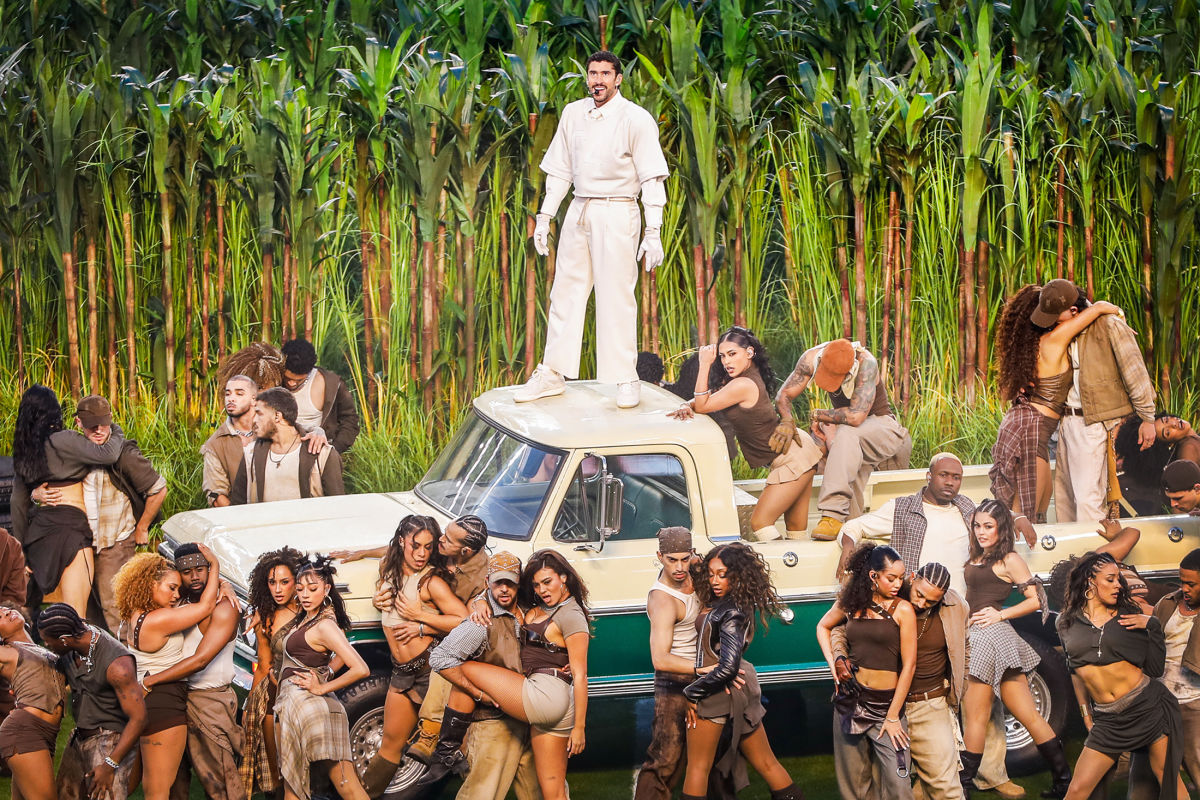
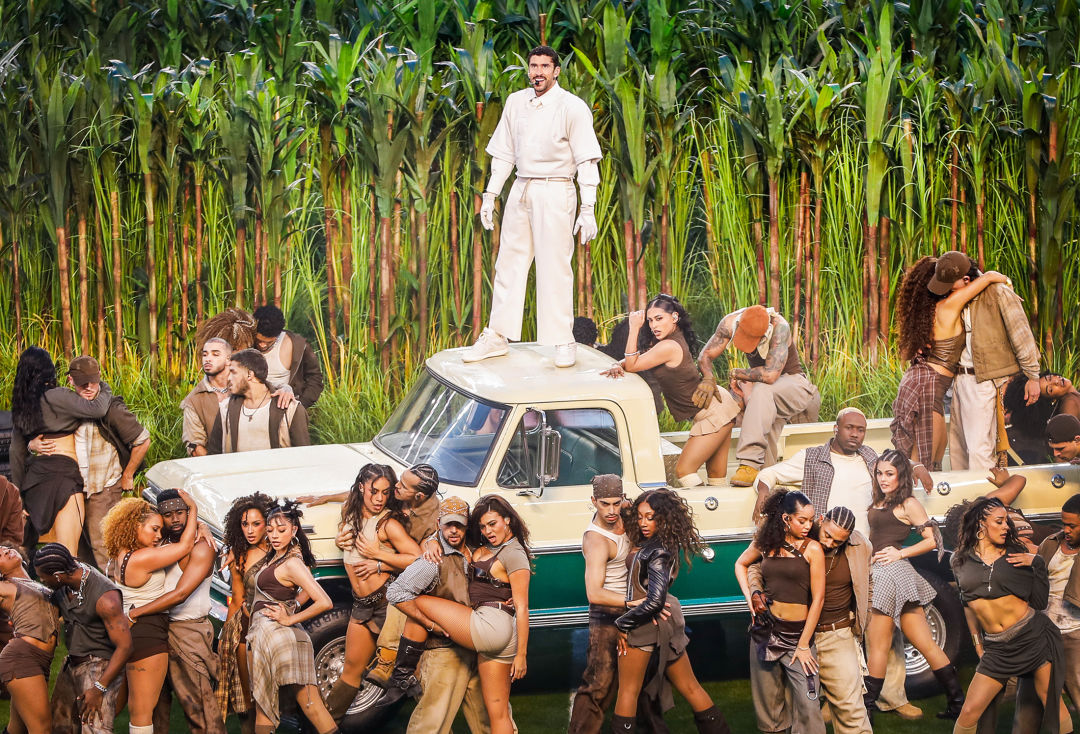
Bad Bunny put on an unforgettable performance at the Super Bowl’s halftime show.
Before Bad Bunny took the Super Bowl stage, before the domino tables and sugar cane fields and electricity towers lit up millions of screens, I was already emotional. Not because I’m Puerto Rican, but because I’m a Mexican American who is a so-called “no sabo kid.” All I could think to myself was, Man, I wish I hadn’t taken so long to be proud of my culture.
Ten years ago, Benito Antonio Martínez Ocasio was bagging groceries in Puerto Rico and uploading music to SoundCloud. Now he’s a global superstar commanding the biggest stage in America. And for Latinos across the country, including those of us in Houston, his 13-minute halftime show felt bigger than music. We were finally being seen on a mainstream platform.
I kept thinking: If I had someone like Bad Bunny when I was younger—or a performance like this—maybe I would have learned to love myself and my culture sooner. I’ve never hated my Mexican side, but I remember trying to push down my heritage to fit in during grade school.
All my life, I’ve traveled back and forth to visit my family in Mexico. At a young age, I did my best to learn Spanish by speaking with my relatives, and we used it at home, too. But that changed when I started kindergarten. My mom worried I’d be treated differently from my peers at school, so we switched to English at home. That’s when I began to notice the differences.
“Why does your dad talk funny?”
“Why are your arms so hairy?”
“Why do you have a mustache?” (I don’t; my peach fuzz is just darker because of my features.)
Even with a friend from Monterrey—my father’s hometown, a beautiful Mexican city in Nuevo León—I still felt like an outsider. I wanted to look and sound like everyone else, so I changed everything about me.
Soon, I didn’t want to go to Mexico anymore. I didn’t want to hear Spanish at home. In trying to blend in, I slowly became what people jokingly call a “no sabo kid,” shorthand for Latinos who know little to no Spanish (no sabo, intentionally, is a grammatically incorrect phrase for “I don’t know”; the proper phrase is no sé).
My family in Mexico says my parents should’ve tried harder to keep the language alive in us, but I am stubborn and strong-willed. Even then, nothing would’ve changed my mind. I needed to find my way back to my culture on my own timeline. My parents understood that.
Things shifted when I left the suburbs to attend the University of Houston, one of the most diverse schools in the country. Although I grew up just 40 minutes away, the notion of diversity and taking pride in it was new to me. There, I slowly learned it was OK to love my culture. But I still struggled.
Taking a Mexican American studies course helped me realize I wasn’t alone. It taught me that this internal tug-of-war was common—and that I didn’t need to choose between identities. I had long felt not Mexican enough for my cousins, and not American enough for my friends, but at UH, I learned I could exist somewhere in between, and that was OK. It was here that I learned a word I now claim proudly: Chicana.
Around the same time, mainstream Latin artists made it feel safe to embrace my heritage. But it wasn’t until Bad Bunny released DeBÍ TiRAR MáS FOToS (DTMF)—my most listened-to album of 2025—that I really began to heal my inner child.
A love letter to Puerto Rico, the album explores gentrification, displacement, memory, and cultural erosion—themes that extend far beyond the island. The title track, which translates to “I should have taken more photos,” seemed to unite Latinos everywhere. TikToks filled with tributes to loved ones who had passed—parents, grandparents, even pets. Ask any Latino now, and they’ll probably tell you they can’t listen to DTMF without tearing up.
When the album won the Grammy for Album of the Year, it was historic. All I could think to myself was, I can’t believe it took this long for an album fully in Spanish to win. That’s why the halftime show hit differently.
Watching Bad Bunny open with scenes of Puerto Rican life—jíbaros in rural fields, older men playing dominoes, piragua stands, and coconut vendors—felt intentional. He wasn’t translating. He wasn’t softening the edges. He was simply presenting, peacefully protesting, centering love and unity without apology.
He performed “Yo Perreo Sola,” a feminist anthem about dancing alone without harassment, atop la casita, as mostly Latin stars—Young Miko, Pedro Pascal, Jessica Alba, Cardi B, and singer Karol G—danced below. He staged an actual wedding, complete with a child asleep across chairs, a detail that felt achingly familiar to anyone who’s attended a Latin party that ran too late, as Lady Gaga serenaded the crowd with a salsa version of “Die with a Smile.” He honored Puerto Ricans’ imprint on New York through cameos from Toñita Cay, owner of Brooklyn’s Caribbean Social Club, one of the last Puerto Rican social clubs in the city, and 5-year-old actor Lincoln Fox, who portrayed a young Benito accepting his Grammy‚ a reminder to dream bigger than your circumstances.
He performed “El Apagón,” Spanish for “the blackout,” atop mock electricity towers, referencing Puerto Rico’s ongoing infrastructure struggles. Ricky Martin joined him for “Lo Que Le Pasó a Hawaii,” a pointed warning about colonialism and displacement. And as he closed with “Café con Ron,” he switched to English to say, “God Bless America,” before naming countries across the Americas—from Bolivia to Canada. A football in his hand read “Together We Are America.” Behind him: “The only thing more powerful than hate is love.”
In the weeks leading up to the game, he joked that people had four months to learn Spanish. Backlash followed, but Bad Bunny made it clear that he wasn’t concerned with translation. “They don’t even have to learn Spanish,” he said in an interview with Apple Music. “It’s better if they learn to dance, but I think there’s no better dance than the one that comes from the heart.” That sentiment feels radical on one of America’s biggest stages.
Bad Bunny’s music has pushed me to ask important questions about my own story and where I come from, about why my dad came to this country, and about how on my mom’s side, we didn’t cross the border—the border crossed us. I’ve developed a deeper appreciation for the culture I once tried to shrink, and that’s all without knowing how to speak the language.
Scroll on TikTok, and you’ll see people from all walks of life dancing to his songs, whether they understand the lyrics or not. (He’s reportedly number one in China, according to an interview with Apple Music.) His reach is one worth studying. Call me crazy, but I’d go as far as to compare what his music has done for the Latin community to Michael Jackson’s contribution to pop culture, but that’s an analysis for another story.
Instead, I leave you with this: In a time where there is too much hate in the world, Bad Bunny’s music continues to remind us to not back down, to embrace the culture, have fun, dance, and most importantly, love—even if we might not understand the literal words of the music.
And I can’t help but think about little Sofia in elementary school, wishing she looked and sounded different. If she had seen a halftime show like this—one that centered Latino culture without explanation or apology—maybe she would’ve come home speaking Spanish louder.