
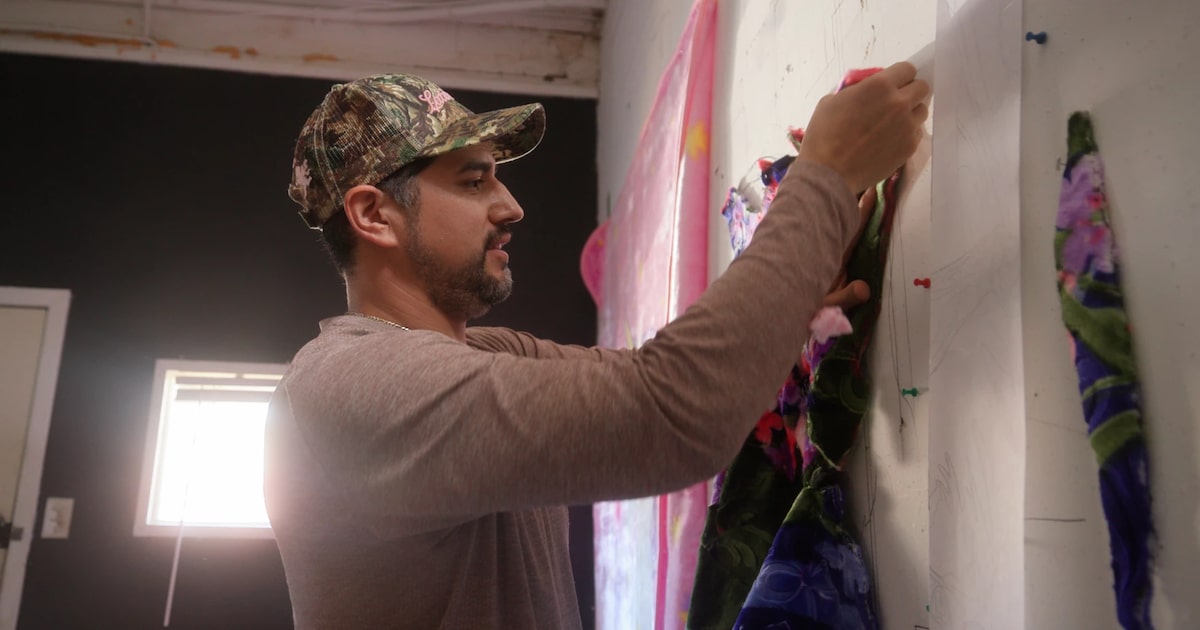
In the summer of 2022, Dallas artist Antonio Lechuga’s career had just started to take off. His first solo show at a gallery had just opened, highlighting his towering lattice sculptures swathed in fleece blankets.
Before the exhibition closed, his life changed in an instant.
The artist was shot while running on the Santa Fe trail near his studio.
“One of the first things I thought about when I got shot was: This isn’t it. Not now,” Lechuga recalled. “I have so much more that I want to do.”
News Roundups
‘Structures of Softness’
Lechuga loved drawing as a child. Eventually, he added painting to his repertoire.
“I always felt that maybe my paintings were just pictures of real spaces, that I can’t create yet either because I can’t afford to, or maybe I’m just thinking too big,” he said.
But that changed in 2020. Lechuga contracted COVID-19 early in the pandemic.
The illness hit Lechuga hard, and he realized that if he didn’t start trying to make his works three-dimensional soon, he might not get the chance.
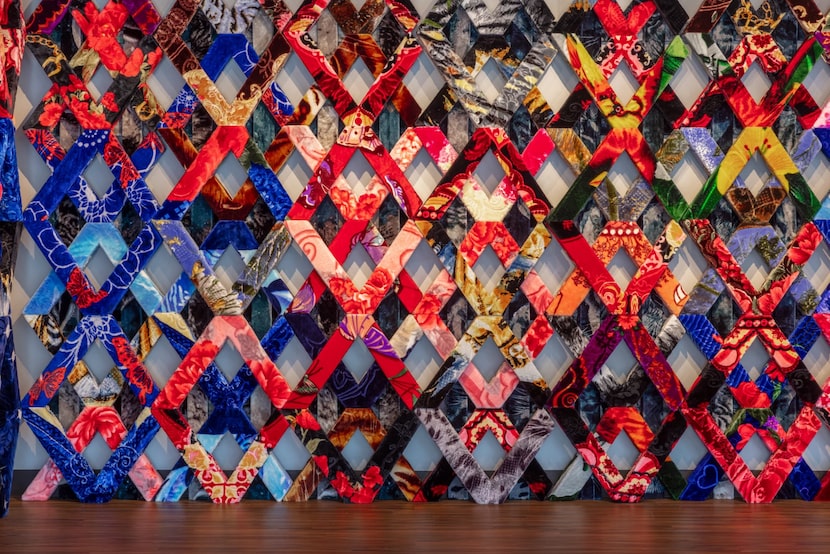
“Structures of Softness” by Dallas artist Antonio Lechuga was previously installed at the Oak Cliff Cultural Center.
Kevin Todora / Courtesy, Antonio Lechuga
After he recovered, Lechuga started building. He created a series of fences, an allusion to the U.S.-Mexico border.
“These fences were very cold, very dark objects, right? They divided people. They divided land, animals, the environment, cultures, generations along this entire border, and they pushed things away,” he explained.
Lechuga wanted his fences to do the opposite.
“One way, at least for me, was to kind of offer this large fence warmth, comfort, care, all that. And to really give it this sense of belonging. And to actually wrap this object just like you would wrap each other,” he said.
He built fences with a lattice pattern and covered them in cobijas, the thick, fuzzy blankets that are a staple in many Latino households.
These large 3-D structures were the focal point of his first solo gallery exhibition called Fences at Love Texas Art in Fort Worth.
‘I had to start over’
When Fences opened in Fort Worth, Lechuga was already preparing for his next show.
Fences was set to close on July 17, 2022.
On July 15 around 6 p.m. he laced up his tennis shoes and went for a run on the Santa Fe Trail near his studio.
Lechuga had paused at an intersection and rested his hands on his hips. Bad Bunny was playing in his ears.
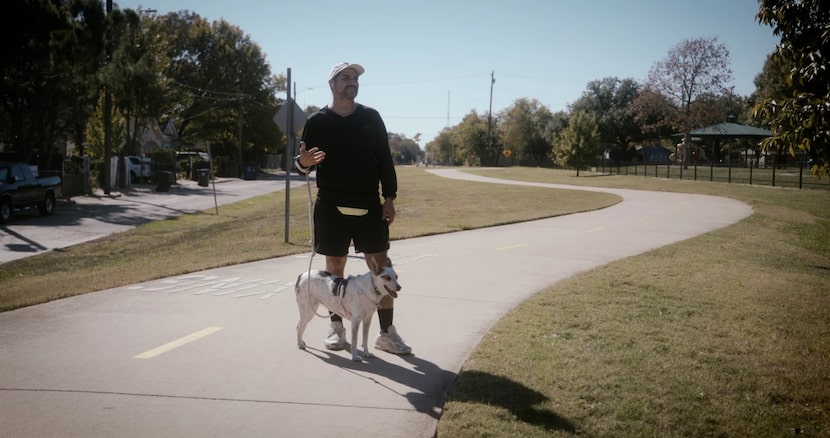
Dallas artist Antonio Lechuga and his dog, Chanclas, stand near where the artist was shot on the Santa Fe Trail in July 2022.
Christian Vasquez / KERA
“And out of nowhere, it just feels like somebody hits me with a bat, right? Just knocks the wind out of me.”
But Lechuga didn’t see anyone around.
“And at that point, I lift up my shirt, and I knew,” he said.
Two bullets pierced his abdomen.
He called 911 but struggled to talk to the dispatcher while trying to catch his breath.
He then went into the road and flagged down a car before lying down and waiting for first responders to arrive.
He was taken straight from the ambulance into surgery.
Lechuga suffered damage to one of his lungs, his large intestine and gall bladder. He also lost his left kidney.
He developed kidney disease and now has to take extra care with his diet, watch his blood pressure and stay on top of follow-up appointments.
“One thing I learned in the hospital was patience, having to take things one step at a time. Not because you want to, because you have to,” Lechuga said. “Life says you have to.”
The gallery extended his show and raised money for his recovery.
“I had to start over, right? With my body and myself and what I was doing,” he said. “Forget the work. I have to start as a person again.”
He spent more than three months in the hospital before moving back in with family, for another six months, to recover.
‘This has to be about healing’
Lechuga taught himself how to use a sewing machine after the shooting.
He uses it to make what he calls paintings, but he’s not using oil or acrylic. Instead, he uses cobijas as his color palette and sews pieces together to create a large fabric collage.
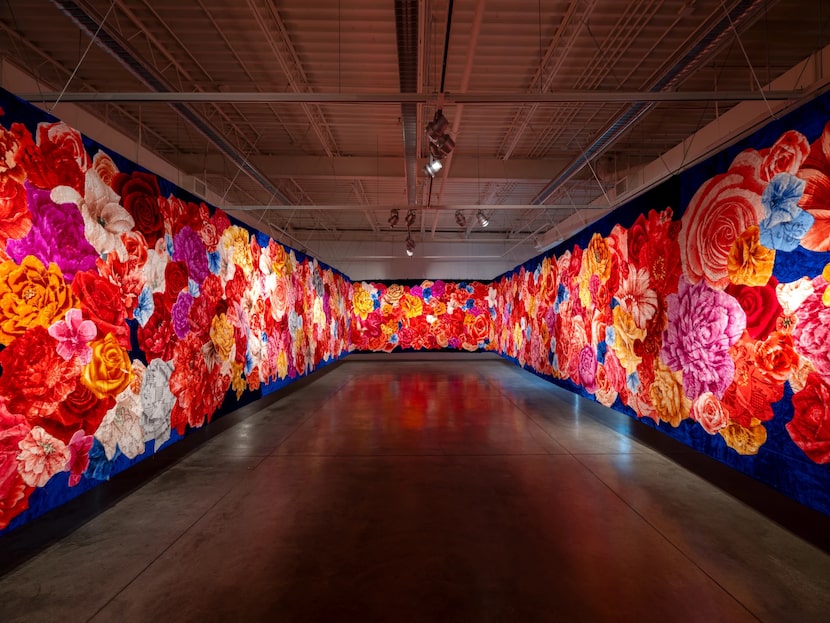
“Flowers for the Living-2022,” was exhibited at the Oak Cliff Cultural Center in Dallas.
Kevin Todora / Courtesy, Antonio Lechuga
He created a landscape of the trail where he was shot, which was acquired by the Dallas Museum of Art.
Lechuga also constructed a 92-foot-long tapestry covered in hundreds of flowers. He dedicated the blooms to all the families affected by mass gun violence in the U.S. in 2022 — the year he was shot.
“I was in the hospital for a long time and I would get messages on my phone, or cards, or a lot of people would send flowers. I’d be there in the hospital thinking about, why would I get flowers and my family and people like that, they wouldn’t get them,” Lechuga said. “Obviously, right now, they’re not in the [hospital] bed, but they were going through this thing just as much as I was.”
Unlike real flowers, these won’t wilt, and he hopes that the exhibition can travel to other places impacted by gun violence. Unfortunately, he said, the issue is still relevant.
“This has to be about healing because in the end this is what these blankets do — they offer healing. And so I want to be able to offer this thing to people where they need it,” Lechuga said.
The comfort of cobijas
Lechuga’s work also engages with religious and cultural imagery.
He’s fascinated by the iconography that is printed on modern cobijas — the Virgin Mary, mustangs and Marilyn Monroe — and challenges himself to rework the material until those images fade into the background.
“It’s almost like ‘Where’s Waldo?’ … Those things are still there, still visible … but I’m using it in a completely different way to tell a different story,” Lechuga explained.
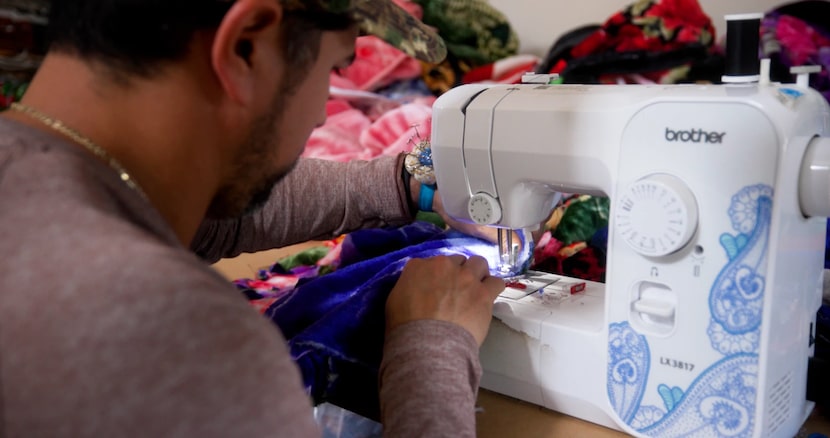
Lechuga taught himself to sew after he was shot. “I knew I wanted to make pictures and I knew I wanted it to look a certain way. … I didn’t want you to know how they came together,” he said. “At that point I knew that I wasn’t gonna glue anything. Nothing was gonna be stapled. I knew I was gonna have to sew these.”
Christian Vasquez / KERA
His pieces depict quinceañera dresses, storefronts, animals and Saint Christopher. Some of those works have recently been on view at Liliana Bloch Gallery in Dallas and Ballroom Marfa.
Maggie Adler is an independent curator and worked on the Ballroom Marfa exhibition.
“Work like Antonio’s, which is highly conceptual and intellectual, finds a point of access by being made out of something that people can understand,” she said. “Even if you didn’t grow up in a Latinx culture with cobijas, you understand the comfort of blankets. You understand fleece. But especially if you did, there’s so much resonance there right off the bat.”
Lechuga is worthy of recognition far beyond Dallas, both for the quality of his work and his character, Adler said. His work speaks to people on a fundamental level.
“But what they won’t see and what they won’t know is the kindness and the generosity and the spirit of hope with which it’s created,” Adler continued. “If I could apply that layer onto their experience of the work, I think everybody should know that this is a really good, gentle, kind, earnest, talented human being. And that’s what you can’t get from a wall label.”
‘It’s never zero to 100 and you’re better’
Lechuga still runs on the same trail where he was shot.
Some days the shooting is top of mind. Other days he doesn’t think about it.
The endorphins from running are real, Lechuga said. Being out on the trail helps him clear his mind and stay active. An added bonus is that his dog, Chanclas, loves it, too.
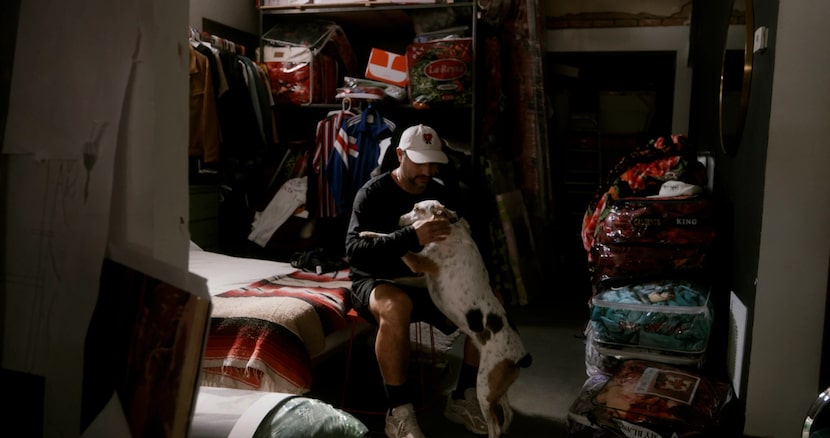
Antonio Lechuga pets his dog, Chanclas, before a run. “One of the many goals that I had coming out of the hospital was going to the shelter here in Dallas and at least saving a dog,” he said. “And of course … [she was] saving me as well.”
Christian Vasquez / KERA
Someday Lechuga hopes to run a race to test his limits. He’s not sure when, but he has a goal of finishing a half or full marathon.
“I’m still fighting what happened, and the fact that it happened while I was running, I think that’s a big part of it too,” he explained. “It’s like, the more I run, the less it happened.”
Dallas police arrested two men, ages 20 and 21 at the time, about a month after the shooting. Gilbert Uvalle pleaded guilty and was sentenced to six years in prison, and the case against the other man was dismissed in late 2023.
“I was angry,” Lechuga said of the shooting. “There’s times where I can still be very angry. With trauma or anything you go through … any event, any horrible thing, it’s never zero to a hundred and you’re better. It’s a very, very slow climb up that hill.”
Immediately after he was shot, Lechuga thought about all of the things he still wanted to accomplish.
Three and a half years later, he’s made significant progress rebuilding his life — stitch by stitch, mile by mile.
This story is shared via Arts Access, an arts journalism collaboration powered by The Dallas Morning News and KERA.
 Immigration’s impact shown through art at Dallas’ Latino Cultural Center
“The Journey North: Hope, Labor and Culture” looks at one of the most fractious issues of our time.
 John Pomara brings his brand of digital disruption to the gallery wall at Barry Whistler
The artist’s deconstructed and manipulated images take portraits and paintings to unexpected places.