
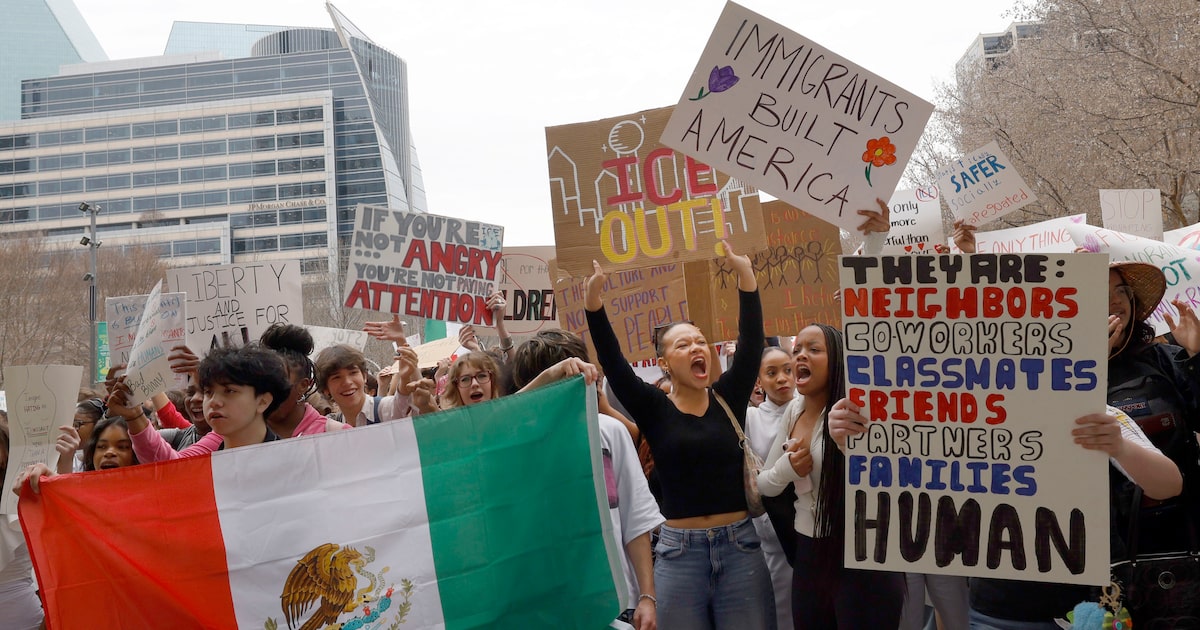

Every so often — like, hourly — I have to remind myself to look at the cracked, faded keychain I’ve carried since 2009: “Never read the comments.” Still, because I’m a masochist, I peek from time to time. I saw just enough beneath the story about Dallas ISD students’ walkouts this week and last, protesting the feds’ immigration crackdown, to know how they split. Somewhere between Brave kids and Flunk them.
Which is inevitable when we’re governed by Internet Comments; predictable, too. So was the outrage of Gov. Greg Abbott and the Texas Education Agency, which last week issued a directive “outlining consequences regarding student walkouts.” Among its numerous warnings: School districts “that facilitate walkouts will be subject to investigation and sanction, including either the appointment of a monitor, conservator or board of managers.”
God knows how many times Dallas ISD students walked out of class in the past to protest something — wars, mascots, laws, layoffs and, more recently, immigration. The archives of Dallas’ two daily papers are rife with stories about such school-day protests, many of them splashed across front pages, like that Tuesday afternoon in September 1991, when thousands of students from across the district walked out of class – and all the way to DISD headquarters – to protest the firing of more than 300 teachers.
But until now, the only warnings, if any were even issued, came from district administrators who worried about student safety, but also saw the value in real-world civics lessons kids could never learn from a textbook.
Case in point: Gustavo Jimenez, who, as a 16-year-old junior at Duncanville High School in late March 2006, used MySpace and paper fliers to hastily organize a walkout that led thousands of students from Dallas and across North Texas to Kiest Park in Oak Cliff and then Dallas City Hall. There, with less than 24 hours’ notice, they peacefully protested proposed legislation that, among other things, would have made it a felony to enter this country illegally.
Opinion
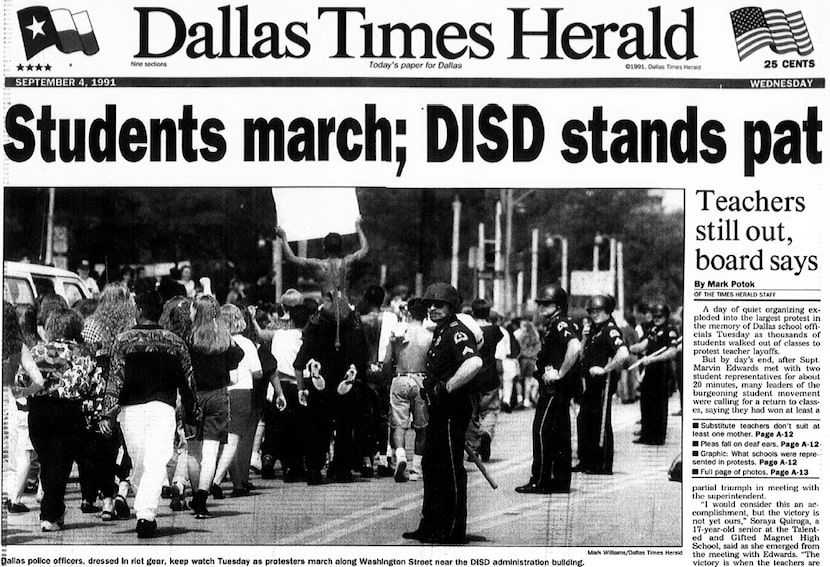
Dallas ISD students in 1991 marched on the district’s administration building to protest mass layoffs that includes more than 300 teachers.
Dallas Times Herald Archives
At the time, Jimenez, the son of Mexican immigrants, was just another faceless junior trying to make it to senior year. On a spring Sunday morning, he saw a MySpace post about walkouts in Los Angeles — “and something clicked in me,” he told me this week, “a calling, if you will.” Twenty-four hours later, on March 27, he was being interviewed by reporters about his activism. Within days, he was among the speakers at the MegaMarch, when some 400,000 to 500,000 people marched from the Cathedral Shrine of Our Lady of Guadalupe to Dallas City Hall.
“I learned more life lessons in that week than if I’d gone to class that Monday,” Jimenez said. “Speaking up is important. Anyone who has a doubt whether their voice matters should really be told they do. And if more people would use their voice in the best way they can, our world would be a much better place.”
Jimenez was back in class the following Tuesday. But students who missed the first day’s walkout continued protesting, leading to a rowdy, tense couple of days that culminated with some students interrupting a City Council meeting and police being called. Then-Superintendent Michael Hinojosa threatened suspensions, truancy arrests and parent-teacher meetings — the worst threat of all.
Still, Hinojosa had to admit at the time, “I’m very proud of the issues that have been raised.” He still is proud, the former U.S. government teacher at Adamson High School told me Thursday, and proud of the kids from the School for the Talented and Gifted at Yvonne A. Ewell Townview Center and Booker T. Washington High School for the Performing and Visual Arts who marched this week.
“I was very proud of them,” Hinojosa said. “This was civil disobedience, and it never got out of control. This was a big issue. This wasn’t, ‘I don’t like the food.’ But this was 20 years ago, almost to the month, and today it’s worse, being threatened by the state. I am disappointed in Austin’s approach. These are kids from Townview and Booker T. These are smart kids. They’re scared for their parents, their siblings, their friends. Because nobody is safe.”
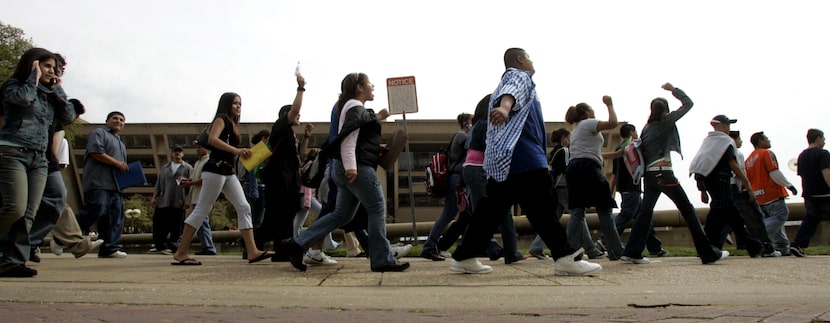
On March 27, 2006, Dallas ISD students marched down a sidewalk along Young St. to a rally at Dallas City Hall to protest proposed legislation that would have made being an undocumented immigrant a felony.
IRWIN THOMPSON / 102040
Hinojosa said there weren’t threats from Austin — “absolutely not” — in 2006, nor in February 2017, when more than 15,000 Dallas ISD students stayed home and another 1,500 middle and high school students walked out during “A Day Without Immigrants” demonstrations to protest, among other things, the Trump administration’s first attempt to end the Deferred Action for Childhood Arrivals program.
Dallas officials didn’t love the 2017 walkouts, largely because they cost DISD somewhere between $500,000 and $750,000 in state funding tied to attendance. There were even robocalls from the administration warning kids about violating district policy. But at the time, Stephanie Elizalde, the district’s chief of schools who would later succeed Hinojosa as superintendent, acknowledged that DISD was caught between a teaching moment and teaching time.
“As a district, we are trying to balance our students’ rights to civilly protest without getting into the arena of dictating to them what they can’t and can’t do,” she told this newspaper on Feb. 22, 2017. But, she added, “We can’t just turn a blind eye to the fact they are absent.”
This week’s protests were preceded by last week’s brief walkout at Thomas Jefferson High School, my alma mater, where students never actually left campus. The only time we walked out of TJ during the mid-1980s was when we went to Mr. Gatti’s for the endless pizza buffet at lunch. But several of my TJ elders reminded me this week that our school has a long history of protest involving everything from the censorship of the school newspaper to the war in Vietnam.
TJ made the front page of The Dallas Morning News on Sept. 14, 1971, when, following court-ordered desegregation, Black students refused to attend class there and at Hillcrest because their white counterparts refused to show up to Lincoln, Roosevelt and Pinkston. Black students also protested their treatment on the TJ campus, where the school mascot was the Rebel, the school song was “Dixie,” and cheerleaders waved the Confederate flag.
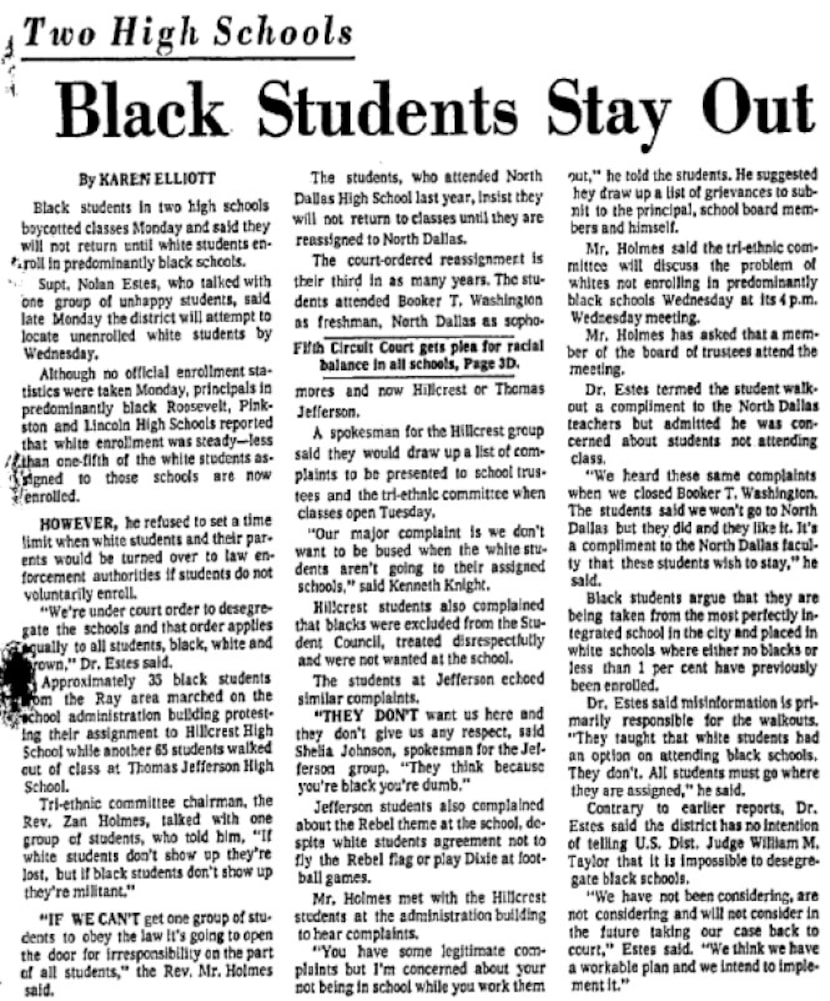
A Sept. 14, 1971, front-page story in The Dallas Morning News about how Black students refused to attend classes at Thomas Jefferson and Hillcrest high schools because white students weren’t showing up to classes at South Dallas schools.
The Dallas Morning News
The same things were happening across the district, from Bryan Adams High School to then-Skyline Center, where dozens of students were injured in January 1972, when the cafeteria erupted into a bloody chair-tossing, fist-throwing melee. But by April 1972, TJ’s student body voted to change its mascot to the Patriots; and by that November, a majority of Dallas residents surveyed said they were optimistic about the future of the Dallas ISD.
Which is just how I felt this week. And in 2006. And in 2017. Hinojosa and Jimenez used the same word to describe how they felt watching news this week and last of the student protests: proud.
“Back then, the majority understood what we were doing,” Jimenez told me. “Seeing it now, it’s a little bit disappointing, if I am being honest, because we’re back to where we were 20 years ago. It’s déjà vu. And it hurts. It’s sad to see the same thing happening. But it’s with mixed emotions, because it feels good to see there’s a new generation proud and willing to stand up for those not able to stand up for themselves.”