
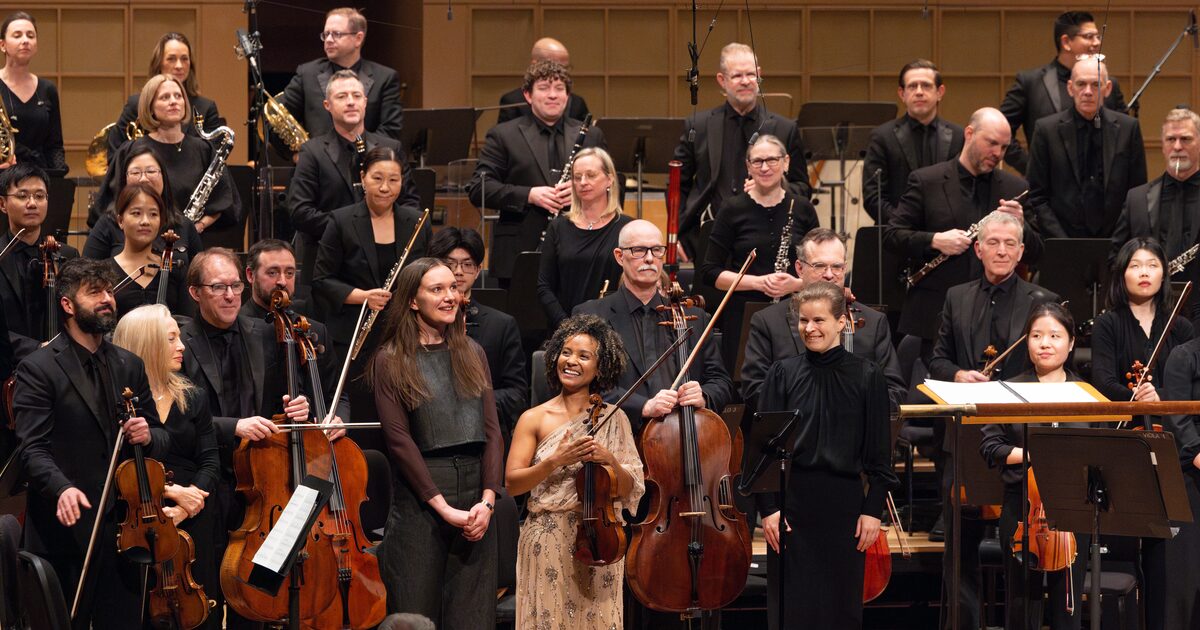
The Dallas Symphony Orchestra had a large and enthusiastic audience for its Thursday night concert at the Meyerson Symphony Center. But two classics of Russian romanticism, Tchaikovsky’s Romeo and Juliet Fantasy Overture and Rachmaninoff’s Symphonic Dances should be sure-fire draws.
With the Norwegian conductor Tabita Berglund as podium guest, these pieces framed the world premiere of a DSO-commissioned violin concerto by the young German composer Sophia Jani. The soloist was the amazing American violinist Melissa White.
Symphony audiences often have defenses up at the prospect of new music. And some composers seem to think new music must be “challenging” to be good.
Jani, by contrast, freely luxuriates in sensuous beauty and, for the violin, soaring lyricism. About 21 minutes long, the score is nominally in the traditional fast-slow-fast sequence, but the movements blend into one another. The “fast” music is as likely to be reflective as the “slow” music is to be energized. Solo winds sometimes echo and counterpoint the violin’s phrases.
News Roundups
Jani, who’s finishing a three-year appointment as the DSO’s composer-in-residence, explained before the performance that the piece was inspired by a stay back in her native area of forests and lakes. As in the music of Sibelius, there’s an outdoorsy quality to it.
Over hushed tremolos of the orchestra’s strings, the solo violin enters dreamily. A surge of orchestral activity breaks through, then the violin responds to undulations of winds with more animation.
The middle movement explores subtle slides of both solo violin and orchestral strings, with glowing backgrounds of the latter. The violin gets some virtuoso flourishes before the music again goes quite dreamy.
A concerto cadenza is usually a display of technical razzle-dazzle, but Jani’s slows typical up-and-down arpeggios into unhurried studies. A gradual acceleration eventually supplies the expected scurries, again with wind answers, and then the full orchestra joins in celebration.
The solo violin was sometimes swamped by surprisingly hefty orchestrations. But, judging by Jani’s comments in the morning dress rehearsal, she seems happy to have the soloist as something of a first among equals. Perhaps a soloist with a more boldly projecting instrument would yield a different effect.
White played with astonishing acuity, in sweetly soaring music as well as the busiest scurries. As in the rest of the concert, Berglund led with fastidious gestures, and the orchestra responded accordingly.
The Tchaikovsky got a glorious performance, its sonic explosions delivered with knife-edge precision, its big tunes warmly shaped. Was I alone in finding much of the Rachmaninoff skillfully dispatched but a little dry?
There’s ambiguous evidence as to what Rachmaninoff meant by his initial “Non allegro” marking, but Berglund’s tempo felt a notch too deliberate. The middle-movement waltz lacked a certain sweep, and both here and in the finale, reflective episodes lost too much steam. But the ending was appropriately stirring.
Details
Repeats at 7:30 p.m. Friday and Saturday, 2 p.m. Sunday at Meyerson Symphony Center, 2301 Flora St. $37 to $196. 214-849-4376, dallassymphony.org.