
My wife and I are standing under the Cattlemen’s sign everyone in our city knows and loves, its twinkling lights firing up North Main as they have for decades, that big fake cow just a few feet above our heads. Before going in, we’re pausing for a moment while I try to remember the last time I was here. Twenty years? Thirty years? All I remember is I took my parents to dinner here, then we walked over to Billy Bob’s to see a Willie Nelson concert. Yeah, must have been 30 years ago, now that I think about it.
Matter of fact, that was my first and only time to visit Cattlemen’s. It’s funny, you live in this city your whole life, and you only visit Cattlemen’s once? But, as I recall, the food and service were a little too rough around the edges for me, and I do like my edges rough sometimes. I think at that point, Cattlemen’s had established itself as one of the city’s premier tourist traps, not necessarily a place where locals go, and after our visit I knew chances would be slim that I’d go back.
Yet here I am, 30 or so years later, about to walk into the restaurant reborn. I’ll admit it: When word started circulating that Cattlemen’s was getting a multimillion-dollar makeover at the hands of Taylor Sheridan, I was a little apprehensive. I mean I love 1883 and all, but Fort Worth has learned, sometimes the hard way, that when one of our beloved institutions gets “reimagined,” its soul can be collateral damage. Whatever Cattlemen’s of yesterday lacked, it most certainly made up for with soul. That I remember.
So with a bit of trepidation, we walked in, expecting to mourn; instead, we were a bit shocked, a bit excited and pretty much floored. This wasn’t the Cattlemen’s we remembered — and I can’t tell you how much of a good thing that is.
Opened in 1947 in the heart of the Fort Worth Stockyards, Cattlemen’s has always been more than a restaurant. Like so many of our other long-running culinary institutes, from Carshon’s to Fred’s to Joe T.’s around the corner, it’s a landmark, an entity stitched into the city’s DNA like the Wrangler patch stitched into the jeans of everyone swirling around us as we’re led to our table. Over the decades, it has fed ranchers and tourists, Stock Show regulars and politicians, locals who could order blindfolded, and out-of-towners bedazzled by cowboy culture. It has survived culinary trends, urban reinvention, a pandemic, and the slash-and-burn mentality that claims so many of our city’s historic dining rooms. That alone makes its survival — and revival — worth celebrating.
The reno, we observed, doesn’t erase the past so much as it frames it. Photographs of Stock Show cattle champions line the walls. Iron chandeliers hang overhead. Polished wood gleams. Booths upholstered in tooled leather beg for long meals of steaks and beer and rowdy conversations. Classy but approachable, with both out-of-towners and locals in mind, this is not a theme park version of Fort Worth, as I feared it might be; this is just Fort Worth all polished up like an old pair of boots that have many, many more miles to go.
Cattlemen’s second wind comes courtesy of Sheridan — writer, director, rancher, and now restaurateur — and partners Dan Schryer and David Glasser, who work under the SGS Holdings banner. Thanks to their room-by-room makeover, it looks better than it ever has, but it still feels unmistakably like Cattlemen’s.
To your left as you walk in is the massive new patio, outfitted with a stage for live music, its own bar and plenty of seating. It will soon be accompanied by its own mini-restaurant, a smokehouse that’ll serve sliders, barbecue, and other light bites. That’ll open in the next month or so, I’m told, when spring/summer start to roll in. A year ago, this patio was a parking lot.
Below us is the already-famous, soon-to-open private club, Cattlemen’s Club, another new addition. It’s in the basement of the restaurant, out of sight, except for the stanchion-blocked entrance visible in the lobby with an illuminated “C” above it. Did you see the third episode of Season 2 of “Landman,” the one where Billy Bob Thornton’s character socked that lawyer on the head with a beer bottle? Filmed right here.
The kitchen, though, is where Cattlemen’s rebirth is truly evident.
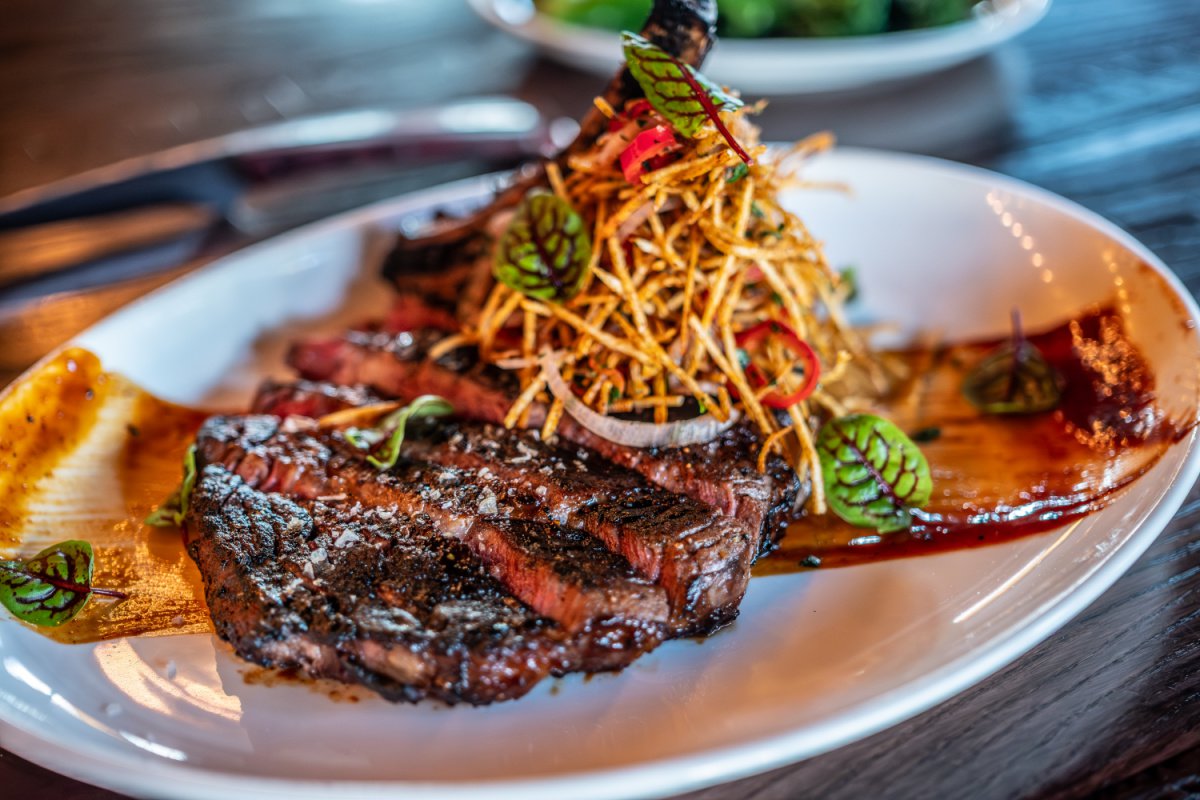
On our first visit back, we ordered the 14-ounce New York strip sourced from the Four Sixes Ranch in Guthrie — now one of Sheridan’s homes. Cooked over an open charcoal fire at one of two dining room grill stations, inches away from diners, the steak arrived with a deep, blackened crust, simple seasoning, and a clean, beefy flavor that made me forget the last steak I had here, all those years ago. Not that I remember it anyway.
That leap in quality is thanks to newly hired executive chef Theodore Tom, formerly of the known SW Steakhouse at the Wynn Las Vegas. Tom had previously collaborated with the 6666 Ranch on events in Vegas, and as word spread that Cattlemen’s Steakhouse was undergoing a major renovation under new ownership, he put two and two together. “When I learned that Taylor Sheridan and David Glasser were behind the project, my interest was immediately piqued,” Tom says. “The more I heard about their vision for a refined, elevated steakhouse in the Stockyards, the more I felt drawn to it.”
Tom’s path to Fort Worth — and to this kitchen — wasn’t exactly linear.
“Even though I loved cooking from a young age, I didn’t immediately pursue a culinary path,” says Tom, who grew up in Denver. “My first career was in the music industry, a world that taught me discipline, artistry, and the power of storytelling.”
That early detour, he says, shaped the way he approaches food now. “After several years, I felt a pull toward something more hands-on and expressive,” he says. “That shift led me into the kitchen, where I began my culinary journey as a line cook.” Through what he describes as “hard work, determination, and a genuine love for the process,” Tom worked his way up in one of the most demanding culinary environments in the country: Vegas.
After more than 15 years at the Wynn, Tom and his wife felt it was time for something new. “Wynn had been a defining part of my career, but I felt ready for a fresh challenge, something that would allow me to grow and help shape a restaurant from the ground up,” he says.
Tom’s first visit to Fort Worth came in April 2025, and it sealed the deal, he says. “I had never been to the city before, and from the moment I arrived, I was struck by the strong sense of community and the genuine character of the people,” he says.
Taking the reins of a kitchen with nearly eight decades of history hasn’t been lost on him. “Stepping into a kitchen that means so much to so many people isn’t something I take lightly,” he says. “Rather than feeling pressure, I see the scrutiny as a responsibility. I’m honored to take the reins of such an iconic establishment, and my goal has been to create a menu that feels contemporary and elevated while still honoring [Cattlemen’s] classics.”
To achieve that goal, he made several updates and edits to what was once a fairly sprawling menu. Now, the menu is tight and focused, with, obviously, a major emphasis on the steaks.
On our second visit, a media dinner, we tried the 32-ounce dry-aged tomahawk chop, beautifully cooked medium rare, presented sliced on a carving board. A pronounced sear and well-formed crust gave way to evenly cooked meat with simple salt and pepper seasoning, the kind of execution that allows the quality of the beef to shine. On the side came pods of fresh garlic and a ramekin of housemade whiskey shoyu sauce, the latter of which was appreciated but hardly needed; as good as the sauce was, the steak was fantastic on its own.
Cattlemen’s revamped steak lineup also includes a 20-ounce cowboy bone-in rib-eye from Bosque Ranch in Texas, joined by a 14-ounce New York strip from the 6666 Ranch, the same place from which the tomahawk hails. Additional Texas offerings include the Trail Boss Favorite 14-ounce rib-eye from Bosque Ranch and a 10-ounce American Wagyu skirt steak from Rosewood Ranch.
The menu also features several Black Angus cuts, such as the 32-ounce Cattlemen’s porterhouse, a 20-ounce Ranch Boss T-bone, and a 16-ounce bone-in New York strip, all sourced from Dodge City, Kansas. Center-cut filet mignon, offered in 7- and 10-ounce portions, comes from West River Ranch in South Dakota, while a 10-ounce Stockman’s sirloin from Lime Springs, Iowa, rounds out the lineup.
Those who recall Cattlemen’s pre-Sheridan days with fondness will be relieved to know several menu stalwarts remain, like the plate-engulfing chicken-fried steak, now topped with Wagyu sausage gravy, hand-battered onion rings, and calf fries, Fort Worth’s dare-you-to-try dish (for the clueless: They’re fried bull or calf testicles).
Alongside the classics are several new dishes: a lovely steak tartare made with chopped filet mignon, serrano chiles, and red onion, and served with seasoned corn tortilla chips; Wagyu meatballs with smoky, cheesy polenta and spicy marinara; and a lone but large crab cake accented with remoulade and pickled Fresno chiles. A nice surprise is the Wagyu beef bolognese tossed with pappardelle and a braised short rib finished with chimichurri and roasted mushrooms. Yes, there’s bolognese at Cattlemen’s.
It’s quite a turnabout from the Cattlemen’s that opened in 1947, a husband-and-wife venture from Jesse and Mozelle Roach. Ambitious and unusually versatile, Jesse cycled through careers as a pharmacist, lawyer, insurance man, and Texas state legislator. A Mount Pleasant native, he trained in pharmacy in Little Rock, opened a drugstore in Austin, then shifted to law after passing the bar, eventually serving two terms representing Hunt County in the Texas House before settling in Fort Worth to operate insurance agencies catering to truckers.
The couple opened Cattlemen’s in the same building that housed their insurance business. Early Star-Telegram ads for the restaurant touted “refrigerated air” and Sunday “Dollar Dinners,” along with calf and lamb fries. The restaurant gained national recognition and eventually expanded to multiple locations across Fort Worth, Arlington, and Dallas, including a beloved spinoff, Farmer’s Daughter on University Drive, a restaurant that was closer to where the couple lived, at 2540 Boyd St.
While the other locations came and closed, the Stockyards original endured through decades of change, most recently under owners Marti Taylor and Larry Heppe, who remain part-owners through this transition.
The restaurant’s next chapter includes the Cattlemen’s Club, the private, members-only space hidden below the main dining room. Memberships are priced at $3,000 annually with a one-time $1,000 initiation fee; corporate memberships run $9,000 and include up to four members. Slated to open by the end of January, the club includes its own bar, kitchen and open grill station.
“It’s basically a second restaurant,” Tom says. “But even more elevated.”
Walking back out under that familiar sign, it struck me that this version of Cattlemen’s doesn’t ask you to suspend disbelief or buy into nostalgia you don’t feel. It just asks you to come eat — and to take the place seriously again. Thirty years ago, I checked it off my to-do list and moved on. This time, I’m already thinking about when I’ll be back.
Cattlemen’s Steakhouse, 2458 N. Main St., cattlemenssteakhouse.com