
EL PASO, Texas (Feb. 13, 2026) – Today, officials at The University of Texas at El Paso announced a $2 million appropriation from the federal government to expand drone testing and operations infrastructure at the University’s remote facilities in Fabens and Tornillo, Texas. University President Heather Wilson was joined by U.S. Congressman Tony Gonzales and UTEP Aerospace Center Executive Director Shery Welsh, Ph.D. for the announcement.
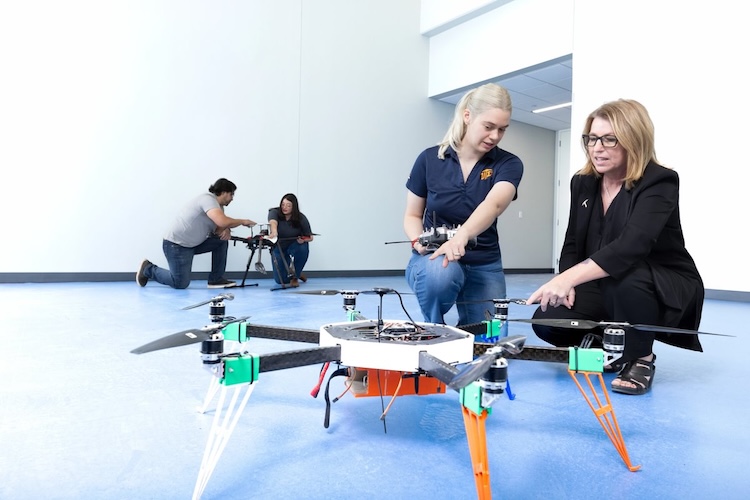
Shery Welsh, Ph.D., far right, works with UTEP students in the Aerospace Center’s Uncrewed Aerial Systems Flight Space. The University has received a $2 million appropriation from the federal government to expand drone testing and operations infrastructure in Fabens and Tornillo, Texas.
“Leveraging drone technology is not only key to our economy, but to our national security. The $2 million I secured in federal funding for UTEP’s UAS program will expand drone and counter-UAS capabilities while boosting innovation, national security, and job growth in the region,” said Congressman Tony Gonzales. “UTEP’s Aerospace Center continues to be a leader for top-tier research, and I applaud President Wilson, her team, and UTEP’s faculty for their partnership on this critical project.”
Funding was one of Representative Gonzales’ high priority community projects included in the appropriations bill recently signed into law.
“This appropriation will help build our infrastructure for research in drone and counter-drone technology,” said UTEP President Heather Wilson. “We are grateful to Congressman Gonzales’ support of this project, which will help not just UTEP, but the entire region.”
The funding will expand UTEP’s unmanned aerial systems (UAS) facilities in Fabens and the drone flight test range in Tornillo and includes updates like radar and electrical enhancement, technology infrastructure and new equipment. The team will also hire staff and students to assist with teaching and research.
In May 2025, the UTEP Aerospace Center secured a Beyond Visual Line of Site (BVLOS) waiver granted by the Federal Aviation Administration (FAA). The waiver allows UTEP to conduct fully remote drone operations — without being in direct line of sight — in a remote region that spans 87 square miles in west Texas.
Most drone pilots, even researchers, are tethered to a basic rule: keep the drone in sight, explained Welsh. With BVLOS approval, UTEP researchers and trainees can send drones miles beyond the horizon to test systems in real-world conditions.
BVLOS waivers are held by approximately 12 other universities in the U.S.
“This isn’t just about flying drones — it’s about solving real challenges in border security, disaster response, and infrastructure monitoring,” said Welsh. “We’re opening the door to cross-campus, cross-industry and governmental collaborations that will redefine what’s possible in unmanned systems research and accelerate the deployment of advanced technologies that keep the United States at the forefront of real-world operations.”
UTEP’s UAS facilities will also help meet the growing demand for drone training for aerospace, agriculture, criminal justice, computer science and emergency management.
Last Updated on February 13, 2026 at 12:00 AM | Originally published February 13, 2026
By MC Staff
UTEP Marketing and Communications