
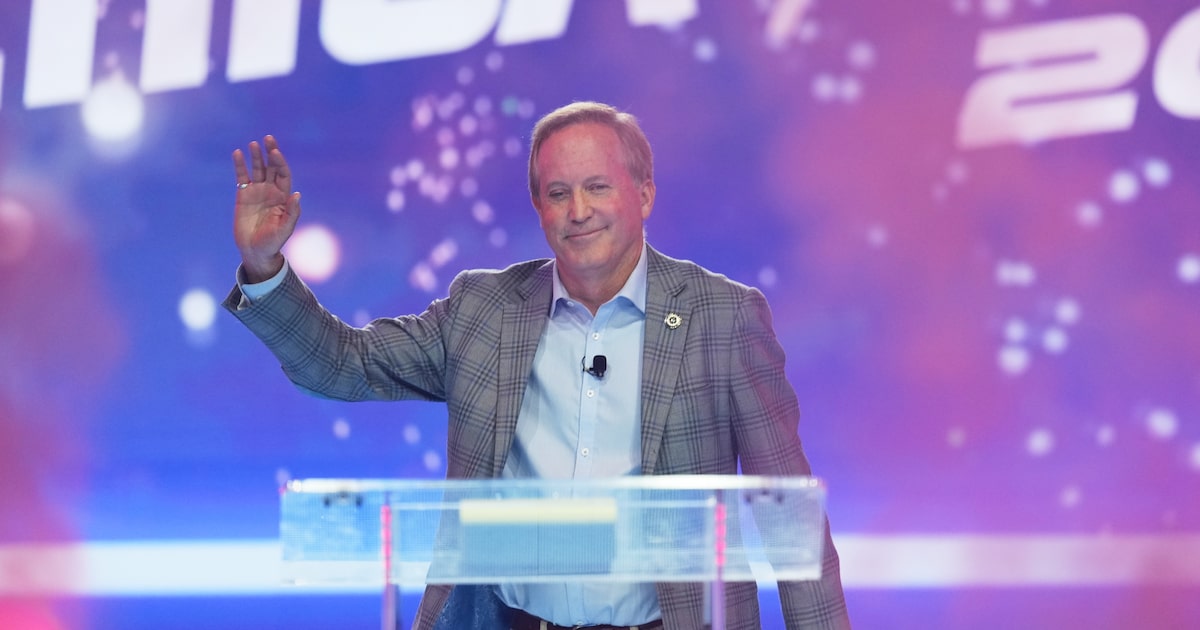
Attorney General Ken Paxton is suing Dallas officials, alleging they are violating the city charter by not devoting enough money to the police department as mandated by Proposition U.
The lawsuit comes after months of warnings of possible legal action from Dallas HERO, the nonprofit that championed the November 2024 voter-approved charter amendment.
Proposition U mandates that the city spend at least 50% of any annual revenue increase on the Dallas Police and Fire Pension System, with remaining funds directed toward hiring more officers to bring the force to 4,000, raising starting pay and boosting officer benefits.
A Dallas spokeswoman said the city was declining to comment Friday, citing the pending litigation.
Political Points
The lawsuit, filed Friday in Dallas County District Court, states the city miscalculated its excess revenue and is underfunding public safety. Chief Financial Officer Jack Ireland, along with the city and City Manager Kimberly Bizor Tolbert, are named as defendants.
Ireland told The Dallas Morning News last year the city’s unrestricted revenue increased by $61.6 million, requiring a $30.8 million reallocation. While the city’s total budget grew by more than $200 million, Ireland said most of that increase came from restricted funds not eligible for Proposition U’s requirements.
But Dallas HERO officials, and now Paxton in its suit, assert the city is using a narrow interpretation of what counts as revenue. They say the excess revenue increase was around $220 million, meaning the actual reallocation to public safety should be closer to around $111 million.
Under the city charter, revenue includes all money collected by the city that isn’t restricted by state or federal law. Critics say the city is withholding funds from police due to its own policies, not legal restrictions.
Behind the suit
The state and two Dallas residents are asking the court to order the city to include all unrestricted revenue in its calculations and properly fund police pensions, officer pay and increase the number of cops.
The two Dallas residents, Jeff Hauschild and Matthew Trammell, are represented by Dallas HERO’s attorney, Art Martinez de Vara. Both were featured in Dallas HERO video profiles on the nonprofit’s website as crime victims who experienced slow police response.
“I filed this lawsuit to ensure that the City of Dallas fully funds law enforcement, upholds public safety and is accountable to its constituents,” Paxton, a Republican who is running for the Senate, said in a statement. “When voters demand more funding for law enforcement, local officials must immediately comply.”
Martinez de Vara said Dallas HERO had “no formal role in the litigation,” but confirmed that he remains the nonprofit’s attorney and worked with the attorney general’s office on the suit.
“I coordinated with the attorney general’s office. They were in need of someone to represent the private plaintiffs and I agreed to do so,” he said. “I was a logical person to reach out to.”
Martinez de Vara said he believed the lawsuit could help ensure the city focuses more on protecting its neighborhoods.
Dallas Police Association President Sgt. Sean Pease said his group is monitoring the lawsuit. He said while the association supports the police department’s hiring progress, he acknowledged that recruiting can be difficult due to widespread anti-police sentiment.
Pease said city officers deserve strong leadership and funding to match their dedication.
Police compensation
The lawsuit also accuses Dallas officials of failing to hire an independent third-party firm to conduct an annual police compensation survey, as required by Proposition U. The survey is meant to help Dallas determine if police officers’ starting salaries and benefits are competitive with nearby cities.
Dallas’ $5.2 billion budget, which took effect Oct. 1, includes funding to hire 350 new officers by fall 2026, and raises starting salaries to $81,232. But Dallas HERO and other critics argue the increase still falls short of Proposition U’s requirement that Dallas rank in the top five among North Texas departments for starting pay.
Tolbert and Ireland told The News last year their review, backed by the city attorney’s office, found Dallas ranks 12th in base pay alone, behind smaller cities like Grand Prairie, Frisco and Plano.
But they argued that when including stipends such as bilingual pay, education incentives and assignment bonuses, a March study placed Dallas third overall, meeting the top-five threshold. Not all officers qualify for those extra benefits, which means many won’t actually reach that higher pay level.
Staff writer Chase Rogers contributed to this report.
 Texas Republican Senate contenders are running starkly different campaigns
Traditional barnstorming, air wars and social media fights have marked contentious GOP wrangling in Texas’ marquee race.
Will Donald Trump make big splash in Texas Senate race?
Even modest moves from Trump could influence the GOP Senate race among John Cornyn, Ken Paxton and Wesley Hunt.
 Trump looms large in Texas attorney general’s race
Republicans running to replace Ken Paxton are spending millions in the March primary, highlighting their ties to the president, while Democrats are pitching their bipartisan credentials.