
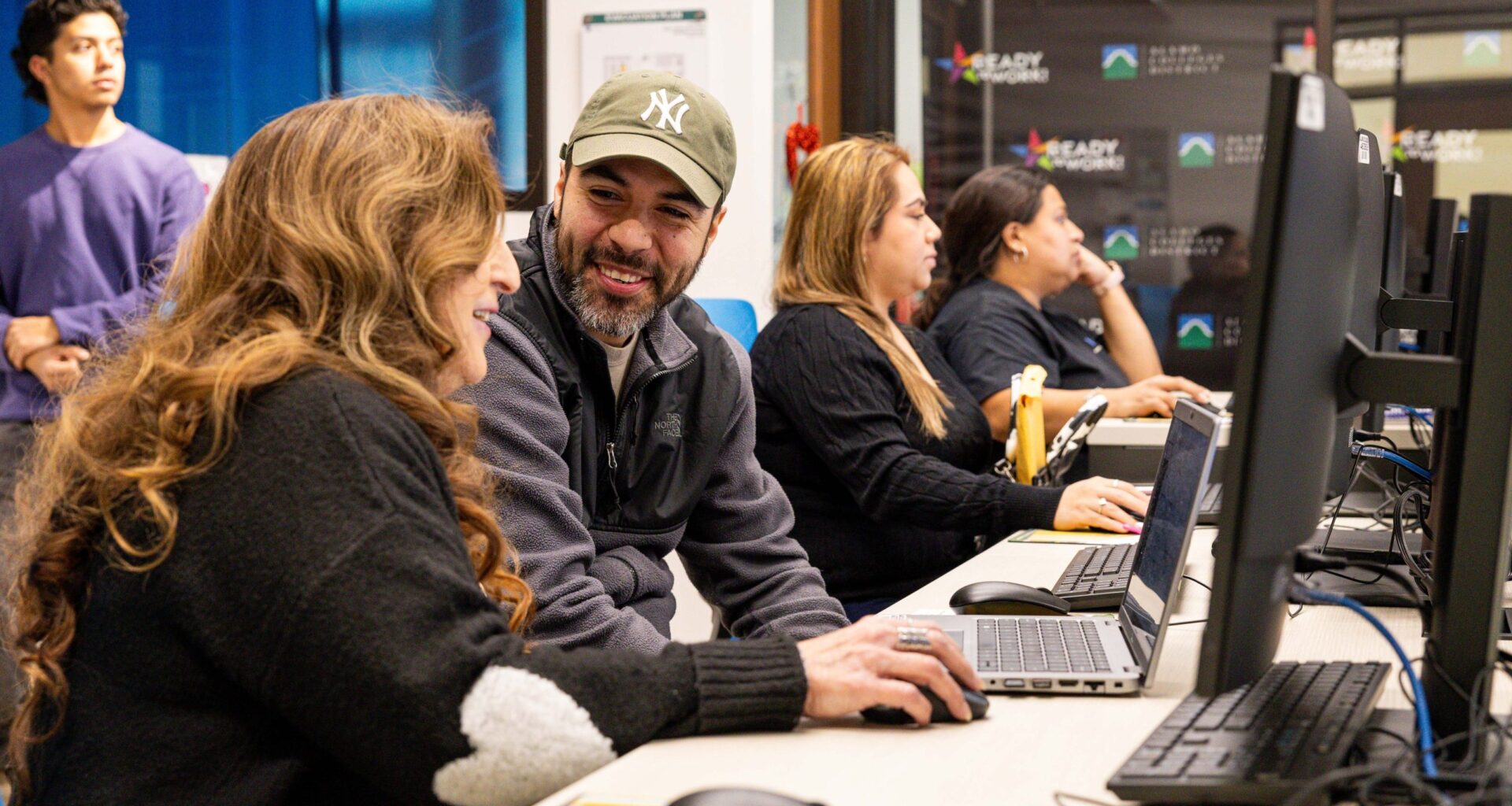
When Ivan Peña describes his role at Alamo Colleges District, one word is often repeated: Connect.
His job is to listen closely to learn about individuals’ potential, their career goals and the barriers they face, then he and his team help them build a plan.
“It’s about connecting the dots,” Peña said. “I tell the students, ‘Step by step. Even if you need to start crawling, do it. I mean, don’t try to run all the way.’”
Peña is a certified enrollment coach and adviser working with Alamo Colleges to connect prospective students to the city of San Antonio’s Ready to Work program — a $200 million voter-approved workforce development program.
It was approved in 2020 by more than 70% of voters who OK’d allocating one eighth of a cent from the city’s sales tax to pay for tuition assistance, career coaching and for residents of San Antonio seeking jobs in high-demand areas. These fields include construction, education, information technology, hospitality, manufacturing, health care,finance and transportation.
To date, Ready to Work officials have reported placing nearly 5,000 graduates in approved jobs earning an average of $45,000 annually. And about 57% of graduates are placed in jobs linked to the program within six months of completion and 70% within 12 months.
“I feel more motivated and I feel more eager to pursue my career,” said Jasmine Pesaud, a prospective participant in Ready to Work after meeting with Peña during an enrollment expo at Alamo Colleges District’s Westside Education and Training Center last week.
Persaud, 39, said she’s worked in the medical field since 2015 as a medical assistant, in administration and other clinical roles. Now that her children are older and she can dedicate more time to both training and a career, she is seeking to upskill to become a registered nurse.
But without financial help, it would be impossible right now, she said.
“I definitely need some sort of financial support,” Persaud said. “It would definitely be a barrier for me. And I think that’s what stops a lot of people from pursuing their career, or going back to school.”
Alamo Colleges District, the largest community college system in the region with nearly 90,000 students, is among the top 10 training providers affiliated with the program, out of about 80 total partner institutions.
 Ready to Work candidates raise their hand for assistance with an enrollment coach during a Ready To Work enrollment expo at the Alamo Colleges District Westside Education and Training Center on Thursday, Feb. 5, 2026. Credit: Amber Esparza / San Antonio Report
To date, the city reports having enrolled more than 15,000 individuals in Ready to Work. Out of these, 5,177 are currently in training and 6,028 have successfully completed it.
Alamo Colleges District’s five colleges — San Antonio College, St. Philip’s College, Palo Alto College, Northwest Vista College and Northeast Lakeview College — as well as it’s training centers have had more than 4,700 Ready to Work participants enrolled since the program launched.
Today, there are 2,403 Ready to Work students across the district, which is about 2.7% of the community college district’s total enrollment.
About 57% of all students who have enrolled in the program at Alamo Colleges have completed some type of training or degree plan. While this number is not as high as program leaders initially hoped for — at about 80% completion — Alamo Colleges Associate Vice Chancellor of Economic and Workforce Development Sammi Morrill says building a system that complies with the process approved by the city has also taken some time to finesse.
“We want to do more, faster, but you have people and we have processes that we need to comply with,” Morrill said. “I want to always remind people like this is the first of its kind. That a community would vote at the level by which they voted … to reinvest in their neighbors. Is huge.”
Nonstop enrollment
That Thursday morning, Persaud was one of about 40 visitors who spent about two to three hours of their day figuring out if the program was indeed of help to them.
File folders in hand, each visitor had either started the enrollment process online and was there to meet a coach, or was ready to apply for the program in person with the help of the coordinators and coaches.
Those further behind in the process were taken into a computer lab, where coordinators helped them create their online profiles and complete applications to then meet a coach to talk about training options and enrollment.
“The goal of this program is to help you with the financial piece of paying for school,” said Fransisco Saucedo Jr., coordinator with Alamo Colleges and Ready to Work, during a brief presentation inside the computer lab.
“[Our role] is to get you through the education portion, but also support you all the way into the job placement piece. We do help with resume building, interview skills and even connecting you with those employers,” Saucedo added.
This is a recurring event that across the Alamo Colleges Education and Training Centers, which were designed as a more accessible option for those seeking workforce certificates and training.
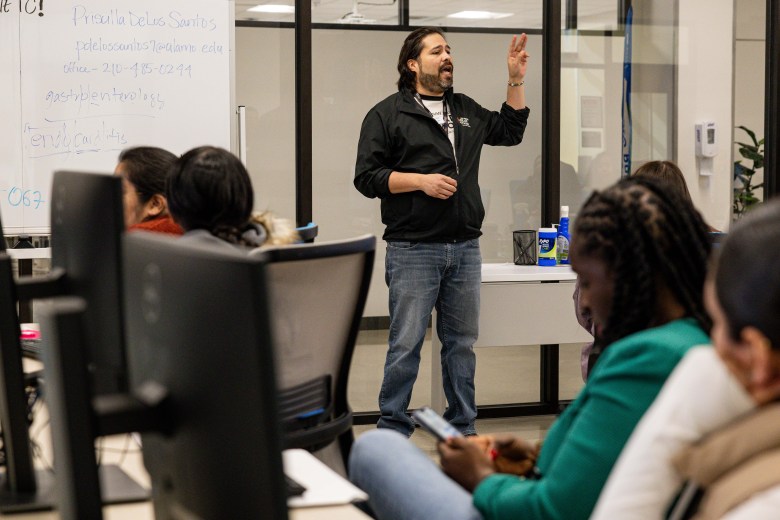 Alamo Colleges and Ready To Work Coordinator Francisco Saucedo goes over the enrollment process with a group of Ready To Work candidates during an enrollment expo at the Alamo Colleges District Westside Education and Training Center on Thursday, Feb. 5, 2026. Credit: Amber Esparza / San Antonio Report
Persaud left her meeting with Peña with a smile, feeling more confident about her ability to reinvest in herself to become a registered nurse, she said. And although going back to school made her nervous, she left feeling encouraged.
“He’s going to call me to see if I’m approved, first,” she said. “I already have an associate degree, so he told me to think about going into the bachelor’s program because I can transfer my credits, which I didn’t know.”
Peña is one of about 33 Alamo Colleges staff members who are solely dedicated to the Ready to Work program. He is based out of St. Philip’s College, but travels throughout the city visiting enrollment expos or meeting with applicants at these training centers.
Each week, Peña has 25 to 30 applicants in his queue who have completed the intake process either online or at an expo.
Some arrive knowing exactly which field they want to enter and whether they want a certificate or a degree, he said. But others need extra support figuring out what fits and if this is the right time to do it.
“Sometimes when they come to us, they’re not really ready to make a decision,” Peña said. “They tell us, ‘I qualify but I don’t know where to go. I don’t know what to do moving forward.’”
This is where good listening skills come to play, he said. Coaches and advisers may suggest aptitude tests to figure out which pathway works best. There’s also a career exploration worksheet that includes median salaries, job availability, local employment projections and training providers.
Participants should spend some time exploring which Ready to Work pathway is the right one for them, Peña said, since they’re not allowed to switch pathways midway through.
Those who choose to pursue a certification program get up to $5,000 to help cover the cost of tuition, while those who seek an academic degree get up to $2,200 annually for an associate degree, and as much as $4,100 for a bachelor’s degree for up to three consecutive years.
Coaching current and prospect students requires a delicate balance of encouragement, guidance and sensitivity, Peña said, to ensure they don’t become overwhelmed by the process.
“People sometimes come to us with many barriers; language could be a barrier, transportation could be a barrier,” Peña said. “Our goal is to make sure that we break down barriers for students and for them to understand that we serve anyone.”
A path forward
As a coach and adviser, Peña draws on his personal experience navigating the higher education system. He arrived in San Antonio in 2002 as a college student seeking at degree at the University of Texas at San Antonio.
Having completed the rest of his studies in Mexico, Peña suddenly faced a system completely foreign to him. He found some help from counselors and advisors and in 2006 he graduated with a bachelor’s degree in education — and with many unnecessary course credits.
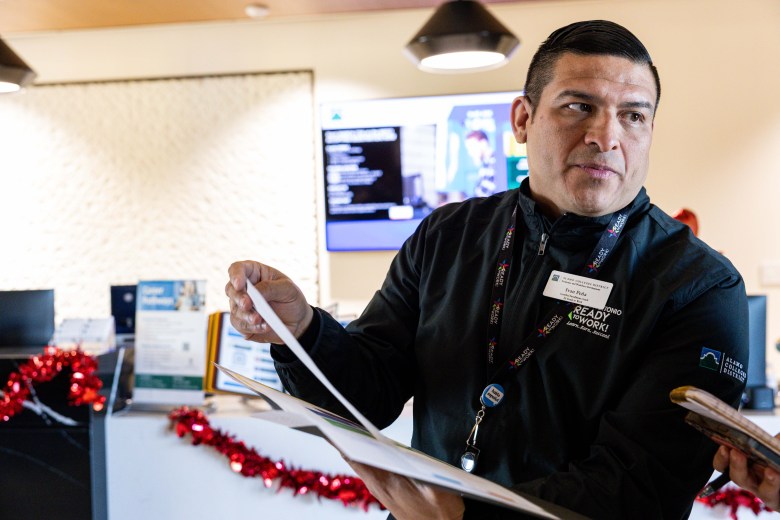 Ivan Peña, an enrollment coach with San Antonio’s Ready To Work program, goes over an information folder given to candidates who are interested in enrolling to learn more about the program and review their options at the Alamo Colleges District Westside Education and Training Center on Thursday, Feb. 5, 2026.. Credit: Amber Esparza / San Antonio Report
“I took so many classes that at the end I ended up with like 20 extra credits that I didn’t need,” Peña said. “I wasted time and money.”
For the first six years of his career he taught in high-poverty schools across San Antonio, teaching English as a second language courses, plus teaching Spanish and coaching soccer. He later transitioned to higher education holding enrollment, intake and adviser roles at the University of Incarnate Word and eventually Palo Alto College.
His experience teaching at high schools taught him that like he did, many students don’t understand the higher education system enough to feel welcome or drawn to it, he said. Many could enroll and get discouraged once they don’t find a clear pathway.
It was during Peña’s time at Palo Alto College that he heard about a new team that would be solely focused on the Ready to Work partnership with the city. The new program was immediately of interest to him, he said, for its promise to target a wider range of candidates.
“For me to say that there’s going to be a program in the community, for the community outside of Alamo Colleges for students to train, to educate themselves, and for them to be able to find jobs at the end, … I said, ‘I want to be a part of that.’”
Beyond Ready to Work
Morrill, of Alamo Colleges District, said the college’s involvement in this program made sense on many levels.
This system closely mirrors what the state of Texas did with 2023’s House Bill 8, which tied state funding to outcomes, incentivizing earned credentials in high-demand job fields.
“It’s given us the framework by which we’re going to build out,” Morrill said. “We’ve learned so much. … It’s the processes, it’s documentation.”
Although intake and enrollment is not foreign to any college, Ready to Work seeks to appeal to a different demographic, one that had for many reasons shied away from the traditional college setting.
As a city program, its leaders measure Ready to Work’s outcomes at every level, from intake to completion and employment.
“It has been evolution,” Morrill said. Early on, her team brough in an outside consultant to evaluate the intake process. Their feedback was, “Y’all are going in hot,” she said as he advised to move through the intake process at a slower pace.
Approaching students alone and taking more time to prepare them for the many questions that would come was one of those adjustments.
“We [had] to train the team to say, ‘Listen, I’m going to ask you for a lot of documentation. Some of it’s going to make you nervous. … But this is what we have to do to put in the system to get the funding that we know you need to get on the success plan.”
The first few years were not easy, she said, with many new processes being rolled out and adjustments having to be made. The Ready to Work program was criticized for not living up to the 2020 campaign promises of helping up to 40,000 workers find life-changing, better-paying jobs — delivering results too slowly and adjusting down original projections of how many San Antonians it would help in its first few years.
The program’s supporters argue that the rare, city-wide effort is a model for the rest of the nation — and Alamo Colleges is a key step in its pipeline.
From enrollment, to retention and completion, Morrill expects the Ready to Work metrics to improve as they continue to refine their internal process.
When asked how he measures success, Peña doesn’t think twice before describing the random calls by students he once advised with updates on their progress, or to send him a friend or family member seeking to also look into the program.
“We can literally change their lives by welcoming them, by servicing them, by being there with them,” Peña said. “For them to know that they’re not just a number.”
The San Antonio Report partners with Open Campus on higher education coverage.