
After months of negotiations, Plano and other member cities that called for withdrawal elections from the Dallas Area Rapid Transit Agency may move to rescind them following a series of regional meetings this week.
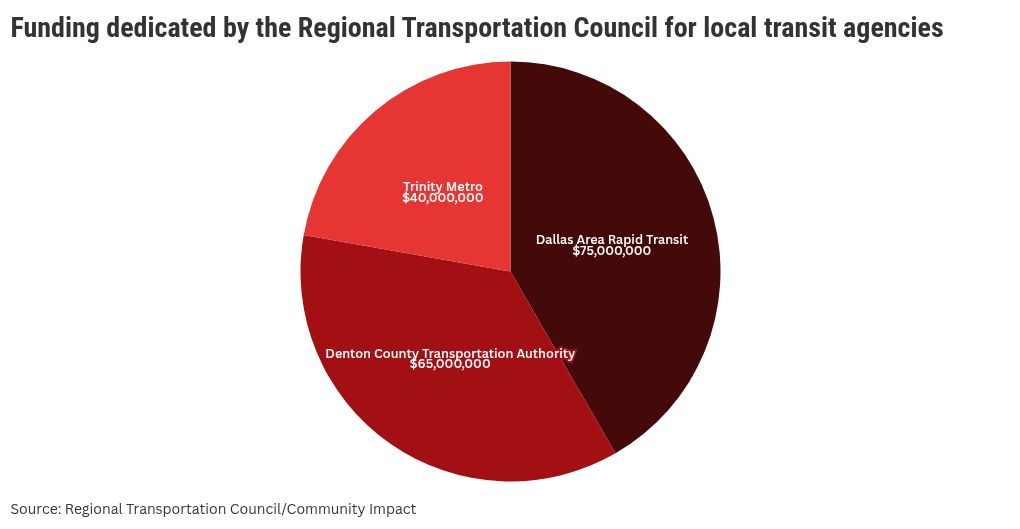
In the latest step, the Regional Transportation Council, a 45-member group of area transportation leaders, approved at a Feb. 12 meeting dedicating $180 million towards regional transit agencies, including about $75 million to help fund DART’s new proposed funding model.
The remaining $105 million will include $65 million for the Denton County Transportation Authority and $40 million for the Trinity Metro, aiming to improve regional rail mobility in the Dallas-Fort Worth area.
What you need to know
At its Feb. 10 meeting, DART officials voted to approve initial proposals for a new funding and governance model for the agency. The Regional Transportation Council voted Feb. 12 to dedicate funding to the new plan.
Additionally, Dallas City Council voted Feb. 11 to reduce the city’s voting share on the DART board to 45% and give up its majority control.
Plano Mayor John Muns said Feb. 13 that while several steps still require approval from the state legislature in its next session, these recent decisions represent a “good compromise” for DART member cities.
Muns, who serves on the Regional Transportation Council, said Plano City Council could consider approving a new interlocal agreement, or ILA, at its Feb. 23 meeting, but that timeline may shift depending on final details.
“Everything will still be contingent upon the ILA and agreement of that,” Muns said. “Hopefully DART will have all their commitments ready for all of us to see, and if all goes well, then we will vote to rescind the withdrawal on the ballot.”
Muns added that other DART member cities are expected to take similar action the week of Feb. 23 through regular or special council meetings.
Nearly half of DART’s 13 member cities have now scheduled withdrawal elections, including Plano, Highland Park, University Park, Irving, Farmers Branch and Addison.
The details
Under DART’s proposed model, the agency would return the equivalent of 25% of sales tax collections to its 13 member cities for six years. Funding would be distributed based on sales tax contributions.
The funds for returning 25% of collected sales tax to member cities would be gathered from three sources:
Guaranteed base funding from DART and the Regional Transportation CouncilTransferring the regional rail system to an independent management authorityCreating new revenue streamsDART and the Regional Transportation Council’s contribution would provide a base of up to 10% sales tax return, and DART officials would work with other regional authorities to make up the rest of the 25% contribution.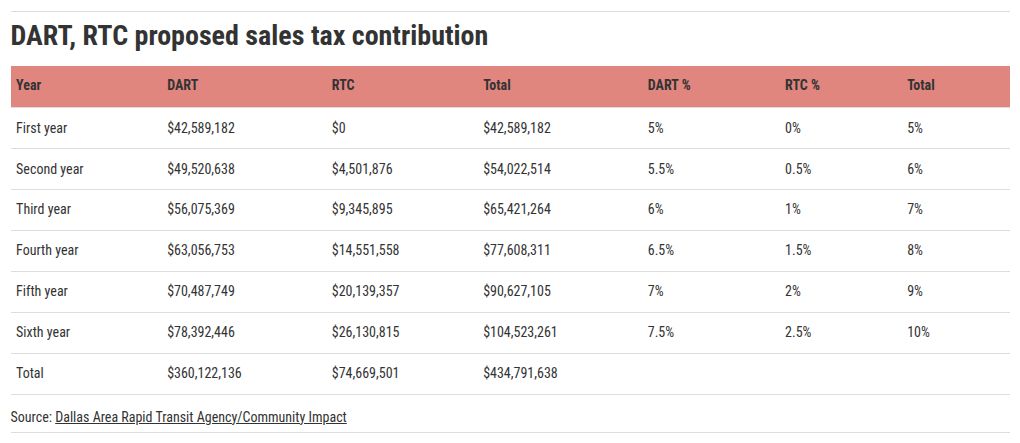
“What DART is doing is giving up almost 7.5% of our contributions, or our revenues, back to cities, in coordination and partnership with the RTC,” DART board Chair Randall Bryant said Feb. 12. “This is just not a bailout or a gift away to any cities. … We’re trying to solve for regional mobility.”
Muns said Plano’s primary concerns regarding funding and governance have largely been addressed, but discussions about ridership and service levels will continue.
“If we get all this resolved, then we still want to talk about how we can improve service ridership inefficiencies that we’ve been a little bit frustrated [about] for many years,” Muns said. “This is not contingent on making a deal with DART, but I think DART knows we still want to continue to have conversations about service issues and improving ridership.”
He added that he would not require additional conditions beyond ensuring the interlocal agreement reflects the negotiated terms.
“The ILA needs to reflect what we’ve all agreed upon and make sure everybody understands how the process will work,” Muns said. “Outside of that, I think everybody understands how we’re moving forward over the next five years.”
Some context
Since calling a special withdrawal election last November, Plano has submitted two written proposals to DART, including a rail-focused transit agreement filed in November and a draft interlocal agreement submitted Jan. 13 that would revise the agency’s general mobility program.
Muns said despite the latest agreement not reaching exactly what Plano previously proposed, the new plan is something the city would consider.
“We’d like to be able to request more, but I think at the same time, we’re trying to be good regional partners,” Muns said. “It’s very similar to what we took down to the legislature last spring.”
Texas House Bill 3187, which died in the House in the last legislative session, would have created a permanent general mobility program that redirected 25% of DART’s sales tax revenues back to its member cities.
“It’d be hypocritical if I wouldn’t accept that funding structure today, and yet I was trying to get it done nine months ago,” Muns said.
One more thing
Muns said officials will continue discussions around microtransit in Plano, particularly as the city considers implementing an alternative local transit system with Via Transportation.
Plans for the service have been delayed several times, including a Feb. 9 vote on the contract that was tabled due to progress in ongoing DART negotiations.
Muns said city officials want to use more data to improve routing and services for DART and local residents, particularly by expanding microtransit options within Plano.
“We’re hoping to be able to implement [that] down the road,” Muns said.
Dates to know
Feb. 23: Collin and Denton County ballot language finalization deadline, Plano City Council considers alternative transit service contract and could consider new interlocal agreementFeb. 24: DART board and officials consider new general mobility program interlocal agreement to replace prior program interlocal agreementFeb. 27: Dallas County ballot language finalization deadlineMarch 18: deadline to rescind electionMarch 24: DART public hearing on potential services changesMay 2: potential withdrawal elections