

The Travis County Medical Examiner’s Office has ruled that 19-year-old Texas A&M University student Brianna Aguilera died by suicide, affirming earlier findings by the Austin Police Department in a case that prompted widespread speculation about the circumstances of the young woman’s death.
A copy of Aguilera’s autopsy report obtained by the American-Statesman lists the cause of death as blunt force trauma and the manner of death as suicide. The determination was based on information provided by Austin police detectives and an independent investigation conducted by the Medical Examiner’s Office, according to the report.
“There was no indication based on law enforcement investigation that another individual was involved in the incident which resulted in the decedent’s death,” Dr. Leticia Schuman, a deputy medical examiner, wrote in the report. “Given the entirety of the circumstances including a history of prior statements threatening self-harm/suicide, the presence of a suicide-type note on the decedent’s phone, and the height of the balcony railing relative to the decedent’s height (measured at 44.5 inches and 62 inches, respectively), it is unlikely that the decedent accidentally fell over the railing.”
The examination found that Aguilera’s blood alcohol content was about twice the legal limit. The psychoactive cannabinoid Delta-8 also was detected in her urine, according to the report.
Aguilera died in the early morning hours of Nov. 29. In the days that followed, Austin homicide detectives said the case was not criminal in nature, but some of Aguilera’s relatives publicly disputed that conclusion. Her mother, Stephanie Rodriguez, sharply criticized the Police Department’s investigation, calling it inadequate. In December, the family retained prominent civil attorney Tony Buzbee to conduct an independent review.
On Dec. 4, detectives disclosed what they described as a key piece of evidence: a suicide note dated Nov. 25 that investigators recovered from a deleted folder on Aguilera’s computer. Police also said Aguilera had expressed suicidal thoughts to friends and in text messages the day before her death.
“I understand how grief and the need for answers can raise intense emotions and many questions,” Austin Police Chief Lisa Davis said at a Dec. 4 news conference announcing the department’s findings. “But sometimes the truth doesn’t provide the answers we’re looking for, and that is this case.”
At the same news conference, homicide Detective Robert Marshall outlined a timeline of Aguilera’s final hours. Witnesses told investigators that Aguilera arrived at a football tailgate between 4 and 5 p.m. on Nov. 28 and was asked to leave about 10 p.m., Marshall said. Surveillance footage showed Aguilera entering a 17th-floor unit at the 21 Rio Apartments roughly an hour later.
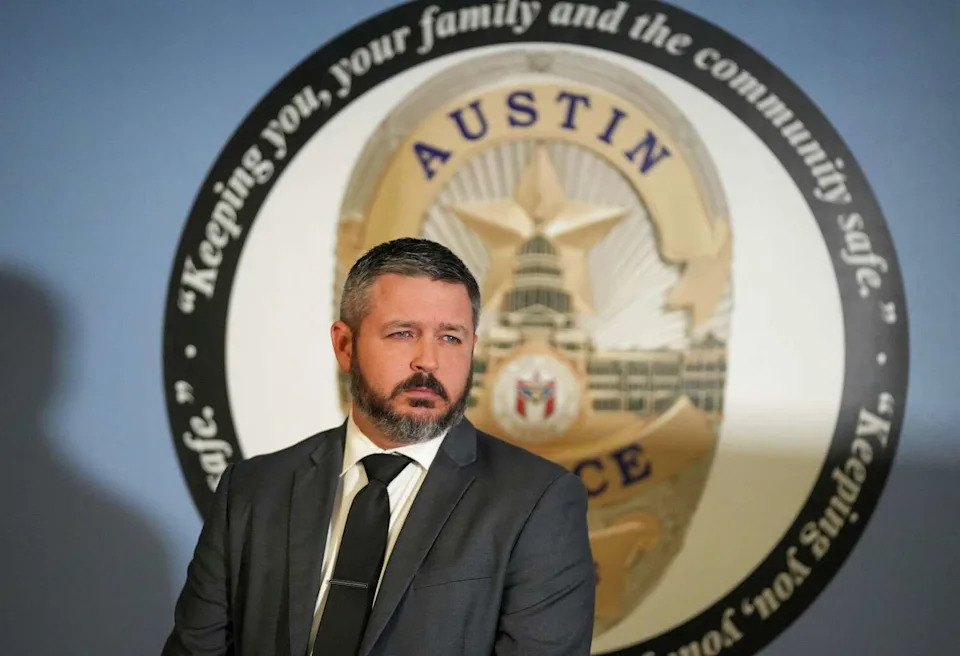
Austin police homicide detective Robert Marshall speaks during a news conference at APD headquarters in Austin on Thursday, Dec. 4, 2025, about the death of 19-year-old Texas A&M student Brianna Aguilera, which has been determined to be a suicide. (Jay Janner/Austin American-Statesman)
At the apartment, Aguilera borrowed a friend’s phone to call her out-of-town boyfriend. Witnesses and the boyfriend told investigators the two argued for approximately two minutes before a 911 call came in reporting that Aguilera’s body had been found.
According to the autopsy report, the call came from a driver who stopped and “began bystander cardiopulmonary resuscitation (CPR).”
Officers arrived at the scene at 12:46 a.m., where they found a woman with “trauma consistent with falling from a higher floor.” The woman, later identified as Aguilera, was pronounced dead at 12:56 a.m.
The next day, as investigators worked to piece together what happened, Rodriguez contacted Austin police several times, including once to report the real-time location data of Aguilera’s missing phone, which appeared to place it in a wooded area near the tailgate.
Rodriguez and other relatives criticized detectives for failing to ensure key steps of the investigation were completed in a timely fashion, such as preserving the scene, collecting physical evidence and thoroughly interviewing people at the scene.
But Marshall, the homicide detective, insisted investigators spent “hours and hours” reviewing surveillance footage, analyzing phone data and interviewing witnesses.
In the months since her daughter’s death, Rodriguez has continued to question the Police Department’s investigation while grieving publicly.
“I miss you so much more than any parent can imagine and more than words can say,” Rodriguez wrote in a Jan. 21 Facebook post.
Editor’s note: This story has been updated to include details from the autopsy report, which the Travis County Medical Examiner’s office released after initial publication.
If you or someone you know is struggling with thoughts of suicide, call or text 988 to reach the Suicide & Crisis Lifeline, or chat via 988lifeline.org.