
In a high-stakes gambit to stop six cities from quitting Dallas Area Rapid Transit, North Texas transportation leaders last week offered a sweeping reset — with Dallas surrendering majority board control of DART, a third agency lining up $180 million in regional funding and DART promising to return a slice of sales tax dollars to member cities.
Suburban leaders indicated the mix of power sharing and new money could be enough to persuade the likes of Plano and Irving to scrap looming withdrawal elections in the nick of time, with just days before some counties finalize May ballots.
But the proposal still needs support from lawmakers and critics are concerned the compromise will gut the regional transportation system’s service.
It’s still the clearest picture yet of a lifeline for the imperiled public transportation agency that has faced a gloomy outlook after nearly half of its 13 members — Plano, Irving, Addison, Farmers Branch and the Park Cities — threw their future with DART to the ballot box.
Breaking News
Related
 Negotiations make progress
A group of DART and city leaders, convened by the North Texas Commission and the North Central Texas Council of Governments, has met for months to consider reforms to the agency’s governance, funding and service — three aspects of DART some member cities find most irreconcilable as they seek a path to cut ties with the agency.
On the governance front, Dallas leaders voted Wednesday to support shrinking the city’s power to at least 45% on DART’s board, which some cities say doesn’t give a fair voice or vote to smaller suburbs represented by the 15-member governing body.
On Tuesday, DART Board Chair Randall Bryant outlined the most detailed plan yet on reforming the agency’s funding, one of the most challenging hurdles to overcome as member cities say they pay too much for the service they receive.
The proposal Bryant presented intends to use three different methods to reach the equivalent of giving roughly 25% of DART sales tax back to cities — a threshold several cities supported previously.
Related
DART’s 13 member cities pay a one-cent sales tax to the agency. Cities not in DART can use that penny on things like economic development and public safety.
Plano, for example, contributed more than $109 million to DART in fiscal year 2023, according to a 2024 report by the firm EY, though DART spent about $44 million on services in the city. Plano staff say the city spends more on DART than on police and economic development combined.
A look at the funding plan
Bryant proposed a three-pronged framework Tuesday to reform DART’s funding plan:
First, DART, with funding support from the Regional Transportation Council of the NCTCOG, would start giving cities some sales tax back — up to 10% of their contributions over the next six years. Cities could use this money for transportation-related projects.
“That gives the cities a small pot of money that they can use to advance some of the programs that they feel like they need to advance to improve mobility,” said DART CEO Nadine Lee. “We’re all in on that. … We want to work together.”
The agency will still have to “scramble,” she said, to make the money available. She said she hopes cities will use funds to improve sidewalks, access to bus stops and improve transportation services within cities so that the region can leverage resources to “get things done in a better way than we’re doing today.”
Second, DART and other authorities would transfer their regional rail systems — including the Denton County Transportation Authority’s 21-mile A-train commuter rail line, Trinity Metro’s Trinity Railway Express and DART’s Silver Line — to an independent management authority. This idea has previously been recommended by a subcommittee of the RTC. It would require action in the state Legislature to become a reality.
“The subcommittee is creating a vision of what the future is going to be,” said Michael Morris, director of transportation at the NCTCOG. “ It may be … integrating all the commuter rail, so that regional rail is like the freeway system of transit.”
The committee will need to find out how to fund and govern the authority and how its assets are handled, he said.
Third, DART would pursue a new revenue stream in coordination with member cities and regional stakeholders, such as a vehicle registration fee. This would also need action by state lawmakers to come to fruition.
The fee that would fund DART’s proposed new revenue stream would also apply to cities not in DART. Mark Enoch, who represents Rowlett, Garland, and Glenn Heights on DART’s board of directors, said he supports sharing the cost of public transportation with neighbors who benefit from DART’s role in reducing traffic and air pollution in North Texas. He called Bryant’s proposal “excellent work.”
“Some of the cost … ought to be fairly shared by cities who are not now members of transit,” he said at Tuesday’s DART meeting. “I like the idea of fairly charging those folks who are gaining the benefits.”
Dollars and sense
The funding plan’s phased return of sales tax from DART would mean giving more than $360 million back to member cities over six years for transportation projects and asks the RTC — the 45-member transportation policy body of the NCTCOG — to contribute more than $74 million over the same timeframe to help bail DART out.
Related
The RTC voted Thursday to approve the $75 million contribution — in addition to another $105 million for the Denton County Transportation Authority and Trinity Railway Express in an effort for “true regionalism,” RTC member and Denton County Judge Andy Eads said.
“We need to not just address one of the agencies, but at the same time demonstrate that same level of commitment to all three agencies,” Eads said. “It is a project that outlives us, and it is a project for future generations,” he said of the investment in the region’s rail system.
Plano stands to gain more than $61 million back from DART through 2031 under the proposed terms, and Irving could see nearly $54.5 million in returns. In total, DART’s 13 member cities would see more than $434 million returned over the next six years, contributed by DART and the RTC.
The six-year time frame includes three legislative sessions to seek action on the proposed reforms and allows cities to call a withdrawal election in 2031 if the plan does not work, Bryant told the board Tuesday. State law allows cities to call an election to leave DART once every six years, an opportunity that falls in 2026 and again in 2031.
Related

Morris said the efforts have brought “the family back together.”
“This is a big deal to be able to go back to the Legislature as a united region,” Morris said. “I think it sets the right message back to our federal partners. We have our act together.”
Bryant pulled the plan together in just a few months; he stepped into the chair role last October, the day before cities announced their plans to seek an exit from DART.
“It’s the culmination of a lot of work in a very short period of time,” Bryant said of his plan’s progress. “And the evidence of what true collaboration can be.”
Is it enough?
Plano Mayor John Muns said if his city receives the agreement discussed with DART and the RTC, he’d seek to put the recall of the scheduled May election up to a vote on his City Council.
“I still want to have those conversations about ridership and service levels and being able to be more specific to the needs of our community,” said Muns, who also serves on the RTC. Those are things he hopes they can work through.
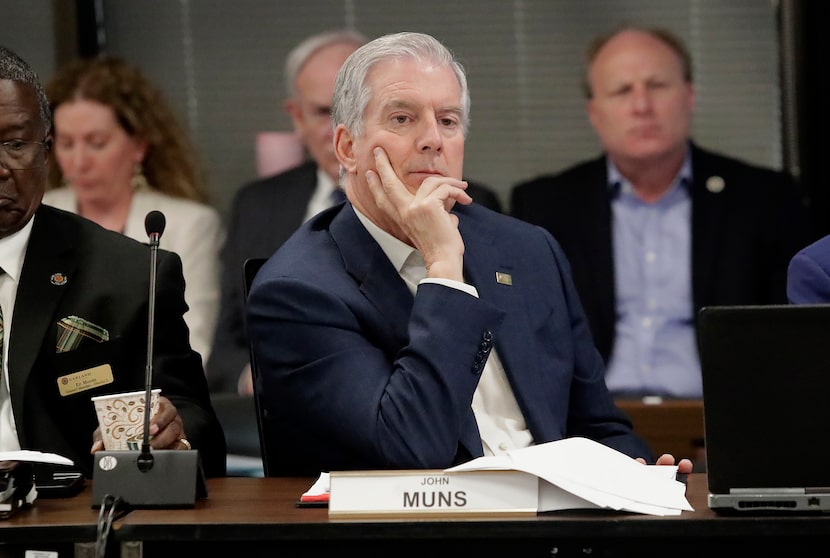
Plano Mayor John Muns listens as the Regional Transportation Council met for a workshop to discuss the future of DART in Arlington on Thursday, February 12, 2026.
Stewart F. House / Special Contributor
“We’re glad that we will still be a partner of DART’s going forward,” he said.
“The city of Irving believes in a strong regional transit system,” said Assistant City Manager Orlando Sanchez to the RTC on Thursday. If DART’s plan moves forward, he said his city plans to consider “to withdraw our request to pull out from DART.”
Irving Mayor Rick Stopfer defended his city earlier in the week, telling other DART board members on Tuesday that the city’s intention was to improve public transportation in the region.
“I get a little frustrated when people say that we’re after a money grab,” Stopfer said at Tuesday’s DART meeting. “[Riders] are concerned. They don’t want us to leave DART. But it’s not because they think DART’s doing a great job. They still feel they do not have the services that they need.”
Addison Mayor Bruce Arfsten said following the RTC’s meeting he also plans to ask his council to consider recalling its scheduled election and hopes his city follows through with canceling the vote.
Related

“We had a common goal, and the regional aspect of it is a great goal to have,” said Arfsten, also an RTC member. “We just have to figure out how to get there.”
Farmers Branch Mayor Terry Lynne also said he’d recommend his council recall their May election.
University Park plans to move forward with their election, “allowing voters to determine the best path forward,” the city released in a statement.
“The city of University Park continues to engage in ongoing discussions with DART regarding the value of transit services within the community and the City’s overall sales tax contribution,” the statement said.
Highland Park’s Town Administrator Tobin Maples did not respond to phone calls and emails requesting comment by 5 p.m. Friday.
Several transportation leaders thanked the board’s chair for the creative thinking as the region seeks to address the needs of an expected population boom — D-FW’s population is expected to grow from 8 million to 12 million residents by 2050.
Related

Some admitted they disliked what the proposal will do to the agency but supported the compromise it seeks to accomplish. Roy Lopez represents Dallas on the DART board and said Bryant’s proposal is the only way to save the agency.
“I really hate this. Who gives up the most? My beautiful city of Dallas,” Lopez said. “This vote is to save this agency … from decentralization. … This, to me, is DART bending over absolutely backwards. The fact that I hate this should really empower our suburban friends.”
DART still dealt a blow
DART’s CEO said the plan would mean a significant financial blow to the system. While Lee said she understands the context of the agreement, she worries the cuts will “undermine confidence that people have” in the agency’s services and only make complaints worse.
“DART is going to have to scrub our entire budget to find out how we can make room for the $60 million a year without impacting our riders as much as … we fear,” Lee said.
Patric Morgan, a member of transit advocacy group Dallas Area Transit Alliance, said the proposal is creative and thanked Bryant for the work to draft it. But he said the plan is not perfect.
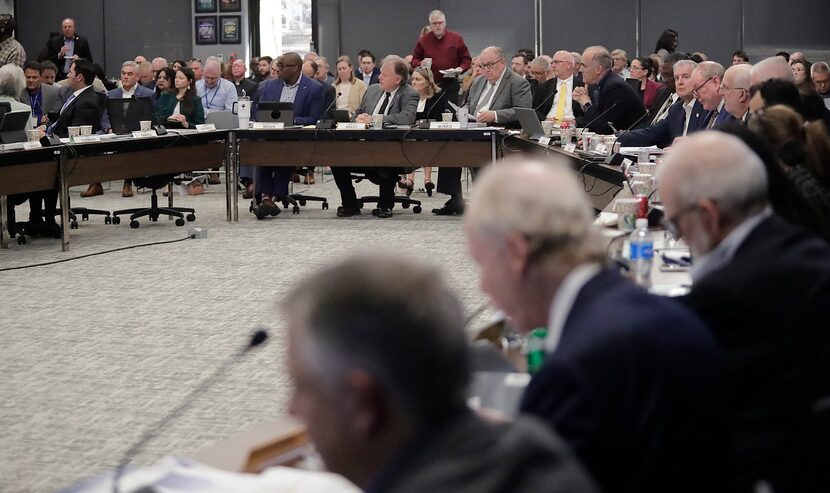
The Regional Transportation Council held a well attended meeting after a workshop to discuss the future of DART in Arlington on Thursday, February 12, 2026.
Stewart F. House / Special Contributor
“It looks like it requires some pretty heavy service cuts for DART, which we can’t accept,” Morgan said, who spoke on his perspective but not on behalf of DATA as an organization. “It does have potential, but I think we can negotiate more.”
In a statement, DATA described “grave concerns about potential service cuts to fund member city handouts,” but recognized Dallas and the RTC’s work to help DART negotiations advance. The group asked DART to supply the estimated dollar amount of service cuts required if the plan advances, to “understand who or what must be sacrificed to pay off” member cities.
The outlook of a mass exodus from DART is also bleak. If all six cities were to leave the agency, its service area, funding and the services DART provides North Texas would reduce significantly.
Related

Service would end the day after votes are canvassed in cities whose voters choose to leave DART, but cities would continue paying sales tax for years to cover debt associated with their contributions.
Some suburbs are considering microtransit alternatives to DART, similar to the on-demand system Arlington uses in lieu of mass transit. Plano postponed its vote on a vendor Monday when negotiations with DART started looking up.
Morris said the RTC’s move to support DART’s funding plan and regional rail projects was one of the most important days of his nearly five-decade career in transportation.
“This financial partnership is a stepping stone to a whole new institutional structure to deliver transit‚” he said. “We got this across the goal line … now we have a little more homework to do.”
Key upcoming datesFeb. 20 – DART’s board will meet to vote on the funding plan and on an agreement with member cities Feb. 23 – Deadline for Collin and Denton counties to finalize ballot language for May electionsFeb. 23 – Plano City Council meets and could vote on recalling their May electionFeb. 24 – Addison City Council meets and could vote on recalling their May electionFeb. 26 – Irving City Council meets and could vote on recalling their May electionFeb. 27 – Deadline for Dallas County to finalize ballot language for May electionsMarch 18 – Deadline for cities to call off May elections May 2 – Scheduled elections to reconsider membership in DART in Irving, Plano, Farmers Branch, Addison, Highland Park and University Park