
A 4,000-seat live music and events venue is seen under construction at River Park, a planned mixed-use development on East Riverside Drive in Austin, on Monday. The corridor is poised for wave of new development, even as city planners look to curb displacement.
Jay Janner/Austin American-Statesman
An old office space on the former Tokyo Electron campus in Southeast Austin was filled with presentation boards and leaflets on the final, chilly Saturday of January as residents funneled through to try to learn about the future of their neighborhood.

Children got their faces painted and made arts and crafts while their parents attended listening sessions with city staff and visited with municipal planners. Residents picked up Koozies touting a light-rail train that might one day run down the main thoroughfare of the corridor they call home.
Article continues below this ad
Rivercrest Apartments on East Riverside Drive in Austin on Monday, Feb. 9, 2026.
Jay Janner/Austin American-Statesman
Houses are under construction on East Riverside Drive in Austin, Monday, Feb. 9, 2026.
Jay Janner/Austin American-Statesman
East Riverside Drive in Austin on Monday, Feb. 9, 2026.
Jay Janner/Austin American-Statesman
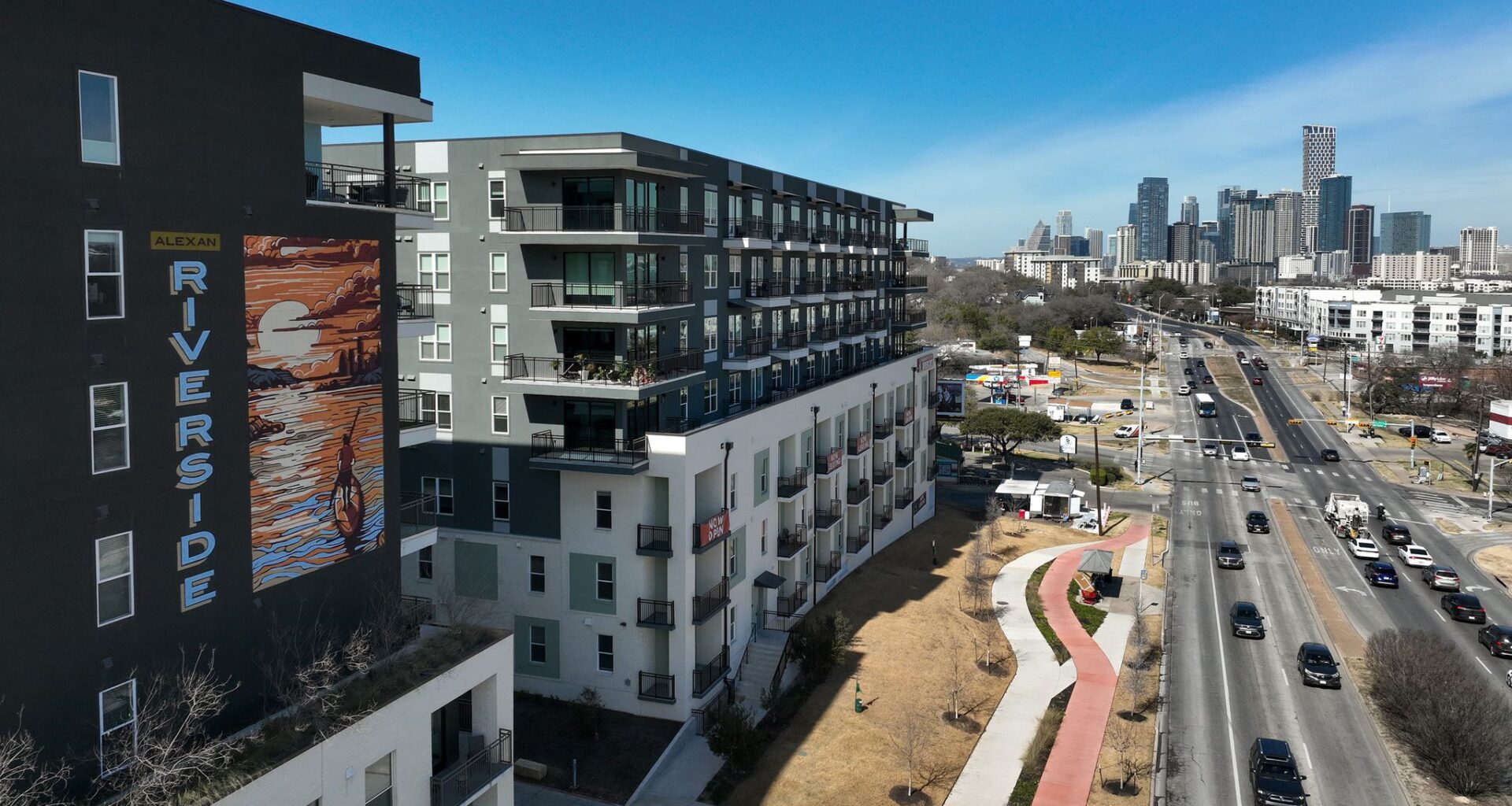
Urban East apartments rises behind a house on East Riverside Drive in Austin, Monday, Feb. 9, 2026.
Jay Janner/Austin American-Statesman
A man cycles past a house and an empty lot East Riverside Drive in Austin, Monday, Feb. 9, 2026.
Jay Janner/Austin American-Statesman
East Riverside Drive in Austin on Monday, Feb. 9, 2026.
Jay Janner/Austin American-Statesman
River Park, a mixed-use development, is under construction on East Riverside Drive in Austin, Monday, Feb. 9, 2026.
Jay Janner/Austin American-Statesman
The former Tokyo Electron campus on Grove Boulevard near East Riverside Drive in Austin, Monday, Feb. 9, 2026.
Jay Janner/Austin American-Statesman
East Riverside Drive in Austin on Monday, Feb. 9, 2026.
Jay Janner/Austin American-Statesman
Houses are under construction on East Riverside Drive in Austin, Monday, Feb. 9, 2026.
Jay Janner/Austin American-Statesman
Graffiti covers a closed business on East Riverside Drive in Austin on Monday, Feb. 9, 2026.
Jay Janner/Austin American-Statesman
East Riverside Drive in Austin on Monday, Feb. 9, 2026.
Jay Janner/Austin American-Statesman
Construction is underway on a 4,000-seat live music venue at Riverside Drive and Crossing Place, part of the larger River Park mixed-use development on Jan. 20.
Jay Janner/Austin American-Statesman
Plans for the Grove Retail Center call for about 8,600 square feet of new retail space at 5900 E. Riverside Dr., with an estimated construction cost of $860,000.
Jay Janner/Austin American-Statesman
A multi-family development is under construction on Vargas Road and East Riverside Drive onTuesday, Jan. 20, 2026.
Jay Janner/Austin American-Statesman
The former tech facility was a fitting venue for the city-sponsored open house focused on changes coming to the East Riverside corridor. The 125-acre campus at 2400 Grove Blvd., which the city acquired in 2024 for $87 million, represents a blank canvas for redevelopment in Southeast Austin.
Austin’s East Riverside neighborhood, a historically low-income, largely Hispanic residential area, is rapidly evolving. Its main corridor — East Riverside Drive between Interstate 35 and Texas 71 — has seen significant growth and development in recent years.
“I think the last five years, what we’ve done in this ZIP code has been transformational,” said Soud Twal, a real estate agent with Kuper Sotheby’s who represents listings in East Riverside. “It looks night and day from what it did five years ago.”
Article continues below this ad
Now, about a year out from the planned start of construction on the Austin Light Rail project, the neighborhood sits on the cusp of another major wave of redevelopment — for better or worse. As the city of Austin prepares for that growth, leaders say they hope to limit displacement in one of the city’s most vulnerable ZIP codes.
City of Austin to revamp East Riverside plans
A 4,000-seat live performance venue is under construction at River Park, a mixed-use development on East Riverside Drive in Austin, on Monday. The 65,000-square-foot facility will be operated by AEG Presents and is expected to open next year.
Jay Janner/Austin American-Statesman
City officials said the Jan. 31 open house was aimed at gathering feedback on a range of public initiatives expected to affect the corridor, including updates to the East Riverside master plans, redevelopment of the former tech campus, the light-rail line and affordable housing initiatives.
Article continues below this ad
Officials view it as an opportunity but acknowledge its potential to fuel displacement. Among the city’s primary efforts in the area is the East Riverside Corridor Planning Initiative, a project aimed at updating two documents intended to guide the area’s future.
Collectively, the East Riverside Vision Plan and Regulating Plan account for the city’s approach to planning across the area. They were adopted in the early 2010s. But in 2024, City Council directed the planning department to align the plans with new equitable transit-oriented housing rules, said Ana Villarreal, a planner with the city of Austin who is leading the initiative.
The update, she said, represents a shift in the city’s priorities for the corridor and a renewed focus on minimizing gentrification and displacement of longtime residents. The city has 46 tools in its transit-oriented development “policy toolkit,” ranging from land use standards to workforce development strategies, which will be incorporated into the updated plans to ease growing pains, Villarreal said.
“One of the main things is to make sure that we are updating the plans with an equity lens, making sure that equity is an actionable goal,” Villarreal said. “Development and growth can often lead to displacement pressures.”
Article continues below this ad
But that could be challenging.
From 2020 to 2025, 233 new single-family homes and duplexes were built in the nearby Riverside, Pleasant Valley and Montopolis neighborhoods, according to city permit data. In the same period, builders have added 55 multifamily apartment complexes.
Twal said the explosion of redevelopment in the area since 2020 comes down to three things: “Location, location, location.”
“You just can’t beat being five minutes from downtown, five minutes from the river and the trails, 10 minutes to the airport,” Twal said.
Article continues below this ad
The Crosstown apartments rise behind a house on East Riverside Drive in Austin on Monday. Since 2020, builders have added 55 multifamily apartment complexes in the East Riverside corridor.
Jay Janner/Austin American-Statesman
He explained that developers and homebuyers had not historically sought out properties in the neighborhood but that changed during the pandemic.
“As pricing and inventory became more scarce and went through the roof, developers saw it as an opportunity simply due to the proximity to downtown,” he said.
That shift has led to housing that, in some cases, is out of reach for the vast majority of Austinites. Twal said one single-family home in the neighborhood is listed at $3 million.
Article continues below this ad
And the developments currently in the works are just the beginning.
Austin Light Rail driving development
Much of the anticipated change is a result of Project Connect — the ambitious public transit initiative approved by voters in 2020 which, if everything goes according to plan, will bring a light-rail line down the middle of East Riverside Drive.
“I think that’s spearheading everything, without a doubt,” Twal said.
Article continues below this ad
A timeline outlines key milestones for the Austin light rail project. Construction on the $7.1 billion system is expected to begin in 2027, with completion projected for 2033.
Austin Transit Partnership
Construction on the $7.1 billion train is expected to kick off in 2027, pending a $4 billion grant from the federal government, and wrap in 2033. And it’s expected to bring with it dense, “transit-oriented” development along its alignment.
Some developers have already launched ambitious projects along the corridor, including River Park at East Riverside Drive and Crossing Place.
The development is set to include a 4,000-seat music venue currently under construction, 5,000 multifamily housing units, a hotel and retail space all within a 15-minute walk from the planned Pleasant Valley light rail station.
Article continues below this ad
“River Park is envisioned as a long-term, mixed-use community that addresses several of Austin’s most pressing challenges — housing supply, environmental resilience, and infrastructure — through a coordinated, transit-oriented approach to development,” Michael Piano, principal with Presidium, said in a statement.
But when it was first announced, the project was not well-received by some residents, who argued that knocking down five existing apartment complexes to make room for the project could accelerate gentrification.
The project’s primary developer, Austin-based Presidium, plans to include up to 565 income-restricted affordable housing units, which Piano said are required by the East Riverside Corridor Regulating Plan. But critics say they will not replace what was lost and could still drive nearby rents upward.
Graffiti covers a closed business on East Riverside Drive in Austin on Monday.
Jay Janner/Austin American-Statesman
“Whatever was demolished was never replaced one-for-one,” said Noé Elias, an organizer with Community Powered ATX and the Montopolis Neighborhood Association. “So that totally changes the community.”
Article continues below this ad
Elias said he does not believe that updating the city’s master plans for the corridor will help prevent further displacement either. He said he views some of the policies they include, principally density bonus programs, as contributors to changes already underway.
“I honestly feel that this experiment, or whatever it is, just completely failed,” he said. “They promised that this was going to be the community vision, and we’ve seen this community completely destroyed.”
Twal acknowledged that gentrification and displacement are real concerns in the neighborhood. Still, he is “very bullish” on its future and believes developers are doing the best they can to avoid overbuilding in order to keep prices down.
“You want to build a nice product that could sell at an affordable price for the average consumer to come in,” Twal said. “We don’t necessarily want to push anybody out or put communities out. I think that developers are doing a good job recreating affordable housing developments, and incorporating that into the development of the ZIP code.”
Article continues below this ad
For the city’s part, the January open house was just one piece of ongoing engagement with the neighborhood. Planners have held focus groups and virtual town-halls, conducted surveys and recruited “community ambassadors” — neighborhood leaders who can help get the word out about the planning initiative.
And planners are looking to engage neighbors on what to do with the Tokyo Electron site, too. Located right next to the future Grove light-rail station, the existing buildings will be used for city operations. But there’s not yet a plan for the vast swaths of land that surround them.
“There are no real plans for what is to come,” city spokesman Peter Partheymuller said. “We’re trying to figure out what the community needs, what the community can support and what they would like to see.”
Article continues below this ad
Karina Kumar contributed to this report.