
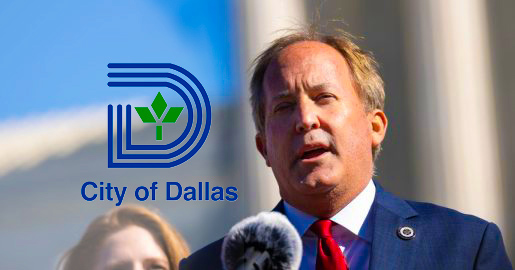
Texas Attorney General Ken Paxton speaks at a press event alongside the City of Dallas logo | Image by Drew Angerer/Getty Images and City of Dallas.
Texas Attorney General Ken Paxton has sued the City of Dallas, alleging the City failed to comply with Proposition U, the voter-approved charter amendment establishing police funding and staffing requirements, The Dallas Express has exclusively learned.
The lawsuit, filed February 13 in Dallas County district court, names the City of Dallas, City Manager Kimberly Bizor Tolbert, and Chief Financial Officer Jack Ireland Jr. as defendants. The lawsuit alleges the City violated the Dallas City Charter by improperly calculating excess revenue and failing to meet funding mandates established under Proposition U.
Voters Approved Charter Mandate
Proposition U went to the ballot after a citizen petition effort gathered more than 160,000 signatures from Dallas residents. As The Dallas Express previously reported, voters approved the amendment in November 2024.
The charter amendment requires the City to maintain at least 4,000 full-time sworn police officers. While the city planned to hire more officers in Fiscal Year 2026, its projected goal still fell short by 576 officers.
The charter amendment requires that if the City’s total annual revenue exceeds that of the prior fiscal year, no less than 50% of the excess be appropriated to the Dallas Police and Fire Pension System, in the amount directed by the State Pension Review Board or the City Council, whichever is higher.
The remaining excess revenue must go toward specific public safety purposes, including:
Increasing the total number of full-time sworn Dallas police officers to at least 4,000 and maintaining the officer-to-resident ratio established at the time of passage
Ensuring starting combined salary and non-pension benefits — excluding sign-on bonuses — rank within the top five of all city police departments in Dallas, Collin, Tarrant, Denton, and Rockwall counties with populations over 50,000, measured on a per-officer basis
The charter amendment broadly defines “revenue” to include all City revenue not restricted under state or federal law. It also requires the city to hire an independent third-party firm to perform an annual regional police compensation survey.
Revenue Calculation Dispute
The lawsuit alleges Dallas improperly calculated excess revenue for Fiscal Year 2025–26.
The lawsuit claims Ireland reported approximately $61 million in excess revenue to the Dallas City Council, based on a calculation that excluded certain categories of revenue. As previously reported by The Dallas Express, the City’s proposed FY26 budget relied on a General Fund-only calculation of excess revenue.
The lawsuit contends projected excess revenue for the fiscal year is approximately $220 million when calculated under the charter’s broader definition of revenue. The filing alleges this calculation resulted in the City falling short of Proposition U requirements.
The filing further alleges the City failed to comply with the charter amendment’s requirement to hire an independent third-party firm to conduct the annual police compensation survey, citing public information requests.
In January, Gov. Greg Abbott addressed the issue at a campaign event in Fort Worth after a The Dallas Express reporter asked whether the state would examine Dallas’ compliance with Proposition U.
“We’re going to be looking into what the City of Dallas has or has not done with regard to funding the police, and see if there’s a violation of the state law that I signed,” Abbott said to DX at the time.
The Dallas Express also specifically asked Abbott what he would do to ensure cities like Dallas hire enough police. In response, he pointed to legislation he signed in 2021.
“Dallas is bearing the burden of their failure to have fully staffed law enforcement, their failure to contain a homeless problem,” Abbott said to DX at the time. “We will defund any city that defunds the police.”
At the time of publication, city officials had not yet publicly commented on the suit.