
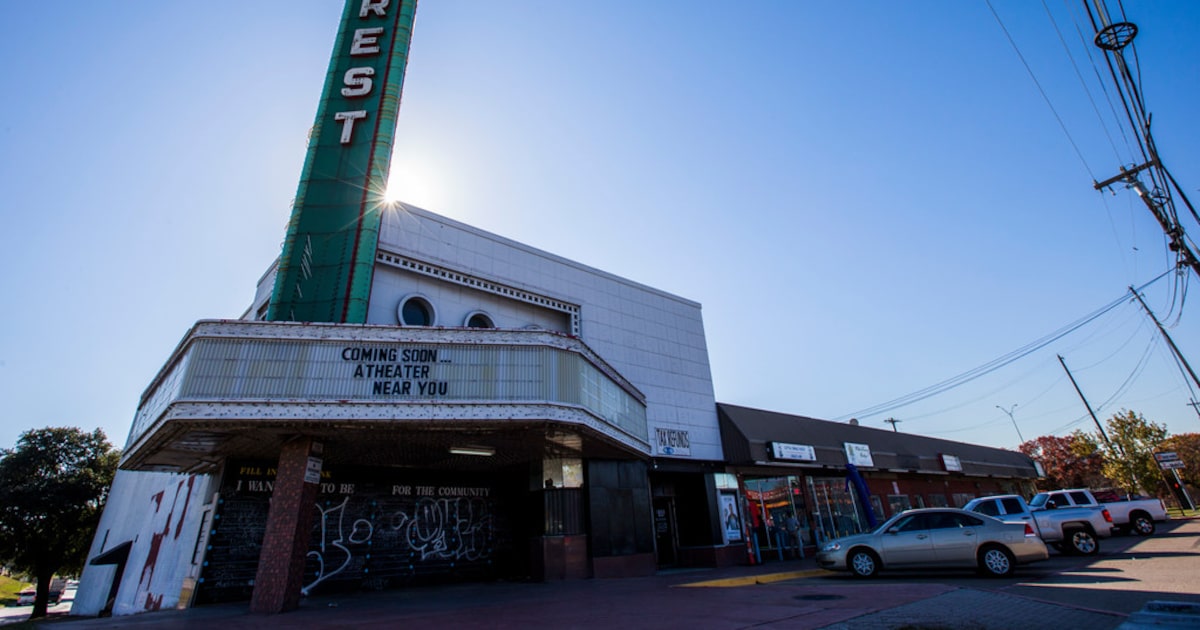
For Dallas’ Black community in the late 1950s through the 1960s, the Forest Theater was the place to see and be seen, recalls Shirley Rhodes, an 80-year-old South Dallas native who spent Saturdays there during her childhood while engrossed in the cinematic offerings.
The city’s Forest Theater, its iconic green-white-and-red spire soaring into the sky, has stood vacant since 2009, but it is poised for its latest reincarnation later this year.
February marks Black History Month, a time to examine historic monuments in Dallas that still hold significance for the city’s African-American community.
As that reopening date nears, some longtime residents have waxed nostalgic over its legacy as a beacon of entertainment in a community that was barred from patronizing other theaters in North Texas.
In the beginning, the theater catered to moviegoers eager to see stars on the big screen.
News Roundups
But as the decades passed and as the neighborhood changed, it morphed several times — into places of worship, a jazz club and an action packed nightclub during the 1980s that fueled the rise of the city’s budding talents like rapper Vanilla Ice.
Many residents have come to regard the Forest Theater’s presence as a living testament to the resilience of South Dallas.
The lone survivor and the Badu era
During its heyday, the South Dallas area was home to other theaters that closed their doors long ago, like the Dal-Sec located on Second Avenue. But those relics of history paled in comparison to the ambience — and opulence — of the Forest Theater.
To Johnnie Price, walking into the Forest Theater felt like stepping inside a royal palace.
Price, 83, was born in East Texas and moved to South Dallas during her early teen years. She said she always marveled at the velvet-looking carpet that lined the building’s staircase.
Rhodes, meanwhile, was wooed by the theater’s balcony, the marquee and lighting. “It was just a whole different atmosphere,” she said, so much so that guests dressed up for the movies.
Young girls and women wore petticoats and poofy skirts, while the boys and men donned cuffed jeans for the movie outings.
“We all wanted to look our best because … that was considered a grand place to be,” Rhodes said. “If you wasn’t there, your friends gone be talking about it Monday and you’re gonna feel left out.”
Imprinted in her memory also was the apex of the building’s structure — a “big round red ball in the sky” — that could be seen illuminated from miles away. It was a welcome sight, she said, that always reminded her she was home.
The Forest Theater opened in 1949 as an entertainment hub for South Dallas’ Jewish enclave. As African Americans moved into the neighborhood, in search of better housing in a city with limited options for them, white families fled to northern Dallas. . In its decades-long lifespan, the Forest Theater would open and close repeatedly as it shuffled through owners.
Erykah Badu ventured at resurrecting the theater in the early aughts, bringing big-name concerts and educational programs to the venue, which she described to The Dallas Morning News in 2004 as “really needed” and an “outlet for entertainment.” She ceased operations at the theater around 2008 or 2009, a move that came after she had spoken publicly about shouldering significant financial costs.
Elizabeth Wattley, CEO of Forest Forward, the nonprofit spearheading the the theater’s reopening, did not experience its heyday.
South Dallas community hub
Instead, she has absorbed the history of the theater via her father, who watched the 1959 movie Imitation of Life — in which a light-skinned Black girl passes as white to get ahead — at the venue as a young boy, and South Dallas community members who relayed jovial stories about baby shoots staged at the theater and future spouses that met there.
In the Forest Theater’s various iterations, Wattley said it has been a “community hub.” Its different business models, she said, evolved to adapt to the social and political economic circumstances of the neighborhood.
As the racial makeup of South Dallas began to shift, Rhodes said there was prejudice among some white residents unhappy with the influx of African Americans in the neighborhood.
“We never knew if something was gonna happen,” she said, but the Forest Theater was a haven where Black kids could be without parental supervision.
As an adult, Rhodes would once more patronize the building, when it was occupied by City Lights. It was a culture shock, she said, seeing how the theater’s rows of seats were replaced by tables. Still, she, alongside her husband, caught venerable musical acts like Tina Turner and B.B. King.
Rhodes can hardly wait until the theater reopens. “I hope I’m still here to be able to go,” she said.
Price has witnessed the permanent closure of several places that used to be on Malcolm X Boulevard, but not the Forest Theater. “It’s just a piece of South Dallas that didn’t leave,” she said.
 Dallas civil rights leader Juanita Craft’s birthday celebrated at African American Museum
Dozens gathered at the museum in Fair Park to honor the late civil rights leader.
 Food for the soul: Dallas’ Sweet Georgia Brown serves meals that nourish, hold history
The restaurant caters to the Oak Cliff community by offering Southern comfort food that can feed the entire family.
 Trump has reshaped U.S. historical and cultural institutions. Here’s how
His declarations and executive orders have led to the dismantling of slavery exhibits, the restoration of Confederate statues and other moves.