
In a moment when separation, division, violence, and institutional abuse rule the day, the sustenance of hope is being generated on the daily in communities of resilience and interconnection. This is what I found on a recent visit to El Paso, just days before that border city — truly two cities, or one contentiously international city, from any perspective — underwent a ridiculous but dangerous Customs and Border Protection-driven airspace scandal.
Debates will simmer on as to whether artmaking is a political act or a field that exists in a distanced bubble while difficult circumstances swirl around us. But in El Paso, what became readily apparent is that creatively-minded people are transcending the question through firmly grounded positive action. In the Les Sembrantes exhibition at the University of Texas at El Paso’s (UTEP) Rubin Center for the Visual Arts, and at The Falstaff Project, what was revealed is a concept of transdisciplinarity in which art is but one contributing factor, equal among others.
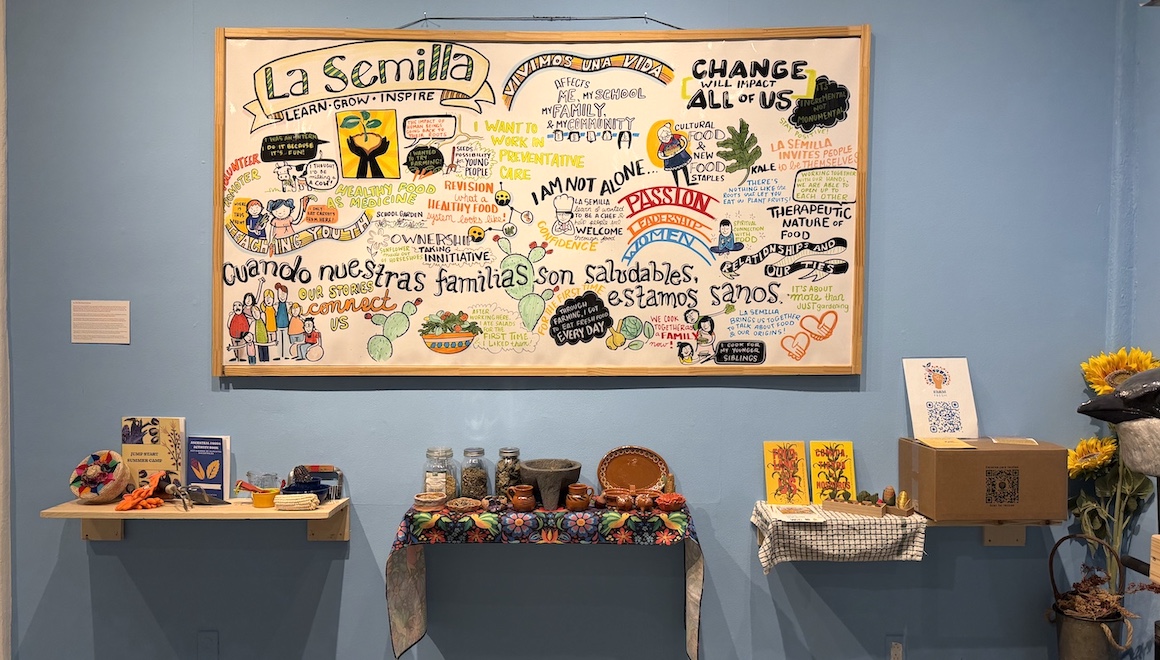
 An installation view of “Les Sembrantes” at the Rubin Center for the Visual Arts
Les Sembrantes, which translates as The Sowers, displays a mixture of artworks, research documents, and informational resources related to New Mexico-based La Semilla Food Center’s multivalent, cross-border work as a community farm, food distributor, Indigenous lifeways advocate, educational center, and cultural facilitator. The exhibition sprouted from La Semilla’s Chihuahuan Desert Cultural Fellowships program, which started in 2022, presenting work by four previous fellows: Janette Terrazas from Cohort 1 (spring 2022), Juan Pablo Fernandez from Cohort 2 (fall 2022), Amalia Mondragón from Cohort 3 (spring 2023), and Eva Gabriela Flynn from Cohort 3 (spring 2023). It is an art exhibition in an art gallery, yet it reaches beyond its walls in a way few exhibitions achieve or attempt. Under the direction of Rubí Orozco Santos, La Semilla annually invites a cohort of Cultural Fellows to work in their various fields in concert with the food center’s “agroecology” food sovereignty ethic and community farming practices.
Cultural Fellowship “tracks,” as they are referred to in the organization’s literature, include “foodways, performing & literary arts, visual arts, natural materials, advocacy, and additional types of practitioners and educators,” which illustrates the openness of the project, and a fundamental awareness of how deeply interconnected these seemingly disparate cultural practices actually are. Many artists and educators work within university and collegiate systems that delineate strict boundaries between disciplines, relegating printmakers to printmaking, photographers to the photo lab, painters to their studios, sculptors to workshops and foundries, designers to design departments, and so on. Some forward-thinking programs allow students to cross these boundaries, and other yet more progressive institutions dispense with them altogether. Even as I type the word “forward,” having experienced the profound perspective of La Semilla, I now question whether “backward” might be the more accurate, and most progressive term.
 An installation view of “Les Sembrantes” at the Rubin Center for the Visual Arts
In the helpful catalog prepared by the Rubin Center and offered free to visitors, La Semilla employs the term “agroecology,” defined thusly:
“Agroecology has been around for thousands of years and just recently acquired the name as we refer to it a few decades ago with its roots in ancestral foodways of Indigenous peoples. It can be understood as the integration of Traditional Ecological Knowledge or Ancestral Knowledge of farming practices into small-scale and biodiverse farming ….”
The definition continues, with a particular focus on the wider spectrum of how current politics can affect food distribution: “… while advocating for responsible governance, community control, and circular and solidarity economies. It should not be co-opted by the current industrial system. It is a path forward for the creation of local food systems where we create new community driven urban-rural links.”
Now reread that definition, replacing “agroecology” with “art,” and the most fascinating aspect of this confluence of art and culture emerges — at least to this observer, a white Midwesterner raised in a tradition of no tradition, with only a vague concept of heritage that disallowed any true connection to an ancestral past beyond a cloudy understanding of so-called European origins. And all this long while, I’ve similarly been operating as though art is a separable discipline from other cultural disciplines, as though the standard term “arts and culture” actually makes sense, as opposed to the more encompassing, more democratic “culture.”
La Semilla’s original Farmer Fellowship started in 2021 prior to the Cultural Fellowship. Orozco Santos recalled an early fellow presenting research on natural dyes, specifically derived from amaranth, which got her “thinking about ecology and and plants as sources of food and medicine, textiles, pigments, earthen wares,” and how artmaking processes are embedded within this larger sense of ecological processes.
 Janette Terrazas, “Bosque del Apache / Apache Forest,” “Keisling Park / Parque Keisting,” “US-Mex International Border / Puente Internacional entre México y EUA,” “Rio Bosque Wetlands Park / Humedales Rio Bosque,” “Big Bend National Forest / Parque nacional Big Bend,” cochineal dyed cotton, Rio Grande water pH test, Polaroid / cochinilla sobre algodon, prueba del agua del Rio Grande, Polaroid, 2024
Julieta Saucedo, La Semilla Farm Education Coordinator and co-curator of Les Sembrantes with Orozco Santos and Henry Alfonso Schulte, the Rubin Center’s Assistant Curator of Practice, shared her thoughts on “transdisciplinary practice” versus “interdisciplinary” practice. “In that sense, when you think of agroecology from the cultural practice” perspective, Saucedo said, “you are also seeing how this relationship that I have with the land is impacting my artistic production, or my cultural practice, and how this cultural background is also impacting my relationship with the land, and the way I choose to produce this artistic form.”
She pointed to the example of Terrazas, represented in the exhibition through multiple artworks and research documentation. With Raymundo Olivas, Terrazas created an adobe wall sculpture map of the Río Bravo/Rio Grande River Basin region, which stretches from Nuevo Leon in Mexico to southern Colorado, with a cochineal-dyed strip of fabric representing five of her research sites along the river. As is made apparent in her nearby series of framed, dyed fabrics, the color of cochineal depends on the pH of the water used to make the dye. By visualizing this, Terrazas raises awareness of how biochemical differences affect our water at various locations, influenced by many factors including soil texture, agricultural chemicals, and effluents. Water is life, and along the Río Bravo/Rio Grande, water is made a contentious border meant to divide even as the people of the land share cultures, traditions, values, and heritage.
An exhibition listing on Glasstire drew me to The Falstaff Project, a gallery within a cozy complex of buildings on El Paso’s south side. That Lovely Land of Might-Have-Been gathered 20 artists, all with some personal connection to Miguel Bendaña, the show’s curator. Bendaña ran the stellar gallery Queer Thoughts from 2012-2023, first in Chicago, then New York City, and in art fairs hither and yon.
 The Falstaff Project in El Paso
Bendaña was born in College Station, then grew up in upstate New York when his father relocated the family for a job, while traveling frequently to Nicaragua, where the family is from. As Bendaña progressed through his art adventures, his parents and sister settled in El Paso as their “American home base,” he said, and he eventually moved there in May 2025. Daniela Lastra, owner of The Falstaff, invited him to curate the inaugural exhibitions at the formal gallery in the complex, which includes artist studios, a café, and communal spaces, activated by ceramics workshops, what Lastra called “family dinners” for the community of tenants, and other events.
Originally from El Paso, Lastra spent years in Austin before moving back home. Importantly, though The Falstaff is a business, her goal was to “establish roots and build community,” and to “create an ecosystem.” As she explained, “it’s more than just having tenants and everyone doing their own thing. We really collaborate. We do an annual dinner where everyone gets together. People share ideas. They share resources. We’re really a wonderful family.”
 A Jueves de Barro community ceramics night at The Falstaff, hosted by Las Chicas del Barro, sisters Isabella Muñoz (at left) and Marlene Muñoz
(standing at right)
On the eight-hour drive home to San Antonio, I was reminded of the work of author Octavia E. Butler, specifically her 1993 novel Parable of the Sower, which peers into a not-too-distant American future — set in 2024! — beset by frequent climate change disasters, social division, and religious violence. The novel’s protagonist Lauren Olamina founds an alternative religion called Earthseed as a sanctuary against the chaos. Even as the novel’s bleakness makes it a difficult read, at its core is a resounding belief in maintaining hope despite debilitating circumstances.
adrienne maree brown, a renowned movement facilitator, somatics practitioner, and social theorist, reveres Butler for her fierce foresight and focus on embracing change with resolute action. In brown’s podcast Octavia’s Parables, she identifies the idea of a seed as potential and hope, but emphasizes the care required to give the seed a chance to root: “the number one thing, perhaps, that people need to awaken to is that sense of responsibility, that it’s not about what you critique in others, but that each of us has something we are responsible for, living into, practicing and doing, bearing, bringing into the world, that if we do not do it, it will not get done. It’s not like someone else can cover it. … Each of us has a particular responsibility for the whole.”
Each taking that responsibility in their own specific yet intermingled ways, community-building entities La Semilla, the Rubin Center, and The Falstaff are a firmly-rooted response to Butler’s hopeful vision and brown’s call to action. In their work, art is an essential contributing factor, equal among other fields of cultural production. On my first El Paso trip, transdisciplinarity felt like a natural outgrowth of this unabashedly transnational, transcultural region.