
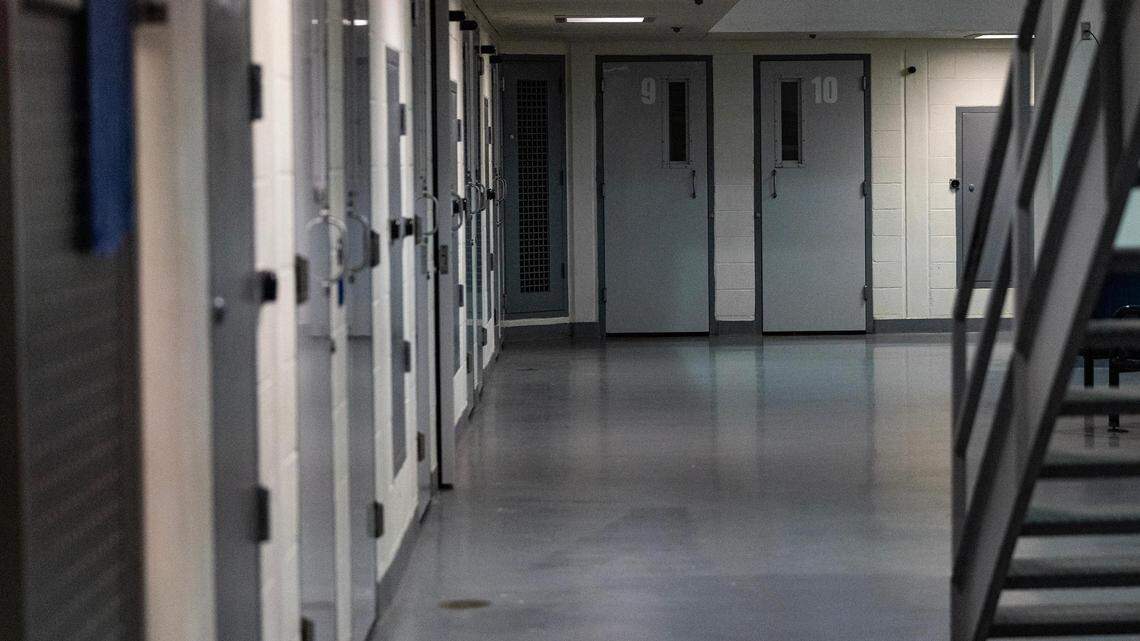
Jail cells at the Tarrant County Corrections Center in Fort Worth on Jan. 25, 2024.
Chris Torres
ctorres@star-telegram.com
Attorney General Ken Paxton issued an opinion on Thursday establishing limits on when an outside investigation must take place following a Texas jail inmate’s death.
State law requires the Texas Commission on Jail Standards to appoint an outside law enforcement agency to investigate inmate deaths. However, Paxton’s opinion specified that requirement only applies in cases where an inmate dies on jail property, as opposed to, for example, in a hospital while still in custody.
On Feb. 18, 2025, Kimberly Phillips died of malnutrition and dehydration at John Peter Smith Hospital while in custody of the Tarrant County Sheriff’s Office. Prior to her death, Phillips had refused meals over multiple days while in the Tarrant County Jail.
That same month, the Denton County Sheriff’s Office opened an outside investigation into Phillips’ death. According to records obtained by the Star-Telegram, that was at the request of the Tarrant County Sheriff’s Office, not the Commission on Jail Standards.
The Denton County investigation found no evidence Phillips was intentionally harmed while in Tarrant County custody.
Phillips, though, was one of more than 70 inmates who have died in Tarrant County jail since 2017, when Sheriff Bill Waybourn took office. The 2024 death of Anthony Johnson Jr. was ruled a homicide, and two jailers have been indicted on murder charges. In the case of Javonte Myers, who died of an untreated seizure disorder, two jailers were convicted of falsifying records saying they had checked on Myers, who lay on his cell floor for hours before anyone discovered him.
A Tarrant County Sheriff’s Office spokesman provided the Star-Telegram with a report that put Tarrant County’s jail deaths in the context of other Texas counties. The report points out that Tarrant County Jail has a daily average population of 4,300 inmates, with capacity for up to 5,015 inmates.
Tarrant County’s 73 inmate deaths since 2017 is less than the 109 in Bexar County, which encompasses San Antonio and has a similar jail capacity as Tarrant County, according to the report. There have also been fewer inmate deaths in Tarrant County than in Dallas and Harris counties, although those county jails have more capacity — 7,552 beds in Dallas County and 10,466 beds in Harris County, the report shows.
According to the report, there were 77 jail deaths in Dallas County between 2017 and 2025 and 140 in Harris County during that time frame.
With Paxton’s new opinion, which was issued to Tarrant County Criminal District Attorney Phil Sorrells, the Commission on Jail Standards is under no obligation to look into deaths like Phillips’. According to the letter sent from Paxton’s office to Sorrells, the opinion came down to the wording of the law.
“The language in subsection 511.021(a) makes clear that the Commission ‘shall appoint’ an independent law enforcement agency to conduct an investigation ‘[o]n the death of a prisoner in a county jail.’”
Paxton’s opinion hinges on those last four words — in a county jail. In Paxton’s opinion, in a jail means just that. Essentially, if an inmate dies while being transported someplace else or while being treated in a hospital, no investigation is required.
“We agree with the Attorney General’s interpretation and Tarrant County will continue to comply with the law,” Sorrells said in a statement.
The Tarrant County Sheriff’s Office spokesman issued a statement that included the following:
“We appreciate the Attorney General’s ruling regarding outside investigations. However, this ruling doesn’t eliminate the multiple investigations that currently take place when an inmate dies in custody.”
The statement went on to say that all in-custody deaths will be investigated by Tarrant County Sheriff’s Office jail staff, the Sheriff’s Office Investigations Division, the Tarrant County Medical Examiner’s Office, John Peter Smith Hospital medical staff, the Texas Attorney General’s Office and the Commission on Jail Standards.
Dallas attorney Dean Malone, who represents families of inmates who died in custody, issued a statement following Paxton’s opinion.
“This is an unfortunate decision and one which allows counties to avoid independent investigations if they can quickly transport a dying prisoner off of jail property,” the statement reads.
Malone characterized the opinion as providing a way for jails to avoid scrutiny and avoid responsibility for properly caring for inmates with serious medical conditions.
“And lest one think that this cannot happen, counties already regularly discharge people from custody when they know that the person is seriously ill and needs hospitalization,” Malone’s statement continued. “County jails do this to avoid the death occurring ‘in custody,’ thus avoiding responsibility for reporting the death to the Texas Commission on Jail Standards or Attorney General of Texas.”
The Tarrant County Sheriff’s Office spokesman refuted that, however.
“The suggestion that jail personnel would send an inmate to a hospital simply to avoid a death occurring inside the jail is entirely unfounded,” he said. “All medical decisions are made exclusively by the medical staff from John Peter Smith Hospital inside the jail. Detention personnel have no authority to determine whether an inmate should receive medication or whether they should be transported to a hospital.”
This story was originally published February 13, 2026 at 11:35 AM.
Related Stories from Fort Worth Star-Telegram

Fort Worth Star-Telegram
Matt Adams is a news reporter covering Fort Worth, Tarrant County and surrounding areas. He previously wrote about aviation and travel and enjoys a good weekend road trip. Matt joined the Star-Telegram in January 2025.