
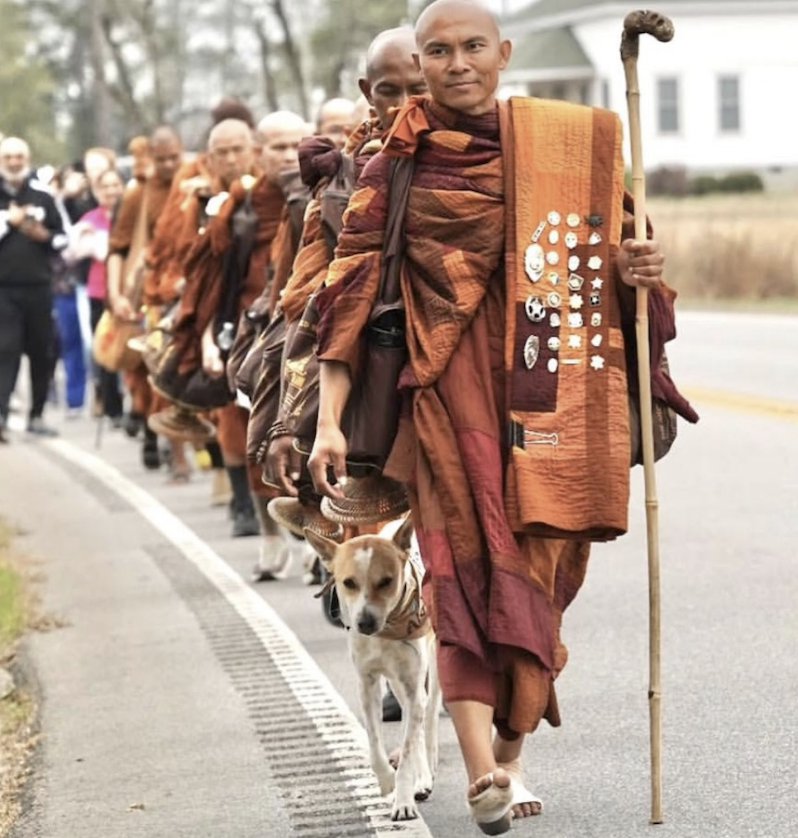
The rich blessings of what the American founders handed down was on full display in a 108-day walk from Fort Worth, Texas, to Washington, D.C.
A group of venerable Buddhist monks, led by Venerable Bhikkhu Pannakara of the Huong Dao Temple in Fort Worth’s Stop Six neighborhood, provided affirmation that faith traditions, even those far from our founding roots, still have urgent moral wisdom to offer the public square.
What was it that captivated a nation as these monks walked 2,300 miles? The Lord works in mysterious ways.
“Our purpose is very clear,” said Pannakara in an interview. “We are not walking to promote anything other than peace. Loving, kindness, and compassion are really needed. And these are the things that all religions teach. I feel grateful we have different religions to serve all kinds of people around the world. All the venerables, all the reverends, all the gurus, all the teachers, all teaching people how to live a better life, how to become a better person, a good person in this society.”
A gentleman by the name of Mike Bedenbaugh met up with them a few miles from his home in Prosperity, South Carolina, where he has lived practically his entire life, save for stints in the Navy and school at Columbia University.
“I’m driving down outside of Aluna, South Carolina, which is a very small rural county seat of only 3,000 people, and they’re 15 miles on the other side,” Bedenbaugh says by phone. “It’s very sparsely populated, and this church is out in the middle of nowhere, and a mile before the church, I start seeing people in parked cars. This is in the most red-district religious Bible belt buckle here in South Carolina, and there’s like 200 or 300 people standing around wanting to see these people. It was astonishing.”
The monks returned to Fort Worth on Feb. 14. They walked the six miles from the bus depot in downtown back to the temple in Stop Six. The monks are of the Theravada tradition of Buddhism. There are three lineages: Theravada, Mahayana, and Tibetan. Tibetan is best known for the Dali Lama.
“We and Tibetan tradition are totally different,” Pannakara said.
Pannakara said he came up with the idea of a walk to raise awareness of peace to all people “because I have seen so many suffering around me in Fort Worth, Texas, where I live.”
For two years during the pandemic, he said his temple gave out food to 750 families a week.
Pannakara told Bedenbaugh, who sat down with him: “I see a lot of people struggling with their life, not physically, but mentally. And then when I also travel around the world to do disaster relief, too, I see that, and I think that I should do something to support this country and the world. If I stay at the temple, then I only can support the small community. But when I do something, then I probably can meet with someone. Finally, I decided to take a walk.”
Pannakara said he simply expected to run into people along the way.
“I thought if they can see us, they can pause for a moment and they can look back within themselves and they feel peace, they feel joy. That’s enough. That’s all I expected at the beginning. I have never expected this turnout.”
Pannakara said he initially expected to walk back to Fort Worth, but he misjudged the mileage.
The walk, Pannakara said, was also meant to test how much pain he could stand — he walked most of it barefoot — stepping on nails, screws, and glass, among other things. The group also got caught in the brutal winter storm. One walker was hit by a car and seriously injured, resulting in leg amputation. Their dog — a stray adopted from India — also required surgery, though he returned to the troupe but carried on in a car.
The monks stayed in a Methodist church that night in South Carolina. The next day after a 15-mile morning, they stopped in Saluda, South Carolina, a town of a little more than 3,000.
“He stood on the steps of the courthouse, and there’s 1,000 people in the yard,” says Bedenbaugh. “I tell you, sitting down with those people and seeing what they were communicating, especially the monks, I saw more connectivity to what Christ taught than I have in a lot of churches I’ve been in.”
Bedenbaugh said there were tears in the eyes of listeners.
“He said I know I’m doing the right thing when I see what’s happening here, to see all these people. He didn’t say this. I am, but you think we’re in the middle of redneck town, and that’s not a derogatory comment. I mean, these are people of the earth, blue-collar workers, and here they are out here just wanting to touch the energy of peace. It was amazing.”