
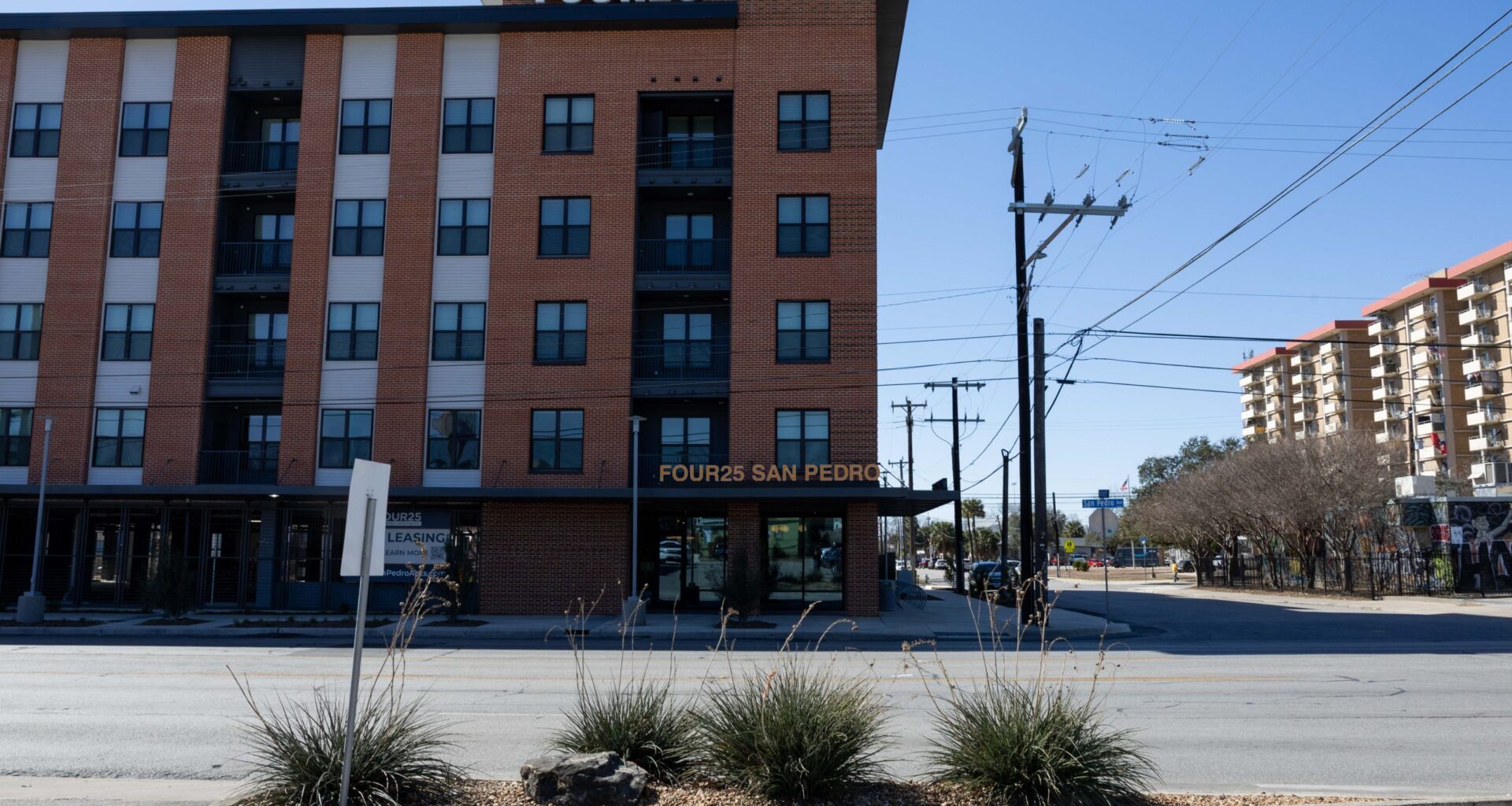
When Patricia Davis saw the Four25 San Pedro complex rising up in her neighborhood, she knew she wanted to move in.
She reached out as soon as the building started leasing. The new affordable housing units were safer, more spacious and had more amenities, said Davis, a 66-year-old retired home healthcare worker.
Davis didn’t want to move out of her neighborhood. She was close to bus lines and parks, just north of downtown near San Pedro Avenue, and she wanted to stay in the area and have an affordable rent.
The units at Four25 San Pedro, a new affordable housing development, accomplish that.
“I’m going to love every minute of it,” she said.
The 80-unit complex is now open. Residents are moving in.
It took years to build — funding for this type of affordable housing complex was part of a 2017-2022 city bond package. The San Antonio Housing Trust worked with other nonprofits, businesses and the City of San Antonio to put together a structure for funding and support services and finally broke ground in 2024.
Now that the nonprofit housing trust has a blueprint for building affordable housing projects, it plans to build more, said Pete Alanis, the housing trust’s executive director.
Residents at Four25 San Pedro will live in spacious two- or three-bedroom units designed for wheelchair and disability access. There is a gym, common areas and a play structure within the complex, which is designed specifically for families.
There are also permanent supportive services on site. SAMMinistries, a local nonprofit, will have offices, staff and a food pantry for residents of the building. One full-time and one part-time case manager will work there, helping residents build more stable lives.
Four25 San Pedro isn’t the first permanent supportive housing site in San Antonio. Towne Twin Village opened in 2023. SAMMinistries has been providing permanent supportive housing services at individual apartments since 2010, said its president and CEO Nikisha Baker. Nonprofits and local governments are pushing to build projects that are designed to have residents and services in the same place.
What does permanent support look like?
David Urdiales is one of the case managers who provides those specialized services in San Antonio.
He’s worked as a case manager for SAMMinistries since 2023. He won’t be working at Four25 San Pedro — his work is focused on single individuals experiencing homelessness, not families — but the model he uses is the same.
“Our number one job is making sure our clients stay housed. Everything else is secondary to that,” he said. “There’s not a cookie-cutter response.”
Urdiales works with 17 different clients who are being housed after experiencing homelessness. There’s no sunset on his services — they can have a case manager as long as they want. That’s what makes it permanent supportive housing.
He helps clients with whatever goals they have. That can be getting a job or enrolling in college. It can also be applying for a driver’s license or a new social security card. Starting over in a new home can be an overwhelming experience, Urdiales added, and case managers at SAMMinistries support people through that.
“Once they get housed, it’s hard for people to adjust,” Urdiales said. “If you’ve been living on the streets, you’ve been living in fight or flight [mode].”
Urdiales said clients have to get used to living in a home and often have to find new communities after they leave the ones they inhabited while homeless.
“We tackle every aspect of a person’s life. If there’s something they want to do, we help them with that. That could be family reunification, document recovery or going to H-E-B,” he added.
Soon after a client is housed, Urdiales said, SAMMinistries conducts a bio-psycho-social assessment. It’s a thorough process that covers sensitive personal topics, he said.
“We don’t do it immediately at move-in,” he said. “We want to build trust.”
Once that assessment is complete, case managers better know how to work with their clients on their specific goals. They meet once a month, at minimum. Clients can exit the program if they are stable, Urdiales said, but they don’t have to.
“Success can look different for different people. There are some people who will be in permanent supportive housing for the rest of their lives,” he said. “And that’s okay.”
Who gets services? Who can move in?
Baker, who oversees SAMMinistries, said all residents at Four25 San Pedro can talk to the case managers like Urdiales and access services they provide.
But 25 units at the development are set aside for families exiting homelessness and will work with SAMMinistries before they even move in.
That program is a collaboration between SAMMinistries and Opportunity Home San Antonio. OHSA is providing federal housing vouchers, also called Section 8 vouchers, for those 25 units. Those families pay a percentage of their income, rather than a set rent.
To qualify for the program, they must be homeless or fleeing domestic violence and must not have been terminated from public housing programs for the previous five years or committed violent or drug-related crimes in the last seven years, according to a program description from SAMMinistries.
The rest of the apartments are for families making less than 30%, 50% or 60% of the area median income. Rents are based on family size and income, Alanis said.
For example, rents for a family making 30% of area median income living in a three-bedroom apartment might pay $556 a month, while residents of a two-bedroom apartment making 60% of the area median income could pay $1,172.
Area median income is dependent on local income data and family size.
Those requirements make applying for an apartment a little more complicated, said Ryan Baldwin, senior vice president of Franklin Development, the company that will operate the apartment complex.
“It’s a little bit heavier paperwork-wise. There’s a few more forms,” he said. “But it’s really not that much more intense than going to a market rate.”
Baldwin and his team are available to help people with those applications, he added. Prospective residents can drop by in-person or go to the project’s website to learn more.
A blueprint for more affordable housing
Alanis said Four25 San Pedro meets many of the San Antonio Housing Trust’s goals. There are safe spaces for children and food assistance onsite to help cost-burdened families.
Beyond being affordable for low-income renters, its location is ideal. The new apartment complex is on San Pedro Avenue, giving residents easy access to the soon-to-be-built VIA Green Line, and close to downtown jobs and activities.
Alanis said building Four25 San Pedro involved multiple stakeholders: Franklin Development, SAMMinistries, the City of San Antonio, which provided $8.5 million and used dollars from its 2017-2022 bond, and USAA, which helped facilitate tax credit financing.
San Antonio Housing Trust also had to work with local residents, who were initially skeptical about Four25 San Pedro to create a project that fit with the neighborhood.
Ryan Wilson, a senior partner at Franklin Development, said that kind of collaboration is essential. Affordable housing has a gap between income — how much is generated in rents — and the cost to build large projects. That usually requires multiple funding sources.
Wilson added that while Franklin Development knows how to build and manage an apartment complex, it needs know-how from groups like SAMMinistries to help residents succeed.
It took years for that plan to come together, Alanis said, but now that blueprint is in place for other projects.
“What we’ve learned from here, we’re now taking and we’re applying that throughout the city,” he said.
His organization is carrying that to Commons at Acequia Trails, a 200-unit permanent supportive housing complex that is expected to cost $56.2 million to build. Alanis said San Antonio Housing Trust is looking at other projects on Buena Vista Street on the West Side and at Vida on the South Side, as well.
“This is the kind of solution that we need in our community,” Baker said. “It not only helps to lower the numbers of those experiencing homelessness, but it increases our ability to meet families and individuals where they are in their times of crisis or time of need, so that children are not disrupted, so that households are not disrupted, so that our workforce maintains strength and stability.”