
FRISCO — For months, the attacks seeped onto social media, often framed as questions. Why do they not assimilate? Where do they work to afford their luxury homes? Is our town becoming an ethnic enclave?
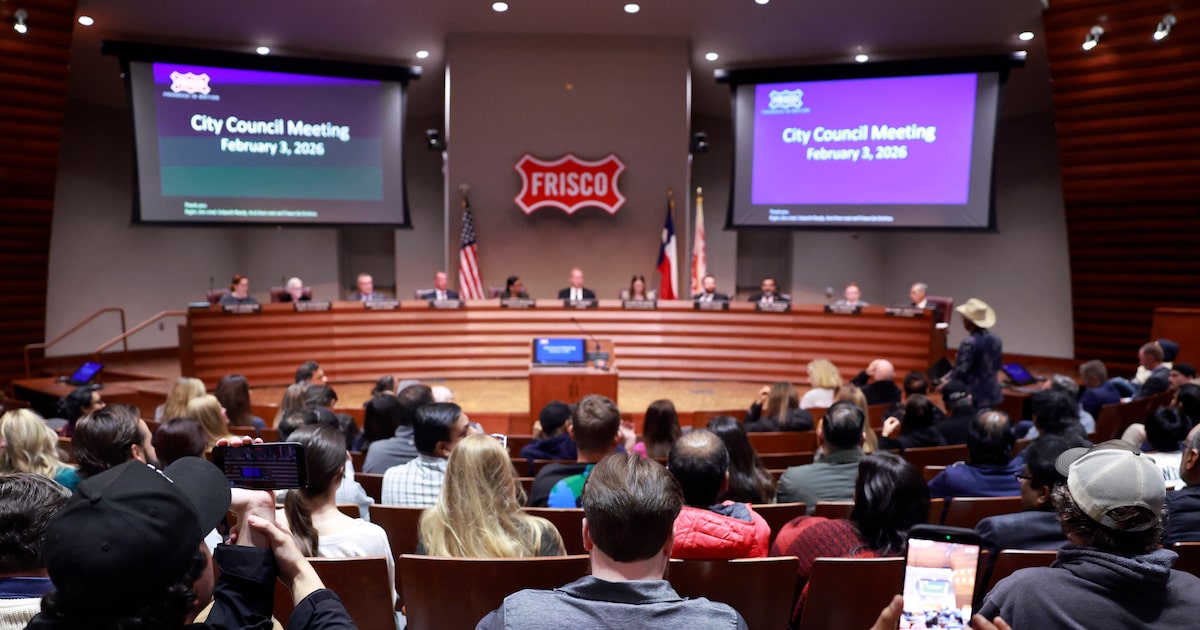
The tensions festering on platforms like Reddit and X erupted this month at a Frisco City Council meeting. Roughly a dozen speakers, some wearing “America First” hats, railed against what they called an “Indian takeover” to raucous applause.
Some argued without evidence that Indian Americans were committing visa fraud, echoing recent charges from Texas Republicans, and stealing jobs from Americans whose ancestors emigrated longer ago. Many said the fabric of their neighborhoods had changed so dramatically they no longer recognized the streets they call home.
That meeting plunged Frisco — an affluent Collin County suburb known for high-ranking schools and a thriving business climate — into the precarious national battleground over race, identity, immigration and opportunity. It also illustrated how legal immigration has come under a microscope as the Trump administration executes a sweeping plan to arrest and deport thousands of migrants.
Breaking News
City leaders and Indian American residents sharply rejected what they called dangerous and divisive rhetoric. Both largely blamed outside agitators, noting that conservative influencers urged people to attend the meeting and several of the speakers came from surrounding towns.
“Hatred and fear are everywhere right now,” said Nick Gupta, 48, a real estate developer who moved to North Texas from New Jersey in 2024. “This is not only a Frisco issue, but it has come to Frisco.”
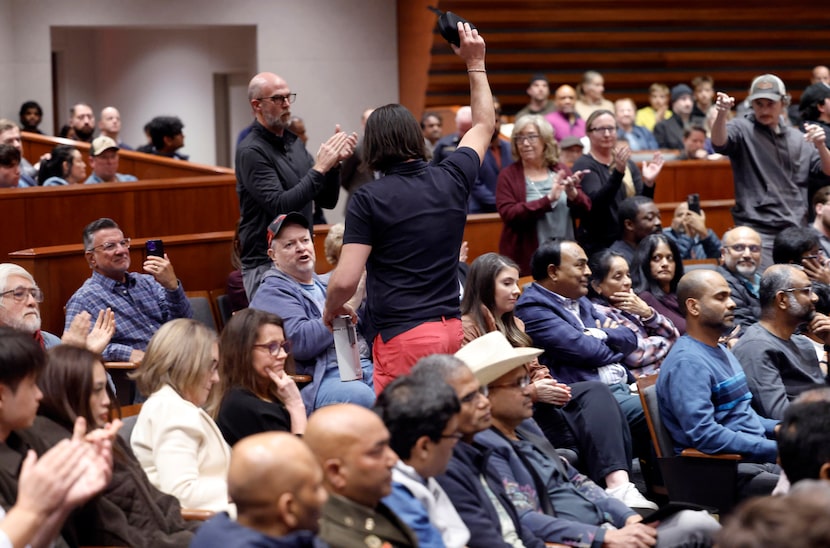
Marc Palasciano of Garland waves to supporters who cheered after he spoke out about the growing number of immigrants on H1B visas in Frisco during a Frisco City Council meeting at the George A. Purefoy Municipal Center in Frisco, February 3, 2026.
Tom Fox / Staff Photographer
Explosive growth
Once a tiny farming town, Frisco’s population exploded in recent years. From 2000 to 2026, the city grew from 33,000 residents to more than 245,000, a roughly 640% increase. Asians made up just more than 2% of the town’s population in 2000, according to U.S. Census data. Now, they account for 33% of its population.
The boom in the Indian population was not mere coincidence. In 2008, an influential spiritual leader, Sri Ganapathy Sachchidananda Swamiji, blessed a 10-acre piece of old farmland, which he said had “good vibrations.” Construction on a temple soon began, and in 2015, the Karya Siddhi Hanuman Temple opened. It is one of the largest Hindu temples in Texas, hosting cultural festivals, faith services and yoga, art and dance classes.
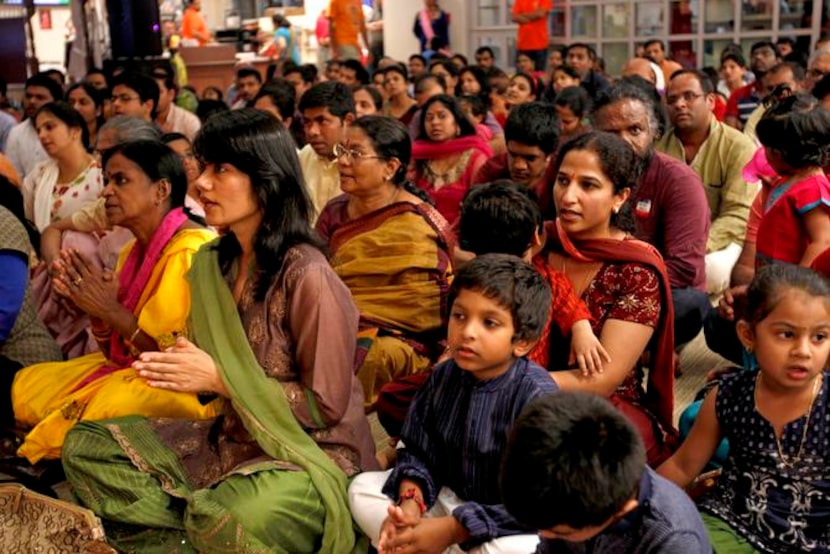
A crowd participates in the Diwali celebration at the Karya Siddhi Hanuman Temple in Frisco.
Kirsten Kearse
Meanwhile, Collin County emerged as a corporate magnet, attracting companies such as Toyota, T-Mobile, JP Morgan Chase, FedEx and more. This year, AT&T announced plans to leave downtown Dallas and build its global headquarters in nearby Plano, just two miles from the Frisco border. That business growth drew workers, many of whom have science and technology backgrounds.
Muni Janagarajan, a software engineer originally from India, moved to Texas in 1996 and settled in Plano before moving to Frisco in 2013, like many drawn by the reputation of the school district. He is now running for a seat on the school board.
Frisco’s schools are central to the city’s success. With more than 60,000 students, it is the largest district in Texas to receive an A ranking from the Texas Education Agency. Last year, it was home to the highest number of National Merit semifinalists in the state, and its average SAT score was more than 160 points higher than the state’s average. About 85% of students go on to attend a college or university after graduation.
When Janagarajan moved here, corn fields still dotted much of Frisco. But he could see the city was changing, and fast. Since then, those corn fields have been replaced with gleaming office buildings, Indian grocers, high-end shops and luxury subdivisions.
Janagarajan threw himself into the community, volunteering as a school crossing guard and serving as director of his neighborhood’s homeowners association. Frisco is his home, he said, which made the anti-Indian rhetoric painful.
“I’ve been heartbroken and embarrassed by the hateful rhetoric directed toward us,” said Janagarajan, 54. “People move to Frisco because of the cultural diversity. This is a strength, not a weakness.”
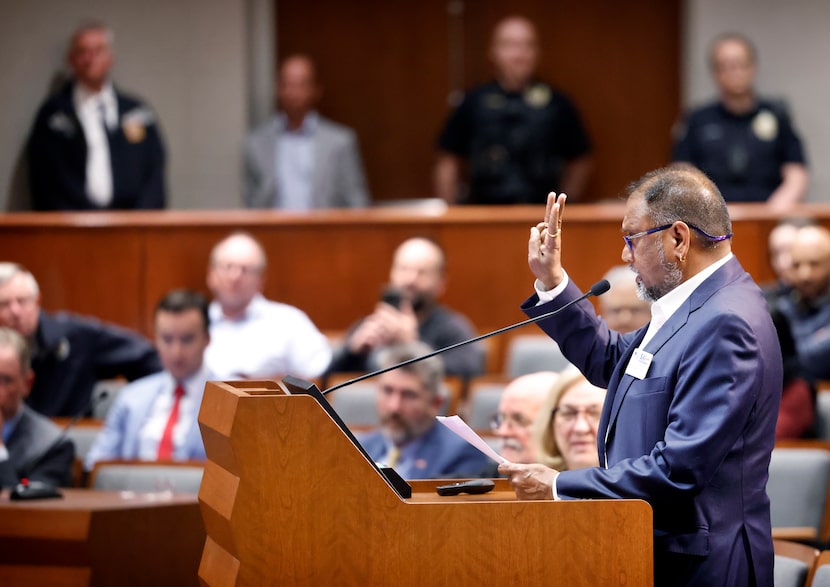
Jagjit “Jags” Malhotra speaks on the topic of immigrants on H1B visas in Frisco during a Frisco City Council meeting at the George A. Purefoy Municipal Center in Frisco, February 3, 2026. The activists have called the surge of South Asians immigrants on H1B visas an “Indian takeover” of the city.
Tom Fox / Staff Photographer
H-1B visas under fire
Marc Palasciano was born and raised around Dallas, and the first thing he wants to make clear is that he is not racist. He does not subscribe to either political party and considers himself “a man of the people.”
After leaving his job at T-Mobile in 2023, Palasciano became a self-described independent journalist and whistleblower. He said he is simply tired of the way corporate America treats Americans.
At some point, Palasciano, who lives in Garland, believed social media outlets were shadow-banning him, or restricting his profile’s visibility. Frustrated, the 42-year-old got the idea last spring to speak to the Frisco City Council, ensuring his thoughts would be included in a public record. (Frisco is home to his former employer.)
When H-1B visas emerged as a contentious issue, Palasciano urged followers on X to attend the Frisco meeting with him to challenge the program, which he believes hurts American workers. A conservative influencer shared one of his tweets, and he soon found himself in a packed room of residents, some angry and others hurt and disappointed.
“This isn’t about race. I have nothing against Indian people,” he later said. “But what’s going on in Frisco is not diversity. When a specific group of people explodes in population, something is happening.”
Alongside Palasciano, speakers assailed the influx of Indian Americans, from accusing them of snatching the American Dream to criticizing their driving skills and even blaming them for traffic. Repeatedly, they said opportunities for themselves and their families had disappeared while Indian Americans prospered.
“Frisco is changing at a speed that no community can absorb without damage. When lifelong residents voice concern, we are told our concern is bigotry,” said Dylan Law, a student at the University of North Texas who lives in McKinney. “That is a lie. It’s not hate. It’s a love of home.”
Many focused their ire on H-1B visas, which allow companies to recruit and hire foreign workers in specialized fields. Passed in the early 1990s, the visa program was signed into law by then-President George H.W. Bush with broad bipartisan support to recruit highly skilled foreign professionals.
More than 17,000 new H-1B visas were initially approved in Texas in the 2024 fiscal year, according to federal data analyzed by Bloomberg News. In Frisco, 917 were approved the same year, the eighth-most among Texas cities. In comparison, more than 2,000 were approved in nearby Richardson; nearly 1,900 in Irving and about 1,700 in Dallas.
Indian applicants accounted for 71% of approved applications that year, according to federal data. About 12% went to applicants from China.
With the program in the political crosshairs, few businesses are willing to discuss how they use or benefit from these visas. Several companies with headquarters or large offices in North Texas, including Infosys, AT&T, Texas Instruments and T-Mobile, declined to comment or did not respond when asked for details.
Immigration experts say these visas are critical, though. The United States simply does not have enough workers to fill jobs, particularly in science, math and engineering, said Laura Collins, director of the Bush Institute-SMU Economic Growth Initiative at the George W. Bush Institute.
“If a company is taking the time to hire an H1-B worker,” Collins said, “there’s likely a compelling reason.”
Hiring only American workers would require a substantial investment in education and would take years, experts say.
Filing and legal fees to obtain an H-1B visa can amount to tens of thousands of dollars, said Karen Pollak, a Dallas immigration attorney who helps companies navigate the laborious application process. Last year, the Trump administration announced an additional $100,000 fee on some H-1B applications.
The federal government also requires companies it considers “H-1B dependent,” meaning they have a large share of these visa holders, to first recruit domestic candidates. Employers are also required to pay H-1B workers at least as much as the wage of similar workers or the prevailing wage.
The lottery program is capped at 65,000 visas per year, with an additional 20,000 reserved for people with advanced degrees.
“The idea that this is stealing jobs from Americans is nonsensical,” Pollak said. “We are just in a very anti-immigration climate right now.”
In Frisco, many accused the visa holders of scamming the program. Accusations of widespread H-1B visa fraud have not been substantiated, and cities have no control over the H-1B program, which is administered by the federal government.
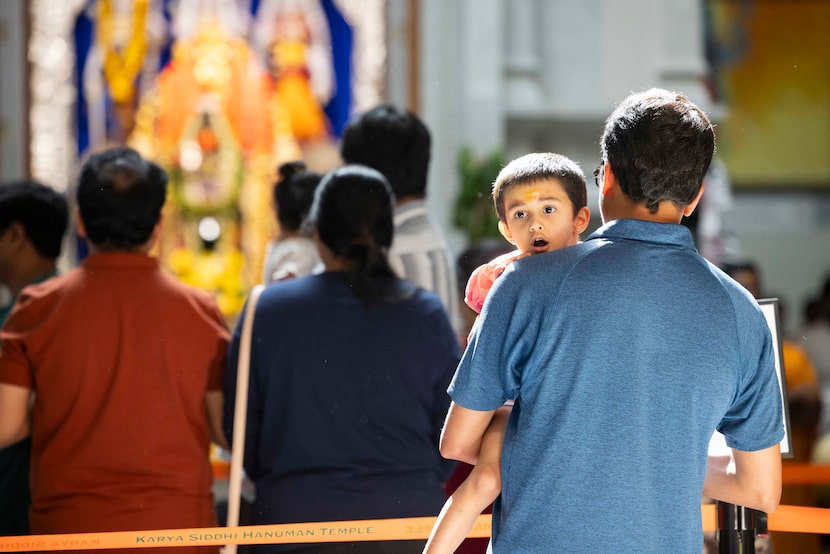
Ravichandran Balashanmugam holds daughter Vaira, 3, while visiting the altar of deities Sri Karya Siddhi Hanuman and Sri Ram Parivar at Karya Siddhi Hanuman Temple in Frisco on Saturday, Aug. 5, 2023.
Juan Figueroa / Staff Photographer
The visas have faced growing scrutiny by Republican lawmakers in recent months. Gov. Greg Abbott directed public universities and state agencies to freeze new H-1B visa applications until May 2027 so lawmakers can add “guardrails” to the program. Attorney General Ken Paxton announced he was launching an investigation into three North Texas companies following reports they set up sham businesses to sponsor H-1B visas. Paxton has not publicly disclosed the businesses or where they are located.
‘MAGA influencers rallied Frisco’
Coverage of the Frisco meeting extended far beyond North Texas. In India Today, an English-language news magazine in India, a headline read, “Right-wing turns Frisco council meeting into H-1B showdown.” The Times of India, the country’s largest English-language newspaper, reported “MAGA influencers rallied Frisco residents on social media.”
Still, the meeting — and more precisely, where the city goes from here — is being dissected by neighbors, on social media, at places of worship.
Billy Echols-Richter, who founded Grace Avenue United Methodist Church in Frisco in 1999 with his wife, Laura, is part of an interfaith alliance with other Christian, Hindu, Jewish and Muslim faith leaders. That work has taken on more urgency.
“We are not suspicious of one another, and we are not afraid of one another,” Echols-Richter said. “We see our neighbors as an asset regardless of religion, race or background.”
Danny Mehta, who owns the Game Show Experience in downtown Frisco, runs a Facebook group disseminating information to the local Indian community. Before the meeting, he said, people were nervous, many asking him if they should worry. “Let’s see how our leaders respond first,” he told them.
During and after the meeting, most city leaders unequivocally denounced the anti-Indian sentiment. Mayor Jeff Cheney wrote later on Facebook that it was perhaps the toughest meeting he has sat through in his 20 years on the council.
“When you choose to call Frisco home,” he said at the meeting, “it will always be our mission that you feel welcome here and safe here.”
Mehta, 53, felt palpable relief.
“I’m not worried about going forward. Yes, there is hate. There’s a lot of division,” he said. “None of that’s really new. What matters is how we respond to it.”
Community leaders could have more opportunities to respond. The next Frisco City Council meeting is Tuesday, and Palasciano said he plans to return.
Data and interactives intern William Tong contributed to this report.