
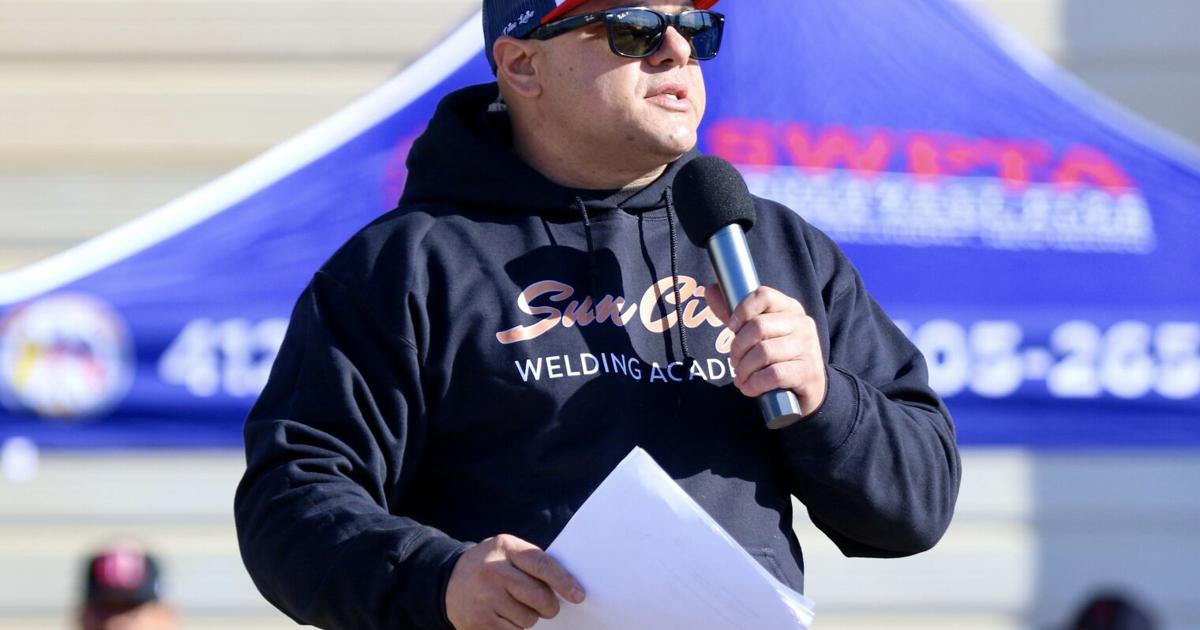
Scott Herndon is a quiet person with a big vision.
Born in Northeast El Paso, he had a rough upbringing. He dropped out of high school, tangled with the law and was a father by the time he was 16.
Taught the skill of welding by his father, Herndon leaned on that trade to build a reputation as a capable steelworker. He earned a living in the sweaty trade of grit and sparks, traveling for jobs across the Southwest.
He took his experience gained on oil fields and construction sites and opened Sun City Welding Academy in 2021.
Since then, Herndon’s welding academy has become a respected fixture in the local trade industry, preparing students for the rigors of turning slats of steel into the sturdy frames and pipe mazes that support homes and industry in this area of the country.
“We’re in a nice region where you’ve got eastern New Mexico, and that’s really active for mining, oil, gas, ranching, and West Texas, the same,” he said.
With a growing student roster, he’s sending his graduates to help construct all sectors of commerce.
“We want to build the city, and we want to build the region,” he said. “We’re seeing a lot of them get employed with infrastructure and construction projects. We’ve got people at Vinton Steel, we’ve got people on the Meta projects, the data centers, and whatever’s being built on Fort Bliss,” said Herndon, crediting Local Union 412 out of Albuquerque for support and job placements.

Photo by Herman Delgado
Herndon, 41, is also the founder and lead organizer of the annual Sun City Welding Academy Texas High School Welding Series Build Off – a competition for student welding teams across Texas and New Mexico vying for top placements, job opportunities and cash awards.
He recently sat down with El Paso Inc. to talk about the value of a skilled trade in a changing economy, the impact of artificial intelligence on his industry, and the opportunities for young people – in college or not – that are available through welding.
Q: We’re on the cusp of another high school welding competition. What year is this for the welding competition?
This is going to be our fifth annual Texas High School Welding Series build-off.
Q: Compared to your first competition, what’s that evolution been like?
It’s been two things that I’ve noticed. On the skill set of the students, and on our planning the event. We’re a little bit more relaxed; we know what to expect on our end.
We’ve got to remember the students are in high school. Let’s try to bring it down to help them out, to be successful and not set the bar so high.
It’s awesome because we see new students, and then we see recurring students. We have students who will be graduating, and it’s going to be their last build-off. They’ve done three build-offs in a row, and this is something that they’re going to want to pursue.
So being that gateway for them is a blessing. And then you see, every year, new students. They are intrigued to be part of the welding program. And that’s a blessing, also. The evolution has been good.
Q: It must feel rewarding to see students come back and to bring in new ones to start that cycle into the El Paso workforce.
It’s been good. We’ve already had students who participated in the build-off come back to Sun City Welding, but now they are in the workforce. We’re starting to see that growth – more participants, alumni and now workforce. So it’s been great.
But for our students, there’s a lot more I wish we were able to do to make them more skilled all-around, more diverse.
Q: What’s the philosophy behind that success?
We don’t try to sell them a dream. We let them know this is a gateway. This is a foot in the door. We tell them, you still have a lot more to learn outside of Sun City.
Q: When you see a group of new students coming into the academy, what does that mean to you?
Well, that might mean some of these students aren’t looking at college. Some of these students might be looking to go an alternate route. Seeing new faces every year is a good thing because we’re giving them that plan B. We’re giving them that insight of maybe college isn’t for you, but here is another option, another route you can follow.
Q: How valuable is it for students who don’t want to go to college to see that there’s another path, and that they know that they can still earn a living without college?
It’s very, very, very valuable, myself being a product of that background. Degrees are important. But I think we got sidetracked, where people were going for degrees, and the degrees meant something to them. But somewhere in there, people just started going for degrees just to go for degrees.
But now with degrees, there are student loans and debts, and not being able to find jobs and stuff like that. So in that time, we started talking about trades, and focusing back on trades and starting to see that decline in tradesmen.
So to have that education is very important. But it’s also important to give an individual a skill set where they can use their hands. That’s very important.
“It’s also important to give an individual a skill set where they can use their hands,” said Herndon.
Photo by Herman Delgado
Q: What are your thoughts on artificial intelligence?
We’ve been hearing about AI, even when I was in the industry 15 years ago. So that scare tactic has been there since I was there. You still see the industry the same as it was when I was in it. But the fundamentals of welding are still there.
Q: You don’t think AI can replace welding jobs?
You can have automatic welding on repetition components – your manufacturing, your production line, stuff like that. Automated welding has been around for generations.
But maintenance, new construction, that is stuff where you’ve got to actually have that human interaction, that intellect. We can go hand-in-hand with AI. There’s a lot of AI that we use in our industry to give us data, and then we go in as the human and execute.
But what we do in pipe welding, I don’t think you’re ever going to be able to simulate that through AI.
Q: The talk has been that AI is going to put people out of work, and you don’t see that for your industry?
Back when I started, they would say it was going to put us out of a job. They would say, well, in 10 years, everything’s gonna be automated and you’re gonna be out of a job, it’s gonna be hard to look for work. But, it’s crazy because you see the exact same processes now in welding.
I don’t think that’s ever going to change.
Q: After all that was said, what is the reality now?
That talk turned out to be crap, a bunch of statistics that they were just throwing out there. Typically, in our industry, even with the automated welding, there’s still an experienced welder behind that machine.
You still need that human aspect. I don’t think you’re ever going to take that away.
Q: For those young people who are hearing about AI taking jobs, and who are leery about getting into the trade industry, what would you say to them?
Well, if you’re coming into a fork in the road and you don’t know what you’re going to do in college, I recommend a trade, no matter what. It’s a long-term career, and the money’s going to be there.
You can use it to survive while you’re trying to figure out what the next step in your life is going to be. More importantly, if you’re looking at welding, we’re never going to be phased out.
Q: You mentioned the high cost of traditional college and the debt that graduates often have. With a trade school, what type of debt are they looking at?
Getting into a trade, you can have that fully paid off within five years, easy. For example, we were at a $15,000 tuition price. And we already have students out there, alumni out there, making more than $120,000. So $120,000 compared to $15,000 tuition. That can be paid off within six months.
It just really goes to show how, even up at a $30,000 price range for a trade school, how little that is compared to what you can do within the industry within a handful of years.
Q: That’s a big return on investment. Why do you think that trade school formula isn’t talked about more?
Maybe it’s still the remnants of people looking down on trade schools for whatever reason.
Q: Do you feel any frustration that more people don’t understand the value of trade education and careers?
Well, I would say people are not educated on that.
Q: For those students who are in engineering programs at college, how important do you think it is to have a full welding training program? Do you think it would make an engineer more marketable?
(With a laugh) Well, engineers need heroes too. That’s why they made welders.
It’s very important because it gives them a different insight. It’s not just theory; it’s not just what’s on the screen. I preach trades and skills because it gives them that common sense. In our industry, you want to work smarter, not harder. So by learning that aspect of it, it’s going to go hand-in-hand with what they’re doing. It’s very important. It is very marketable.
We would love to have more engineers come through our program and get that hands-on aspect of it because they’re going to know what it takes to build what they’re engineering.
Photo by Herman Delgado
Q: How effective would it be to have a co-op with area universities to provide engineering students with a fundamental education in welding?
Our business name is Sun City. We want to build the region. We want to build the city, so we would love to have co-ops.
Q: Growing up, you had a rough childhood. Did going through that hardship give you any lessons that have helped you in what you’re doing?
The only thing that it showed me was survival. At the end of the day, you’ve got to survive, you’ve got to eat. That transformed me into being hardworking. It didn’t matter what you had going on, it didn’t matter how you felt, you made sure you’re there at 5:30 in the morning, right? You’ve got to make sure you get a paycheck.
When you’re young and you’re going through hardship – and it doesn’t matter if it’s self-inflicted or the circumstances – it just shows you how to survive. By all means necessary, you’ve got to eat.
Q: Looking from where you are and what you’ve accomplished, what would you say to that younger version of you?
Give yourself some grace. It’s not the end of the road. Learn a skill, and more importantly, make good decisions.