
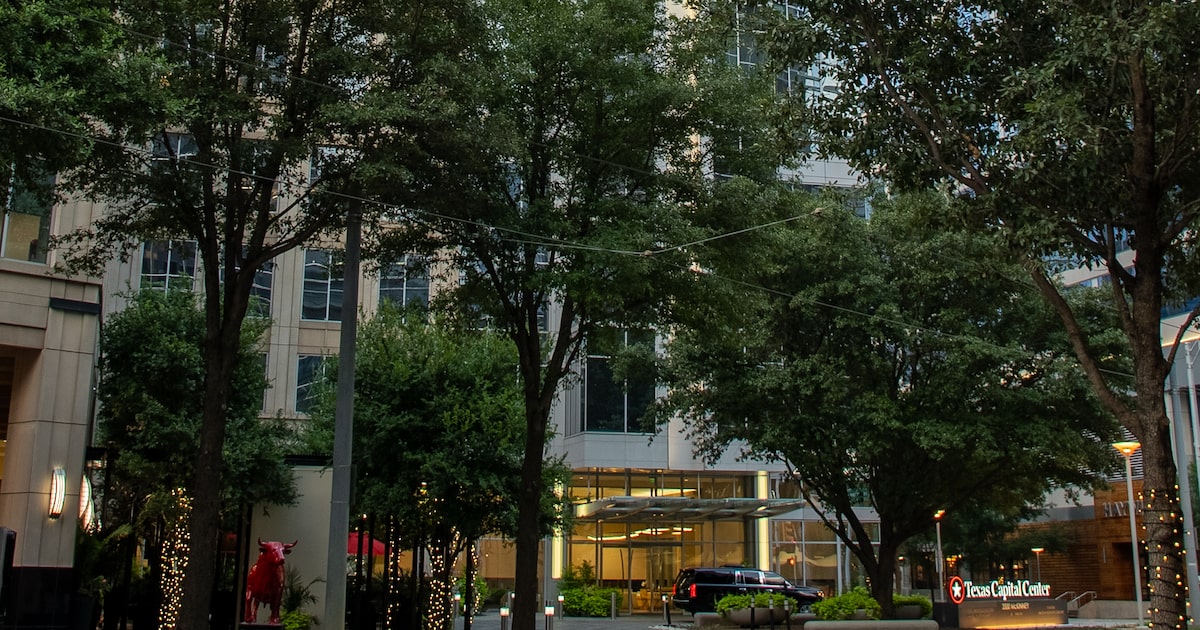
Texas Capital Bancshares swung to a profit in the third quarter, reaping the rewards of a diversified banking model and robust financial services activity that bolstered its return on assets.
The Dallas-based firm on Wednesday reported diluted third-quarter earnings per share of $2.18 on nearly $150 million in net revenue that restored it to profitability. That compared to a loss share of $1.41 on $115 million in revenue during the comparable year-ago quarter.
Most notably, the bank’s adjusted return on average assets — a key indicator of bank profitability — hit 1.3%, exceeding Texas Capital’s longstanding objective of 1.1% in a demonstration of Texas Capital’s 180-degree turnaround. The rough industry average for FDIC-insured institutions is 1%.
Texas Capital’s stock ended Wednesday’s session up modestly around $82, within the upper limits of its 52-week range and up over 5% year-to-date. The bank’s diversified portfolio of investment services, private banking and fee-related income has helped it weather a storm that’s engulfed other regional banks in recent sessions.
Business Briefing
Related

Rob Holmes, chairman, the president and CEO who took over leadership of the bank in 2021, declared that the quarter represented “the most successful bank transformation in the last 20 years, structurally elevating our earnings power and achieving industry-leading growth” in key product areas.
In an interview with The Dallas Morning News on Wednesday, Holmes downplayed the market’s recent concerns about regional banks, in part a rerun of the infamous ― and isolated ― crisis sparked by Silicon Valley Bank’s 2023 collapse.
Since then, investors have become sensitive to suggestions that smaller banks with weaker credit profiles could be vulnerable to runs on their stock prices.
Holmes insisted that all banks are not created equal, and that the SVB crisis of 2023 was really about “two or three poor strategies executed by poor management teams, because the rest of the banks did just fine.”
“As a matter of fact, after SVB, we excelled in terms of market share because we had a lot of capital capabilities. It was really an inflection point of the transformation…and that’s what I would say about today as well,” the executive said.
“People talk about credit problems, and some of the people that talk about credit problems are the ones that had the credit problems,” he added.
Texas Capital’s model runs on “a very conservative posture as it relates to risk, and a very aggressive posture as it relates to client obsession.”
The latter part he emphasized as a means that banks must use to differentiate themselves from competitors, and blunt risky bets.
Holmes added “the real risk mitigator is for banking. And I don’t care if it’s credit or operating risk or market risk, whatever the risk you’re talking about, the number one mitigator is client selection.”
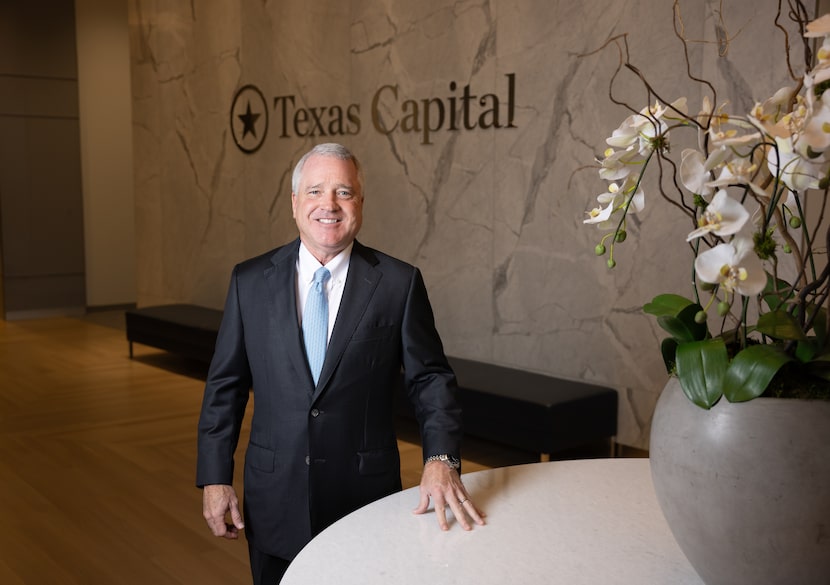
CEO Rob C. Holmes poses for a photo at Texas Capital Bank’s Corporate Headquarters in Dallas on Wednesday, Oct. 22, 2025.
Juan Figueroa / Staff Photographer
‘Client obsession’ as risk mitigation
Wall Street analysts expect Texas Capital to hit $1.6 billion in revenue and around $439 million in earnings by 2028 as its shift away from loan products to investment banking helps to drive eventual annual revenue growth in the double digits.
Keefe Bruyette and Woods, which expects the stock to hit $100 and assigned it an “overweight” rating, thinks investment banking will help bolster Texas Capital’s bottom line. Amid turmoil in regional bank stocks, Argus Research recently lowered its price target to $94, but still rates the stock as a “Buy.”
Fears about credit quality have walloped regional bank stocks in recent days. However, a resurgence in banking mergers has counterbalanced those fears – especially in the Dallas-Fort Worth market.
Since the summer, three local banks have been bought out by larger firms outside of the region, suggesting that bigger firms still see the D-FW as a major growth center. National and international financial institutions have taken a growing interest in North Texas, as Canada’s Scotiabank and Goldman Sachs plant roots in the area.
And earlier this month, Dallas-based Comerica was acquired by Cincinnati-based Fifth Third Bancorp in a $10.9 billion, all-stock deal. Separately, Denver-based National Bank Holdings swept into the D-FW in September, acquiring locally based Vista Bancshares for $369 million.
Back in July, Ohio’s Huntington Bancshares spent $2 billion to acquire Veritex Holdings, another Dallas-based institution.
Yet Holmes told The News that M&A was at the bottom of the bank’s “menu” in terms of its growth strategy. He suggested Texas Capital was unlikely to get swept up in the merger fever that’s seen out-of-state banks buy their way into the D-FW market — at least not in the immediate future.
“We’re really, really focused on tangible book value per share for our investors. And so we’re going to be very, very disciplined in not” rushing into a merger or buyout, he added.
How will the Fifth Third-Comerica merger work? CEO Tim Spence answers
In Fifth Third’s Friday third-quarter earnings call, Spence got down to the nitty-gritty about what the merger will look like.
 Charles Schwab reports strong Q3 earnings, boosted by surging retail demand
Openings of new brokerage accounts topped 1 million for the fourth quarter in a row.