
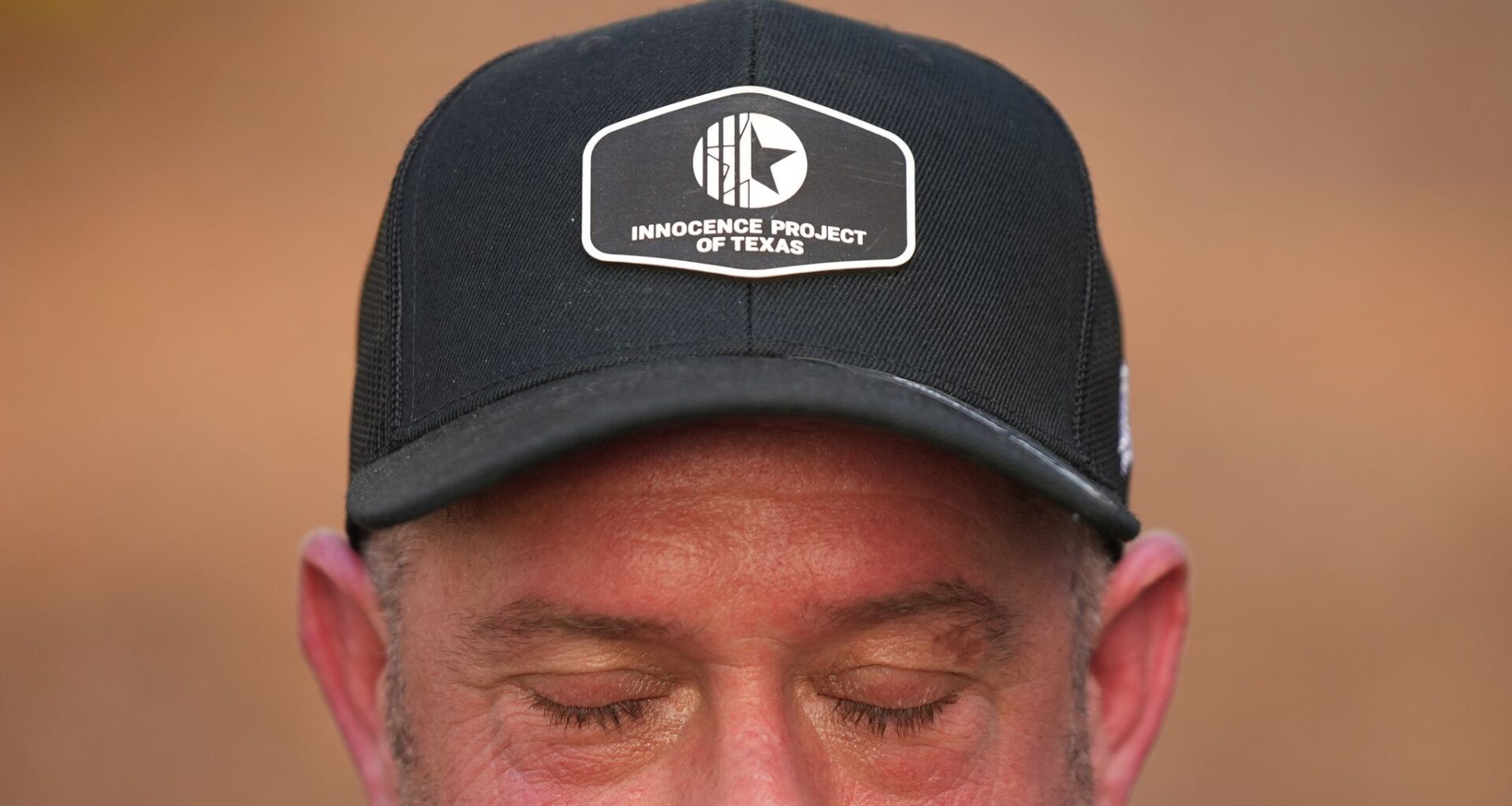
Soon after fulfilling a dream of owning a business when he bought a popular South Austin saloon last year, Forrest Welborn saw a sharp drop in sales – even among loyal customers.
The 49-year-old father with a salt-and-pepper beard, admittedly hesitant with strangers, instantly suspected why: Word had spread that the new owner of the Manchaca Springs Saloon, a lively honky tonk on Travis County’s southern edge, once stood accused in one of Austin’s darkest crimes.
It was a familiar pain in a life ruined. Welborn has spent 27 years fighting for his reputation and livelihood, sometimes through bouts of homelessness, after he was charged with three other men in 1999 with the murders of four girls at a North Austin “I Can’t Believe It’s Yogurt” shop. Over the decades, he has been blacklisted from jobs, lost friends, and tethered on the edge of his entire life unraveling when someone “put two and two together and realized I’m one of the guys from the yogurt shop murders,” he said.
When news broke nearly five months ago that police had linked the crime to a serial killer — and that police no longer believe the four original suspects were involved — a once-regular customer returned.
Article continues below this ad
“He gave me a big hug and said, ‘Man, I am here to support you,'” Welborn said.
Three hours away in the Dallas-Fort Worth suburbs, Kim and Marisa Pierce fight back tears that their husband and father, Maurice Pierce, never got that vindication. Pierce, after years of what they describe as traumatic interactions with police, died in 2010 after a confrontation with an Austin officer.
“I am grateful that his name is going to be cleared – that is what we have always wanted,” Marisa Pierce said. “But he’s not here.”
Article continues below this ad
On Thursday, prosecutors and attorneys for the four will take steps to rectify what many consider one of Travis County’s gravest injustices. It sent Robert Springsteen to Texas Death Row, Michael Scott to life in prison, and left Pierce and Welborn labeled as killers with unresolved cases dangling for decades.
In what is expected to be an extraordinary and emotional proceeding, prosecutors will ask a judge to exonerate each – a hearing in which officials likely will apologize for a blundered police investigation that elicited false confessions by Springsteen and Scott. Although initially charged, with their names and mugshots plastered to the world when police declared the case solved, Welborn and Pierce never faced trial. But the allegations have long followed them.
The certification hearing of yogurt-shop suspect Forrest Welborn, (left) began today in the 98th District Court in Austin. Maurice Pierce, not shown, was also in the courtroom. District Judge Jeanne Meurer will decide whether to certify these men to stand trial as adults. They were juveniles at the time of the slayings. November 29, 1999.
David Kennedy/Austin American-Statesman
The day-long exoneration hearing will include testimony about why Austin police investigators believe that Robert Eugene Brashers acted alone when he murdered Amy Ayers, 13, Eliza Thomas, 17, and Jennifer and Sarah Harbison, 15 and 17, on Dec. 6, 1991.
Article continues below this ad
To many in Austin’s legal community, especially those involved in the case, the proceeding will give a necessary but full accounting of how an investigation propelled by emotion over fact singled out the wrong men – and underscore that Springsteen nearly paid with death.
“It publicly answers and publicly acknowledges the accusations and corrects the misjustice that was done to these boys all these years,” said Amber Farrelly, who represents Springsteen.
For the three men and Pierce’s family, the lead-up to a moment decades in the making has stoked a painful past. Slowly, they are opening to the idea that a system that once railroaded them will now erase the stain they have carried for more than a quarter-century.
“A lot of people still believed I was one of the people who committed this crime, just that there was a lack of evidence,” Welborn said. “It’s been rough.”
Article continues below this ad
Marisa Pierce said, “No amount of coverage or court hearings is going to undo the years of what he endured.”
Her mother added, “We would’ve had a completely different life without this.”
Closing a chapter
Kim Pierce, the widow of yogurt shop suspect Maurice Pierce, and their daughter, Marisa, plan to attend an exoneration hearing Thursday in which Pierce and three other men will be declared innocent. Maurice Pierce died in a confrontation with Austin police in 2010.
Tony Plohetski/Austin American-Statesman
When state district Judge Dayna Blazey signs orders declaring the men “actually innocent,” the penstroke will close the final chapter on one of Austin’s most infamous murder cases.
Article continues below this ad
For years, police said a killer or killers entered the frozen yogurt shop as it was closing around 11 p.m.
Authorities discovered the girls’ bodies after Austin firefighters were called to the store in a strip mall on West Anderson Lane. They had been shot in the head, and the shop was doused in accelerants.
Eight days later, Austin police arrested Pierce, then a lanky 16-year-old, with a .22 caliber revolver at Northcross Mall, a few blocks east of the yogurt shop. Pierce said he had loaned the gun to Welborn, a 15-year-old with collar-length hair, who used it to kill the girls.
Police did not arrest them, and for the next several years, investigators followed hundreds of leads and thousands of tips.
Article continues below this ad
A newly created Austin police task force in 1999 re-focused on Pierce, Welborn and two friends, Scott and Springsteen.
Scott and Springsteen admitted to the murders after police used tactics that in subsequent years have been linked to false confessions and denounced by modern-day law enforcement.
Over the next several years, prosecutors dropped the case against Welborn after a grand jury declined to indict him. Pierce remained in jail for more than three years before charges against him were thrown out due to insufficient evidence.
However, prosecutors proceeded with trials against Springsteen and Scott. Their convictions were overturned in the mid-2000s after courts ruled the confessions were improperly used.
Article continues below this ad
Kim Pierce, the widow of yogurt shop suspect Maurice Pierce, and her daughter, Marisa Pierce, said he struggled to live a normal life after being wrongly linked for years to one of Austin’s darkest crimes.
Pierce Family Photos
Then in 2009, scientific advancements led to DNA testing that excluded each man from the crime scene, prompting prosecutors to drop the cases against Springsteen and Scott.
But none were exonerated.
In fact, prosecutors have, at times in the 17 years since, doubled-down on their belief that the four were responsible.
Article continues below this ad
Mike Ware, director of the Innocence Project of Texas, said part of the push for Thursday’s hearing is to spotlight how the legal system failed on nearly every front.
“There were some horrible mistakes that are both bad judgment on individuals’ parts and maybe some more systemic,” he said. “We want accountability, and we want reform.”
The case took a sudden and sharp turn last fall.
Investigators linked Brashers, responsible for at least three other murders and a series of other violent crimes across the nation, to the yogurt shop scene using a combination of newly available DNA testing and ballistics. Brashers died in 1999 by suicide as police moved to arrest him at a Missouri motel – nine months before Austin police arrested and charged Springsteen, Scott, Pierce and Welborn.
Article continues below this ad
Forrest Welborn, one of four men wrongfully accused in the 1991 Austin yogurt shop murders, poses for a portrait at Manchaca Springs Saloon, which he owns, on Thursday, Feb. 12, 2026.
Jay Janner/Austin American-Statesman
Case closed
Marisa Pierce was driving her 10-year-old son to football practice on Sept. 26 when her mother called with news about the break in the yogurt shop case.
“She was like, ‘Are you sitting down?'” Marisa Pierce said. “It was almost just a minute of processing where I didn’t know how to react or respond, and then I just gave into a lot of emotions.”
Article continues below this ad
Three days later, the mother and daughter sat together watching a 90-minute news conference with details about why police think Brashers, who had no connections to Austin, acted alone.
“It just didn’t seem real,” Kim Pierce said.
But soon, she was flooded with emotions from the hardships caused by the taint of her husband being considered a suspect.
“It was hard,” Kim Pierce said. “Every time he went for a job interview, people started doing backgrounds, right? It was there. He had to explain it.”
Article continues below this ad
She said they sometimes faced challenges to find housing; she would often leave his name off a lease, only for landlords to discover Pierce was living there and who he was, risking instant eviction.
The two plan to address the court at the proceeding.
Springsteen’s attorney said he did not want to comment prior to Thursday’s hearing, and Tony Diaz, who represents Scott, said his client also was not prepared to comment but plans to issue remarks during the proceeding.
“Mike has gone through so much hell,” Diaz said. “So much hate foisted upon him. He sometimes tells me he is having to pinch himself because he doesn’t believe this is happening.”
Article continues below this ad
Welborn was at his saloon when a customer walked in that Friday afternoon with news he’d just seen on TV.
“They said they knew it the whole time, that I was not the one,” he said. “I felt sad, angry, and relieved that they finally found the guy and I can finally be cleared of this.”
Photo by Larry Kolvoord/AA-S….12/9/99…..Murder suspect Forrest Welborn , center, reacts to District Judge Jeanne Meurer’ judgement that he will have to stand trial as an adult in the yougurt-shop murders. His attorneys Robert and Linda Icenhaver-Ramierz stand at his side.
Larry Kolvoord/Austin American-Statesman
Welborn has spent the past four months reflecting on the weight of suspicion that has dominated his life and how differently the past two decades could have unfolded. On the day he was arrested in October 1999, Welborn was operating a mechanic shop he thinks would be thriving today.
Article continues below this ad
“I am pretty sure I would have been a business owner a long time ago and succeeded,” he said. “I could have had a really nice house, owned property, a lot of things would have been different.”
He was a frequent customer of the Manchaca Springs Saloon, and when it went on the market last year, he was determined to cobble together money from construction jobs to buy it.
“I have worked as hard as I can to get where I am today,” he said. “It has taken a lot.”
It is unclear if the family members of the four girls killed 34 years ago will attend the hearing.
Article continues below this ad
During a recent interview, Welborn talked flatly and stoically about his own life, generally in succinct sentences.
His voice cracked only once when the conversation turned to the girls killed at the yogurt shop – Amy, Eliza, Sarah and Jennifer – and their families.
“I’m sorry this happened to their girls,” Welborn said, wiping away tears. “And I’m sorry that it took this long for them to get closure, to find the one who actually did this.”