
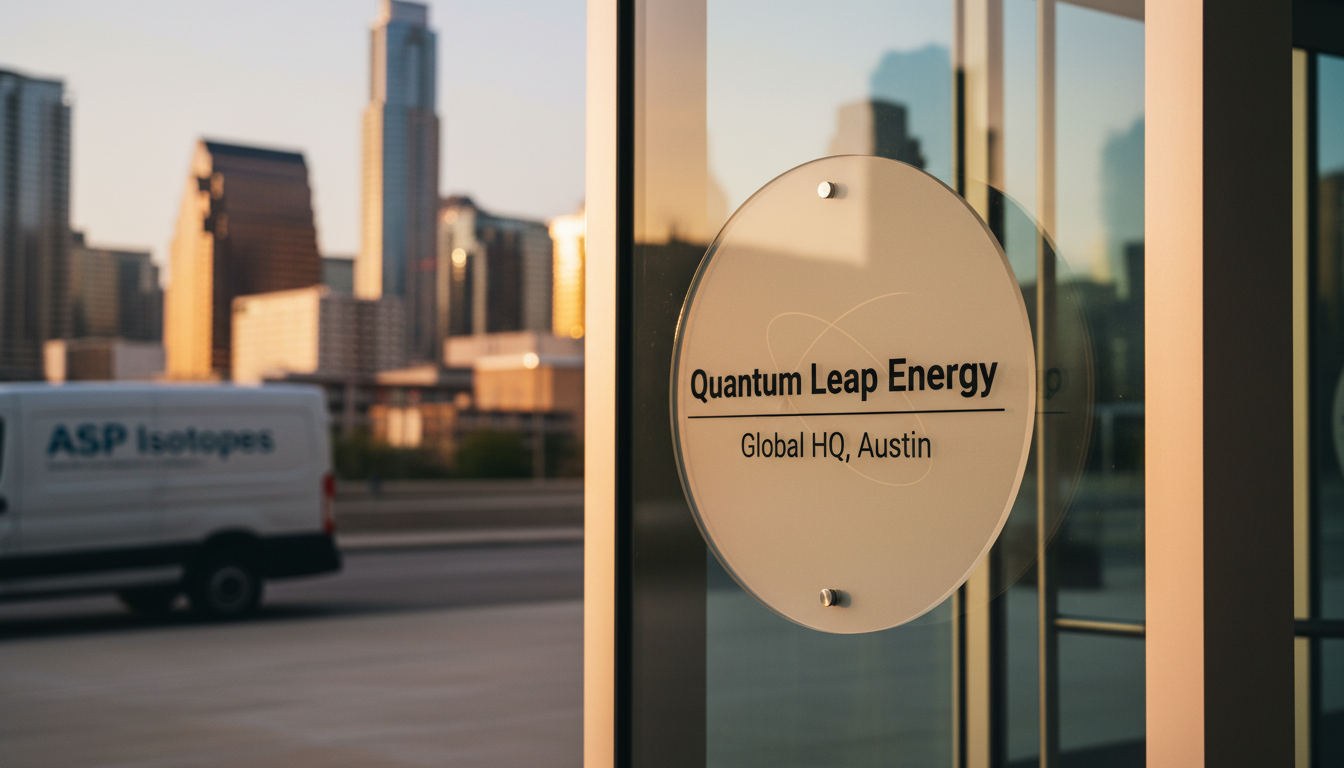
ASP Isotopes (NASDAQ: ASPI) said its wholly owned subsidiary Quantum Leap Energy will establish global headquarters in Austin, Texas, expanding QLE’s U.S. presence and operational plans. QLE plans a significant Texas footprint and to advance a joint venture with Fermi America tied to HALEU enrichment and isotope production.
QLE and ASPI plan facilities affiliated with Fermi America’s Amarillo hypergrid campus, aligning with DOE estimates of rising HALEU demand through 2035–2050.
Loading…
Loading translation…
Positive
Global HQ relocation to Austin strengthens U.S. presence
Planned joint venture with Fermi America to pursue HALEU enrichment
Planned commercial facilities for stable isotopes and advanced nuclear materials
DOE HALEU demand cited: 50 tpy by 2035, 500 tpy by 2050
HALEU demand 2035
50 metric tons per year
U.S. Department of Energy estimate for 2035
HALEU demand 2050
500 metric tons per year
U.S. Department of Energy estimate for 2050
$5.22
Last Close
Volume
Volume 3,017,374 is below the 20-day average of 5,946,969 (subdued trading vs. typical levels).
low
Technical
Price at 5.22, trading below the 200-day moving average of 8.04 despite positive strategic news.
ASPI gained 1.75% while peers were mixed: WLKP up 0.42%, LXU up 1.03%, REX up 1.59%, and GPRE down 1.72%, indicating stock-specific drivers rather than a broad chemicals move.
Date
Event
Sentiment
Move
Catalyst
Jan 29
Positive
-8.8%
Helium Project production progress and throughput improvements after Renergen acquisition.
Jan 07
Positive
-3.1%
Closing of Renergen acquisition and large financing plans for helium expansion.
Dec 17
Positive
+1.2%
Receipt of all regulatory approvals for Renergen acquisition scheme of arrangement.
Dec 02
Neutral
+0.0%
Founder and Executive Chairman scheduled to return as CEO after health-related leave.
Nov 28
Positive
+5.1%
Three-year donation to endow a Photonics Chair and support quantum enrichment research.
Pattern Detected
Recent positive operational and M&A updates have produced mixed reactions, with notable selloffs on otherwise constructive helium and acquisition news.
Recent Company History
Over the last few months, ASP Isotopes announced multiple milestones, including completion of the Renergen acquisition and related regulatory clearances, leadership changes, and a photonics research endowment. Operationally, it reported a production update on the Renergen Helium Project. Price reactions ranged from a -8.82% drop on the helium production update to a 5.07% gain on the photonics endowment, showing inconsistent market responses to generally constructive strategic developments ahead of today’s Texas nuclear-fuels expansion news.
This announcement highlights QLE’s decision to base its global headquarters and operations in Texas while pursuing a HALEU enrichment facility with Fermi America, framed against DOE demand projections of 50 and 500 metric tons per year by 2035 and 2050. In context of recent Renergen acquisition and helium project updates, investors may focus on execution of the Texas build-out, progress on the joint venture structure, and how these nuclear initiatives integrate with existing helium and isotope businesses.
high-assay-low enriched uranium
technical
“development of a high-assay-low enriched uranium (“HALEU”) enrichment research…”
High-assay low-enriched uranium (HALEU) is uranium fuel that has a higher concentration of the fissile isotope uranium‑235 than conventional reactor fuel but remains below the level defined as highly enriched; think of it as a higher-octane gasoline made for advanced reactors. It matters to investors because HALEU is a specialized, regulated commodity critical to next-generation nuclear reactors and related supply chains, so its availability, cost, and regulatory controls can directly affect the economics and timelines of companies in the nuclear energy and materials sectors.
HALEU
technical
“50 metric tons per year of HALEU to support its nuclear power industry…”
HALEU (high-assay low-enriched uranium) is uranium fuel enriched to a higher level than traditional reactor fuel but below weapons-grade, roughly like a higher-octane gasoline for nuclear reactors. It matters to investors because this fuel enables newer, smaller and more efficient reactors to run longer or produce more power from less material, so availability, regulation and production costs can affect utilities, reactor developers and mining companies’ prospects.
fission
technical
“across critical segments of the fission and fusion nuclear fuel cycle…”
Fission is the process where a single entity splits into two or more parts, most commonly used to describe an atomic nucleus breaking apart and releasing a large amount of energy; in biology it can also mean a cell dividing into two. Investors care because fission underpins nuclear power and medical isotope production, and in biotech it can affect how organisms reproduce or how therapies work — like breaking a log to release stored energy, it creates potential value, regulatory scrutiny, safety risks, and market opportunity.
nuclear fuel cycle
technical
“segments of the fission and fusion nuclear fuel cycle, to establish QLE’s…”
The nuclear fuel cycle is the full supply chain that turns raw uranium into usable reactor fuel, manages its use in power generation, and handles spent fuel and any recycling or disposal. Think of it like the path from coffee beans to a brewed cup and the leftover grounds — each step (mining, conversion, enrichment, fabrication, reactor use, storage or reprocessing) affects cost, regulatory risk, supply security and long-term liabilities, all of which influence the value and prospects of companies involved.
baseload power
technical
“meet the clean, baseload power demands of AI data center infrastructure…”
Baseload power is the consistent, reliable electricity output that a power plant or source can provide around the clock to meet the minimum demand on the grid, similar to a factory that runs steadily to keep essential machines humming. For investors, baseload capacity matters because it tends to produce predictable revenue, supports grid stability, and reduces the risk that production will be sidelined when demand dips, making assets and contracts tied to it easier to value.
AI-generated analysis. Not financial advice.
02/17/2026 – 07:30 AM
State’s Support of Nuclear Power and Constructive Regulatory Environment to Boost Commercial Pathway for Developer of Advanced Nuclear Fuels
DALLAS, Feb. 17, 2026 (GLOBE NEWSWIRE) — ASP Isotopes Inc. (NASDAQ: ASPI) (“ASPI”) today announced its plans for Quantum Leap Energy LLC (“QLE” or the “Company”), a wholly-owned subsidiary of ASPI dedicated to advancing innovative technologies and processes across critical segments of the fission and fusion nuclear fuel cycle, to establish QLE’s new global corporate headquarters in Austin, Texas, strengthening its presence in Texas and strategically positioning the Company to better serve its United States customer base.
In addition to the planned global corporate headquarters, QLE intends to build a significant operational presence in Texas, with QLE’s management focused on working with Fermi America to implement the joint venture outlined in the Joint Venture Memorandum of Understanding (MOU) signed by QLE, ASPI and Fermi America last year. The collaboration contemplated by the MOU includes a joint venture between QLE and Fermi America focused on the development of a high-assay-low enriched uranium (“HALEU”) enrichment research and commercial production facility, alongside ASPI’s planned commercial facility for the production of stable isotopes and advanced nuclear materials, both to be affiliated with Fermi America’s hypergrid campus in Amarillo, Texas.
“As the nation’s leader in energy production, Austin and Texas have established a beacon as the natural home to America’s advanced nuclear energy industry,” said Ryno Pretorius, Chief Executive Officer of QLE. “The epicenter of the American nuclear renaissance, with its central location, affordable cost of living, highly educated workforce and supportive business climate, is a natural fit for QLE’s own headquarters. The state’s distinct pro-nuclear stance and supportive regulatory environment have proven critical to growing commercial support for the nuclear sector, and will help ensure we have access to the best talent and infrastructure in the market.”
“Texas is home to the world’s most innovative companies, and today we are proud to welcome Quantum Leap Energy’s global headquarters to our thriving business ecosystem,” said Governor Greg Abbott. “Thank you to ASPI and Quantum Leap Energy for choosing Texas for this important investment and for your growth in our state. Working together with industry leaders like Quantum Leap Energy, we will power the future of energy innovation and fuel America’s nuclear resurgence from right here in Texas.”
QLE’s new headquarters comes at a critical time as advanced reactor technologies are being developed globally at an accelerating pace to meet the clean, baseload power demands of AI data center infrastructure and industrial electrification. For example, the United States Department of Energy estimates that by 2035, the country will need 50 metric tons per year of HALEU to support its nuclear power industry, escalating to 500 metric tons per year by 2050.
About Quantum Leap Energy
Quantum Leap Energy is a development stage nuclear fuels company dedicated to advancing innovative technologies and processes across critical segments of the nuclear fuel cycle. The company focuses on both front-end activities, including uranium conversion, enrichment of uranium-235 for nuclear fuel production (HALEU, LEU+ and LEU), and isotopic separation of lithium-6 and lithium-7, as well as back-end radioactive waste treatment technologies. Through exclusive global rights to proprietary Aerodynamic Separation Process (ASP) and laser-based Quantum Enrichment (QE) technologies, Quantum Leap Energy aims to address gaps in the nuclear fuel supply chain for advanced nuclear reactors, small modular reactors, and fusion systems. The company has established strategic partnerships or initiatives with industry leaders including TerraPower, Fermi America, and the South Africa Nuclear Energy Corporation (Necsa) to accelerate the commercialization of critical isotopes essential for next-generation nuclear energy systems. For additional information, please visit: https://www.qleapenergy.com/.
About ASP Isotopes Inc.
ASP Isotopes Inc. is a development stage advanced materials company dedicated to the development of technology and processes to produce isotopes for use in multiple industries. ASPI employs proprietary ASP technology. ASPI’s initial focus is on producing and commercializing highly enriched isotopes for the healthcare and technology industries. ASPI also plans to enrich isotopes for the nuclear energy sector using QE technology that ASPI is developing. ASPI has isotope enrichment facilities in Pretoria, South Africa, dedicated to the enrichment of isotopes of elements with a low atomic mass (light isotopes).
Forward-Looking Statements
Statements contained herein relating to future plans, results, performance, expectations, achievements and the like are considered “forward-looking statements” within the meaning of the Private Securities Litigation Reform Act of 1995. These forward-looking statements include, but are not limited to, projections about future nuclear fusion power generation technologies and enrichment methods, QLE’s anticipated growth strategies and anticipated trends in QLE’s business, statements relating to the formation of a joint venture with Fermi America, the commencement of research, development and production activities in the United States, the future of the company’s enrichment technologies as applied to uranium enrichment, the outcome of the company’s initiative to commence enrichment of uranium in South Africa and the company’s discussions with nuclear regulators in South Africa and the UK, the outcome of the project contemplated with Necsa, the expected need or desire for HALEU by third parties, the outcome of the transactions contemplated by the definitive agreements with TerraPower, commencement of supply of isotopes to customers and the application of new technology for the enrichment of isotopes, the planned construction of additional isotope enrichment facilities, and statements we make regarding expected operating results, such as future revenues and prospects from the potential commercialization of isotopes, future performance under contracts, and our strategies for product development, engaging with potential customers, market position, and financial results. These forward-looking statements involve known and unknown risks, uncertainties, and other factors, many of which may be beyond ASPI’s or QLE’s control, that may cause actual results to differ materially from any future results, performance or achievements expressed or implied by any forward-looking statements. All forward-looking statements speak only as of the date hereof. QLE and ASPI undertake no obligation to revise or update any forward-looking statements except as may be required by applicable law.
Contact
QLE@icrinc.com

FAQ
Why is ASP Isotopes (ASPI) establishing Quantum Leap Energy headquarters in Austin on Feb 17, 2026?
QLE chose Austin to strengthen its U.S. presence and access talent and infrastructure. According to the company, Austin’s pro-nuclear stance, educated workforce, and supportive regulatory climate drove the decision to locate the global headquarters there.
What does the joint venture between Quantum Leap Energy and Fermi America mean for ASPI (ASPI) shareholders?
The joint venture aims to develop HALEU enrichment research and commercial production capacity. According to the company, the collaboration ties planned isotope and advanced materials facilities to Fermi America’s Amarillo hypergrid campus, expanding commercial pathway potential.
What facilities does Quantum Leap Energy plan in Texas related to ASPI (ASPI)?
QLE plans a significant operational presence including HALEU enrichment research/commercial production and a commercial stable isotopes facility. According to the company, both facilities are to be affiliated with Fermi America’s Amarillo hypergrid campus.
How does the Department of Energy HALEU forecast affect ASPI’s (ASPI) plans?
Rising DOE HALEU demand supports commercial opportunity for QLE’s planned facilities. According to the company, DOE estimates 50 metric tons per year by 2035 and 500 metric tons per year by 2050.
Will Quantum Leap Energy’s Austin HQ change ASPI’s (ASPI) U.S. strategy or operations?
Establishing the HQ is intended to centralize U.S. operations and customer engagement. According to the company, the move positions QLE to better serve U.S. customers and coordinate joint venture activities with Fermi America.