
The city of El Paso is facing a financial crossroads as leaders look to generate more revenue, including possibly increasing existing fees and implementing new ones, to help offset ballooning expenses driven largely by public safety.
A five-year financial forecast presented to the City Council on Monday shows city expenses increasing by a combined $146.5 million over the next five years. Nearly $90 million of that increase, or 61%, is due to pay and benefit increases for police and fire department personnel if the terms of the current contracts are extended into the future.
Other rising costs include non-uniform employee pay raises and health insurance, utility costs, information technology expenses and materials and supplies. Sales tax and property tax revenues are also expected to level out as some COVID-era federal funding sources also come to an end.
The City Council will begin strategic budget planning sessions next week focused on addressing the growing financial imbalance.
“We need to start finding some additional revenue sources, or start making some adjustments on the expenditure side – it’s as simple as that,” Chief Financial Officer and Deputy City Manager Robert Cortinas told El Paso Matters.
To adopt no-new-revenue tax rates in recent years, the city has relied on one-time fixes such as not filling vacancies, tapping into reserve funds, and reducing funding for vehicle replacements and facility improvements. No-new-revenue tax rates collect the same amount of property tax revenue as the previous year on the same properties, which is often achieved when property values increase.
Cortinas on Monday repeatedly stressed to the City Council, which adopts the budget and tax rate, that the city cannot continue to rely on those one-time fixes.
“Looking forward – really again – that structural imbalance, and we keep using that term, and that’s critical, because you can balance the budget year after year with these sort of one-off, one-time adjustments on the revenue expenditure side, but at the end of the day, are we properly funding all the city services that the city provides?” Cortinas said.
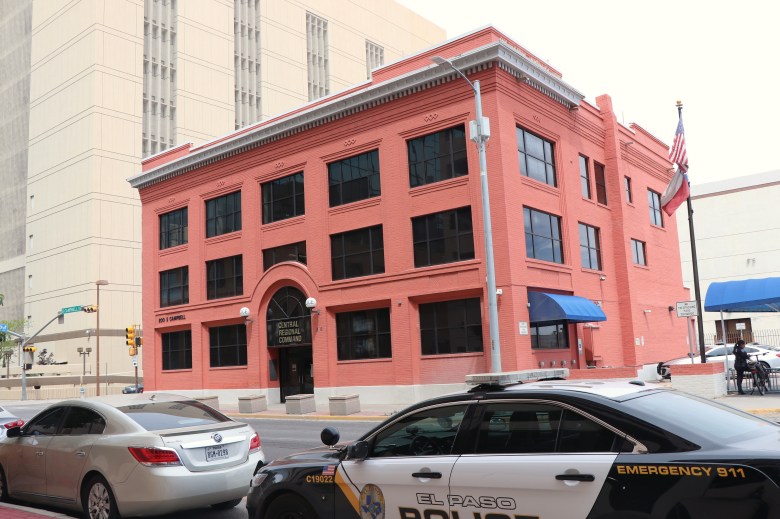 The city of El Paso is buying the vacant Bonham Elementary School from EPISD to build a new command center to replace the El Paso Police Department Central Regional Command Center, 200 S. Campbell Street. (Cindy Ramirez / El Paso Matters)
Some of the options that will be considered during the strategic planning session include passing down some of the rising health insurance costs to employees and evaluating whether existing programs are effective.
Other revenue-generating proposals include increasing user fees for parks and planning and inspections, implementing a 1% sales tax on the residential use of electricity and gas as well as transportation user fees, and charging the hotel occupancy tax to short-term home vacation rentals. The city’s hotel tax is 9%, of which 2% is allocated to the Downtown ballpark.
If the utility sales tax were to be implemented, residents would see the fee on their monthly gas and electricity bills, paying $2 on a $200 electric bill, for example. That money, an estimated $4 million, would be added to the general fund.
Prior efforts to implement transportation user fees – monthly fees charged to residents and businesses to create a dedicated fund for street repairs – have failed. The most recent attempt was in November, when a planned presentation on the fee was deleted from the City Council meeting agenda.
The financial outlook helps set the stage for planning the next year’s budget, Cortinas said. A preliminary budget for the 2026-27 fiscal year will be presented in July and voted on in August.
The council last fall adopted a $1.3 billion overall budget, including a general fund budget of about $624 million. Of that, about $366 million is for public safety – the primary responsibility of municipal governments.
Public safety services, the largest expense from the city’s budget, exceed property tax revenue by $54 million and have grown by about $17 million, or 6% over the last five years.
Collective bargaining agreements, which are set to be renegotiated for fire this year and police next year, will be key to setting the next few years’ budgets.
“Those agreements don’t go down in cost ever. They only continue to increase and they become cumulative,” Cortinas said.
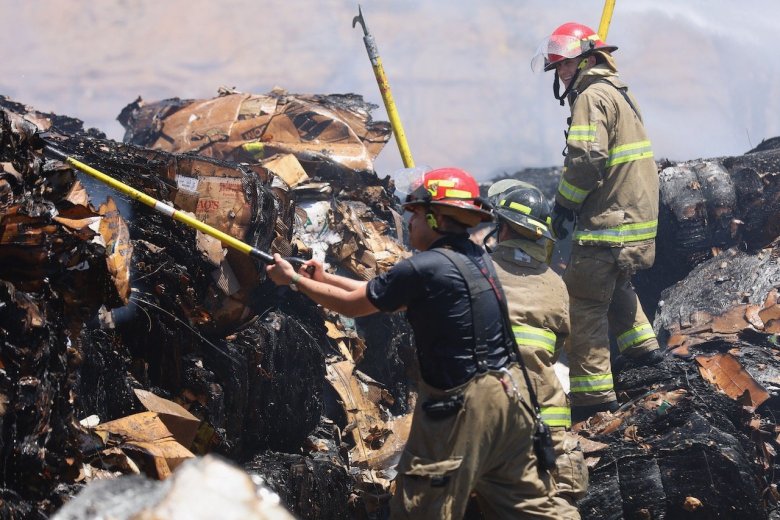 El Paso Fire Department crews respond to a fire at a recycling plant on the 1600 block of Paisano Drive in May 2022. (Courtesy El Paso Fire Department)
The El Paso Association of Fire Fighters Local 51 collective bargaining agreement is set to expire in August, and the El Paso Municipal Police Officers’ Association collective bargaining agreement will expire in August 2027.
“We have to be aware that the things that we ask for and the more that we ask for can also be detrimental to the community, so while we want a fair and equitable deal, and we want to work with the city to to gain that, we don’t want to hurt the citizens in that process,” Local 51 President Jay Nicholson told El Paso Matters.
The fire union will always focus on two main areas: pay and benefits and insurance, and a close third is vacation time, he said.
“It’s a matter of trying to keep up – the best way I could say it is trying to keep up with the industry standard (but) you try to be cognizant of our community,” Nicholson said.
Nicholson said part of the goal is to recruit and retain firefighters who will work their entire careers serving El Paso.
But negotiations and decisions are not a unilateral decision. The union develops committees that come up with the list of asks that aren’t always tied to monetary changes, sometimes they are for updating language in the contract, he said. The union membership as a whole votes on any changes throughout the negotiation process.
The current fire collective bargaining agreement included 12% pay raises over the four-year period based on established pay scales, increased pay incentives for special assignments and education pay. It also added three paid holidays, increased vacation slots and added the ability to sell accumulated sick leave among the changes. The prior agreement from 2018 through 2022 included 11% pay raises over the four-year period.
In 2015, the city and firefighters union could not come to an agreement, so they went to voters, who overwhelmingly approved a 3% pay raise to be implemented over 2015 to 2018. The city asked voters to approve a smaller wage increase from 0.25% to 1.25% over the agreement period.
The police collective bargaining agreements also included pay raises: 1.25% from 2014 to 2018 and 1% from 2019 through 2023. The largest raises were negotiated under the current agreement from 2023 to 2027, where pay raises ranged from 13% to 17% depending on an officer’s rank.
The police union did not respond to a request for comment.
 Fire Station 10, recently renovated using funds from the 2019 public safety bond, reopens in Central El Paso, April 17, 2024. (Corrie Boudreaux/El Paso Matters)
Public safety bond projects grow in cost
Aside from increased pay for police and fire staff, the city is facing higher costs for infrastructure, much of it stemming from the $413 millionpublic safety bond approved by voters in 2019.
The City Council on Jan. 20 approved about $40 million in budget transfers from accrued interest and savings from the 2019 bond to cover the increased cost of several fire station renovations and for the construction of the public safety complex.
Additional budget transfers may be requested in March when the city anticipates finalizing a guaranteed maximum price bid. The transfers would have been needed regardless of the bid, Yvette Hernandez, city engineer and deputy city manager, told El Paso Matters.
“Given that these were project savings, and I knew that we would need them now, I wanted to go ahead and make that budget transfer,” Hernandez said.
Seven fire stations each needed at least $400,000 more for renovations than was originally budgeted, a city presentation shows. The City Council approved transferring $3.3 million from the Fire Department bond project savings to cover the cost.
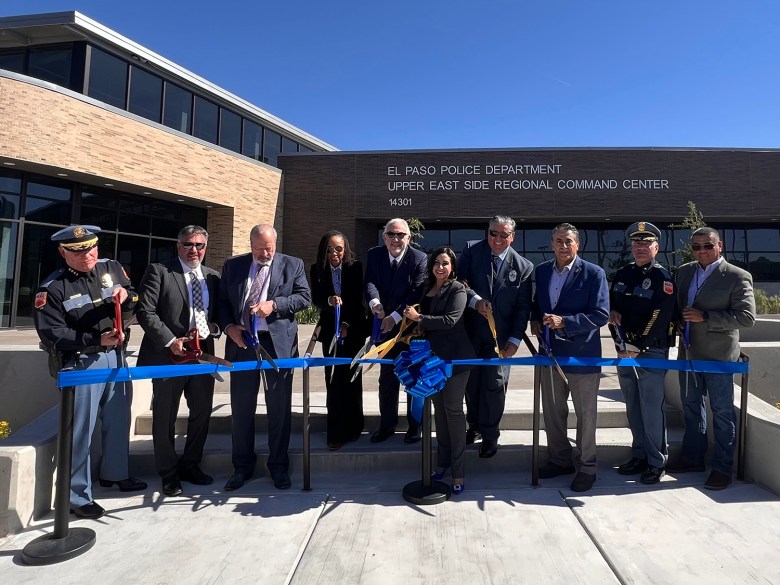 City and law enforcement leaders participated in a ribbon-cutting ceremony Wednesday, Sept. 25, for the new $39 million El Paso Police Department Upper East Side Regional Command Center. (Pablo Villa / El Paso Matters)
The public safety complex – which will house police and fire operations, including the public safety training academy, Fire Department headquarters, and a vehicle maintenance and logistics center – needed about $36 million more than what was budgeted in 2020.
The police portion of the complex was estimated to cost about $19 million and has increased to about $29 million. The estimate for the fire portion increased from about $57 million to $84 million.
Hernandez said the increases are due to higher construction costs and an expanded scope of work to meet training and certification requirements. She said estimates already factored in a 30% contingency and 4% escalation costs in 2019, which helped absorb some of the cost increases.
The city is also cancelling the planned construction of Fire Station 40 in Far East El Paso, whose service area can be addressed with current resources, Hernandez said. That fire station did not yet have a set location.
Hernandez said population growth estimates from 2019 did not materialize.
The city’s population is about 678,000. The county has a population of about 879,000 and is not expected to see significant population growth over the next 35 years, according to a Texas Demographic Center analysis.
Hernandez said she worked with Fire Chief Jonathan Killings to ensure that building the new Fire Station 36 in West El Paso and Fire Station 38 in Far East El Paso at Pebble Hills Boulevard and Tim Foster Street would meet current population shifts and keep acceptable response times.
Operations and maintenance costs for all of the public safety bond facilities are estimated to be about $13 million from 2026 to 2030.
The public safety training facility is in the pre-development phase. Design will begin after the city awards the guaranteed maximum price bid which may be in early March. A timeline for completion will not be available until the City Council awards the contract.
The City Council largely downplayed the projections presented by Cortinas on Monday, reiterating that the financial forecast is not the actual budget.
“We’re not talking about the budget right now, but I know that we identified a (funding) gap potentially in the future. But from what I know, year after year, we’ve always adopted a balanced budget,” city Rep. Alejandra Chavez said.
City Rep. Ivan Niño said the city has obtained grants for public safety expenses like the $4.26 million to fund 21 new entry-level firefighter positions from the Staffing for Adequate Fire and Emergency Response, or SAFER, grant from the Federal Emergency Management Agency.
But Cortinas said once the grant ends in a few years, the city will have to shoulder the cost for the additional firefighters through the general fund.
City Rep. Deana Maldonado-Rocha said that there is no additional funding for City Council members’ new program or budget requests.
“It ties back to the ‘strategy without funding can’t be executed’ without a trade off,’” Maldonado-Rocha said.
City Rep. Chris Canales said the financial forecast is designed to help with future planning, but that the city is not in bad shape.
“This isn’t an indication of poor financial health, or you know that the city is headed toward bankruptcy, that this is a tool that we use to plan and that we adopt balanced budgets every year,” Canales said.
Related