
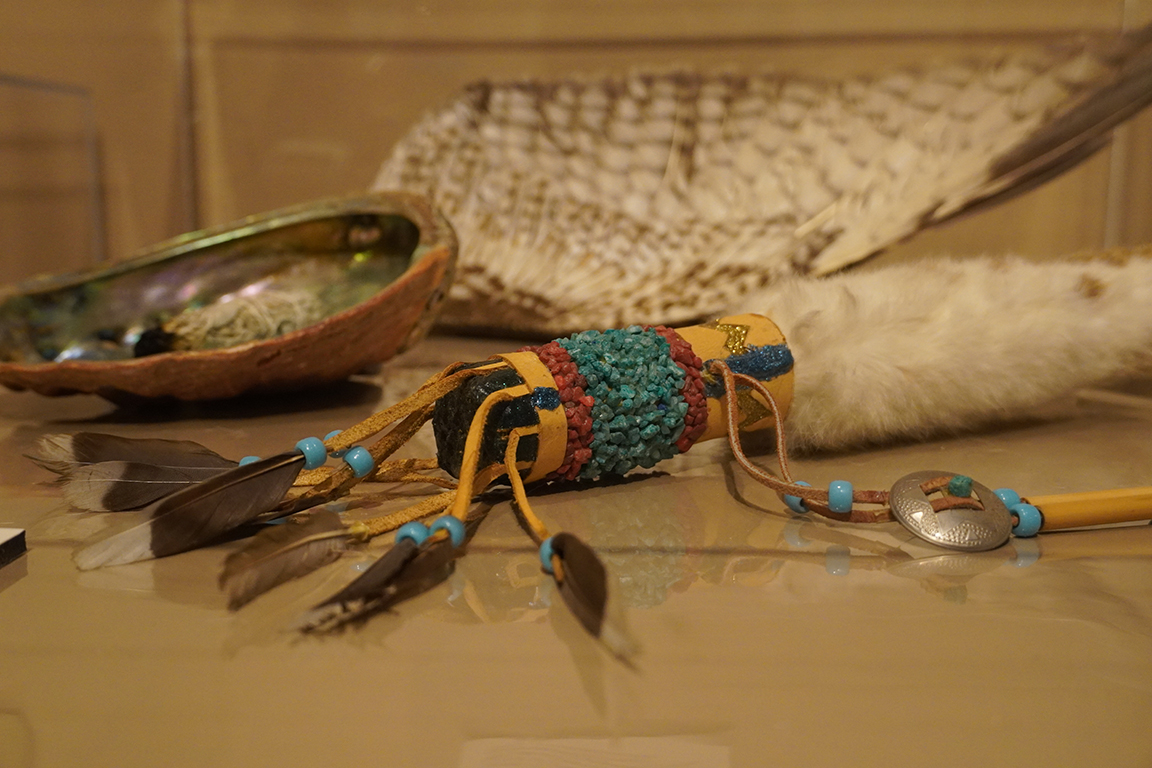
Blessing Staff, Shell, and the Ceremonial Staff are using during ceremonial blessing and cleansings. January 30, 2026
On Sept. 16, 2025, the Branigan Cultural Center in Downtown Las Cruces opened its first of six exhibits in a series called “Land of the People.” Until May 2027, residents can visit the exhibit from 10 a.m. to 4:30 p.m. Tuesday through Friday and from 9 a.m. to 4:30 p.m. on Saturdays.
Each of the six exhibits prominently features one of six major indigenous communities in the El Paso-Las Cruces region. Those are the Ysleta del Sur Pueblo, the Tortugas Pueblo, the Mescalero Apache, the Piro-Manso-Tiwa Indian Tribe, the Chiricahua Apache, and the Gila Apache. The Ysleta del Sur Pueblo’s exhibit was the first to open on Sept. 16, 2025, and ended on Nov. 29, 2025. Since Dec. 20, 2025, the exhibit for the Tortugas Pueblo has been on display, and will remain until March 14, 2026.
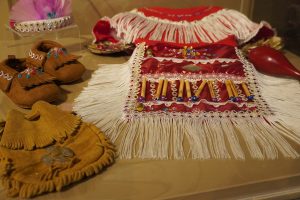 Traditional Traje is used for Danza. (Melanie Zepeda)
The City of Las Cruces stated in a post on their website the information shown at the exhibit comes from the indigenous groups themselves, in an effort to include Native American voices into the collaborative project.
“Through their own words and perspectives, each group presents information about their traditions and current lifeways,” the City of Las Cruces wrote. “Reflecting the collaborative nature of this exhibit, each group has included their interpretation of the term ‘Land of the People’ within the title, corresponding with their exhibit rotation.”
Two visitors came to Las Cruces, Christine Stout, and her daughter Keri Herrera of the Chicago area, to see the Tortugas Pueblo exhibit. Herrera talked about why the two of them came to the Branigan Cultural Center.
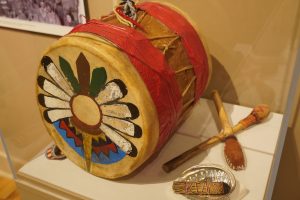 Traditional Drum set used by Men and Women Leader Leaders. January 30, 2026 (Melanie Zepeda)
“We’re from a suburb of Chicago, just here with my mom visiting,” Herrera said. “She’s been to New Mexico many times before, meanwhile this is my first time. We wanted to get away from the Chicago winters for a little bit and have some fun in the sun. We came to this exhibit because my mom is interested in Native American culture and history […] I personally like how they dress.”
Stout, a former docent at the Field Museum of Chicago who specialized in the Pawnee culture, drew comparisons between the traditions of the Southwest and Midwest.
“There are tons of differences, like in the housing styles,” Stout said. “Because each culture used the materials that were available to them. The materials here are quite different, and clothing is the same way. In the Midwest, you needed much warmer clothing. But some of the similarities were the oral tradition; all of their knowledge being passed down orally, the respect for elders. I think that’s consistent throughout the indigenous cultures I have studied to a small degree.”
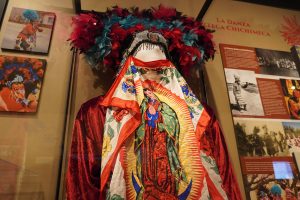 Monarca outfit used for La Danza Chichimeca worn by female or male leaders. January 30th, 2026 (Melanie Zepeda)
Stout said she admired the perseverance of Native American cultures throughout the country and how they have adapted to modern society and technology.
“It’s the resilience and the pride everybody has in their culture, I think that’s so cool,” Stout said. “I just wonder how long it takes to make some of this stuff (the exhibit)? Maybe six months to a year at least. And that is so neat. When you are talking about their regalia, it looks like they are living in two worlds. They get dressed just like we are when they go to school and work, but for their ceremonies […] the regalia that the young kids wear that their moms and grandmas had beaded is beautiful. To me, it’s like a snapshot of how you can adapt and maintain your traditions.”