
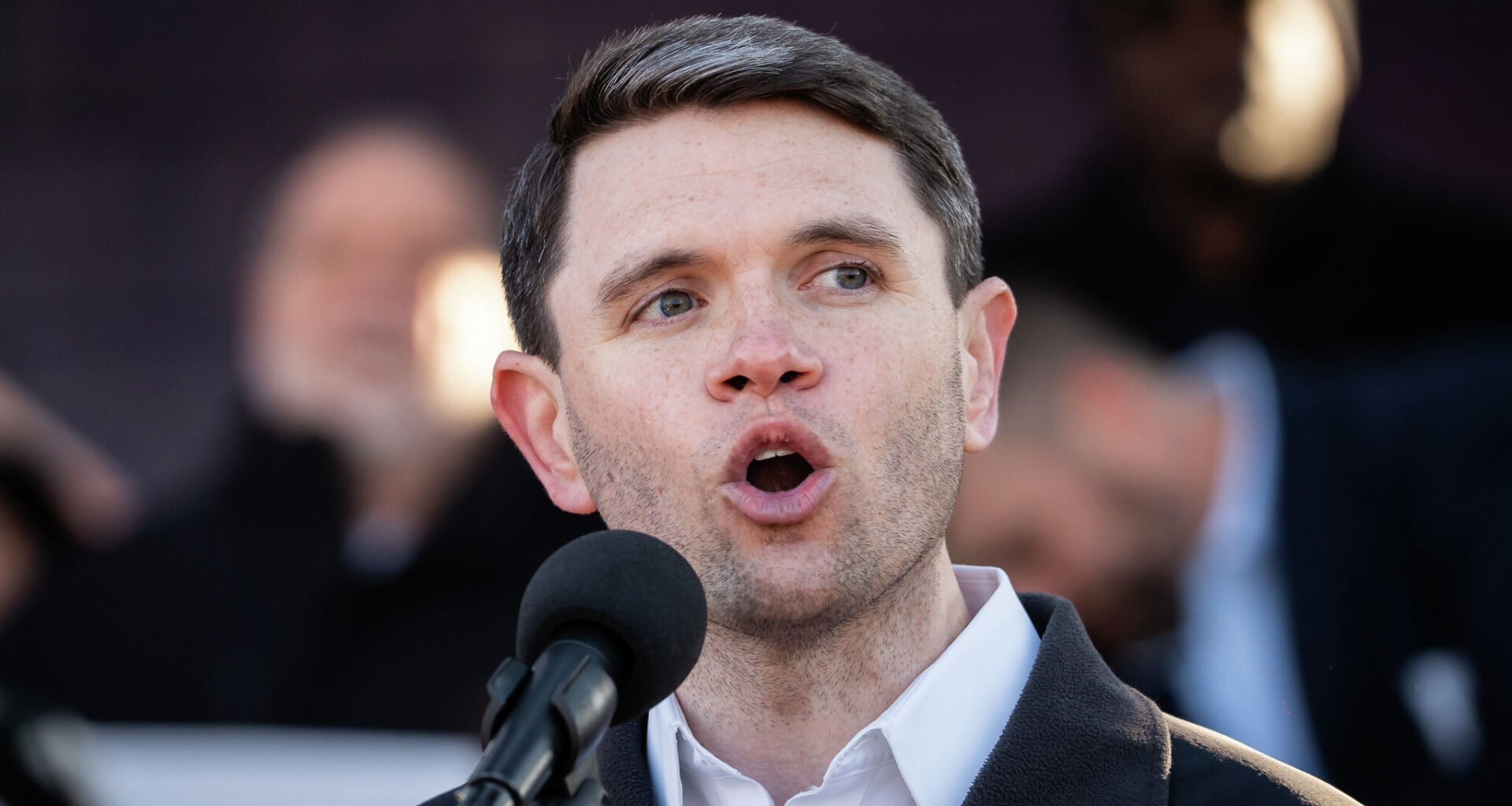
Texas Rep. James Talarico, D-Austin, speaks to the crowd during a “Stop ICE Rally” at Pan American Neighborhood Park in East Austin, Jan. 31, 2026. Thousands gathered at the park to hear politicians and community leaders speak against the practices of Immigration and Customs Enforcement agents in Texas, Minnesota and around the country. Talarico is running for the democratic nomination to take on U.S. Sen. John Cornyn in the senate race.
Sara Diggins/Austin American-Statesman
Late-night host Stephen Colbert is accusing CBS of preventing him from airing an interview with Texas Senate candidate James Talarico, a Democrat and outspoken critic of President Donald Trump, citing concerns about federal election rules.

Colbert told viewers Monday that lawyers for the network instructed his team “in no uncertain terms” not to broadcast the interview, which had been taped for the Feb. 16 episode of “The Late Show.” He also said the network directed him not to discuss the decision publicly — a directive he openly defied. Colbert then released a full interview with Talarico on his YouTube channel, directing users to the website during the show.
Article continues below this ad
CBS has not publicly commented.
You can watch the interview here:
Why CBS said the Talarico interview couldn’t air
Colbert said CBS cited the Federal Communications Commission’s “equal time” rule, which generally requires broadcast stations to offer comparable airtime to opposing political candidates during elections.
Article continues below this ad
LATE NIGHT WITH SETH MEYERS — Episode 1761 — Pictured: Comedian Stephen Colbert arrives on January 27, 2026 — (Photo by: Lloyd Bishop/NBC via Getty Images)
NBC/Lloyd Bishop/NBC via Getty Image
Historically, news and talk shows have been granted exemptions, allowing interviews with candidates without triggering equal access requirements. But Colbert said recent guidance from FCC Chairman Brendan Carr has raised concerns inside broadcast networks that those protections could be narrowed.
Carr, a Trump appointee, has argued that some late-night programs operate with partisan intent, which could affect how the rule is applied.
Article continues below this ad
Colbert said the FCC has not formally changed the policy and accused CBS of enforcing a stricter interpretation preemptively.
Who is James Talarico?
James Talarico is a fourth-term state representative from Austin who has built a profile as one of the Texas House’s most visible Democratic voices.
First elected in 2018 at age 28, Talarico represents District 50, covering a portion of Austin and a small part of Pflugerville. A former public school teacher, he has frequently highlighted his classroom experience in debates over school funding, vouchers and public education policy.
Article continues below this ad
State Rep. James Talarico, D-Austin, speaks to supporters as he kicks off his campaign for U.S. Senate at Centennial Plaza in Round Rock, Tuesday, Sept. 9, 2025.
Mikala Compton/Austin American-Statesman
During the 2025 legislative session, Talarico often referenced his Christian faith in floor speeches and campaign appearances. He has said he is studying to become a Presbyterian minister, a background he argues informs his views on poverty, health care and immigration.
In the Senate race, Talarico has positioned himself as a progressive focused on economic inequality. He has called for raising income and capital gains taxes on the wealthiest Americans and for restructuring Immigration and Customs Enforcement, saying it should be replaced with an agency more focused on public safety.
The American-Statesman recently endorsed Talarico over U.S. Rep. Jasmine Crockett, stating that the Austin-area lawmaker “reflects a conviction that political leaders should focus on building trust.”
Article continues below this ad
At 36, Talarico is seeking to become the first millennial to represent Texas in the U.S. Senate.
What did Stephen Colbert say on air?
During Monday’s show, Colbert sharply criticized both Carr and CBS, framing the decision as part of a broader political effort to limit criticism of Trump on broadcast television.
Texas state Rep. James Talarico speaks during a rally to protest against redistricting hearings at the Texas Capitol, Thursday, July 24, 2025, in Austin, Texas. (AP Photo/Eric Gay)
Eric Gay/Associated Press
He also said the network went beyond blocking the interview by prohibiting any images of Talarico during the show, adding he was not permitted to share a link or QR code directing viewers to the full interview on YouTube. On air, Colbert used a photo of a man who looked vaguely similar to Talarico.
Article continues below this ad
Instead, Colbert said: “I am going to interview James Talarico tonight, but it’s not going to be on ‘The Late Show.’ It’s going to be on ‘The Late Show’s YouTube page.”
How the Colbert controversy ties to federal scrutiny and media pressure
CBS said its decision to cancel “The Late Show with Stephen Colbert,” which ends in May 2026, was driven by financial pressures in late-night television. But the move drew scrutiny after it came days after Colbert criticized Paramount Global — CBS’ parent company — over a $16 million settlement with Trump tied to a 2024 “60 Minutes” interview. Some lawmakers and media observers questioned whether the timing was linked to Paramount’s push for federal approval of its $8.4 billion merger with Skydance Media, which the company has denied.
The issue has resurfaced as ABC’s “The View” faces a federal investigation after hosting Talarico. Regulators are reviewing whether the appearance violated the FCC’s “equal time” rule, which requires broadcasters to offer comparable access to competing candidates. New guidance issued in January said talk shows may no longer automatically qualify for exemptions long used by news and late-night programs.
Article continues below this ad
Together, the disputes have fueled a broader debate about whether corporate interests, federal regulators and election rules could shape which political voices reach national audiences — especially as high-profile races like the Texas Senate primary gain national attention.
Rep. James Talarico, D-Austin, asks questions during the debate of SB 10, relating to the display of the Ten Commandments in public school classrooms, at the Capitol on Wednesday May 21, 2025. during the debate of SB 10, relating to the display of the Ten Commandments in public school classrooms, at the Capitol on Wednesday May 21, 2025.
Jay Janner/American-Statesman
Why FCC controversy matters in Texas
The controversy comes as Talarico runs in a competitive Democratic Senate primary that has drawn national attention.
Article continues below this ad
“I think Donald Trump is worried that we’re about to flip Texas,” Talarico said during the interview.
The dispute also highlights how federal election rules and regulatory pressure could shape the visibility of political candidates — including those from Texas — across national media platforms.