

Harris County Precinct 4 has partnered with researchers from the University of Houston to create an interactive dashboard of mental health providers in ZIP codes with limited resources.
The agreement between local researchers and policymakers aims to help residents in underserved portions of Katy, Cy-Fair, Tomball and the Memorial area connect with licensed providers, which could serve as a blueprint for addressing mental health needs countywide.
The overview
Harris County commissioners unanimously approved a one-year agreement with UH on Feb. 12.
As part of the partnership, the university will create an interactive and publicly accessible online dashboard highlighting service disparities in Precinct 4, according to agreement documents.
Additionally, Precinct 4 and UH will collaborate to host workshops at local community centers to facilitate open conversations about mental health and connect community members to services, the agreement shows.
The project encompasses recommendations from the Justice and Safety Committee’s January 2024 report, which highlighted the need for more diverse and accessible services, Precinct 4 Commissioner Lesley Briones said during the Feb. 12 Commissioner’s Court meeting.
“We know the need is tremendous [and] widespread, and strategically the more data we have, then we can really inject strategy where it’s most needed,” Briones said.
Looking back
UH researchers Damien Kelly and Chakema Carmack published a study Oct. 15 highlighting “mental health deserts” across the Greater Houston region. The study found that ZIP codes with lower household incomes, education levels and economic development had significantly fewer licensed mental health professionals in the area.
Of 96 total ZIP codes analyzed in the initial research, 43% were considered “distressed” in the U.S. Census Bureau’s Distressed Communities Index, or DCI, which rates areas based on household income, educational attainment and poverty levels, among other factors.
Kelly and Carmack found distressed ZIP codes had only 1.9 licensed mental health professionals on average, and 39 ZIP codes in Greater Houston had no providers at all, Community Impact previously reported.
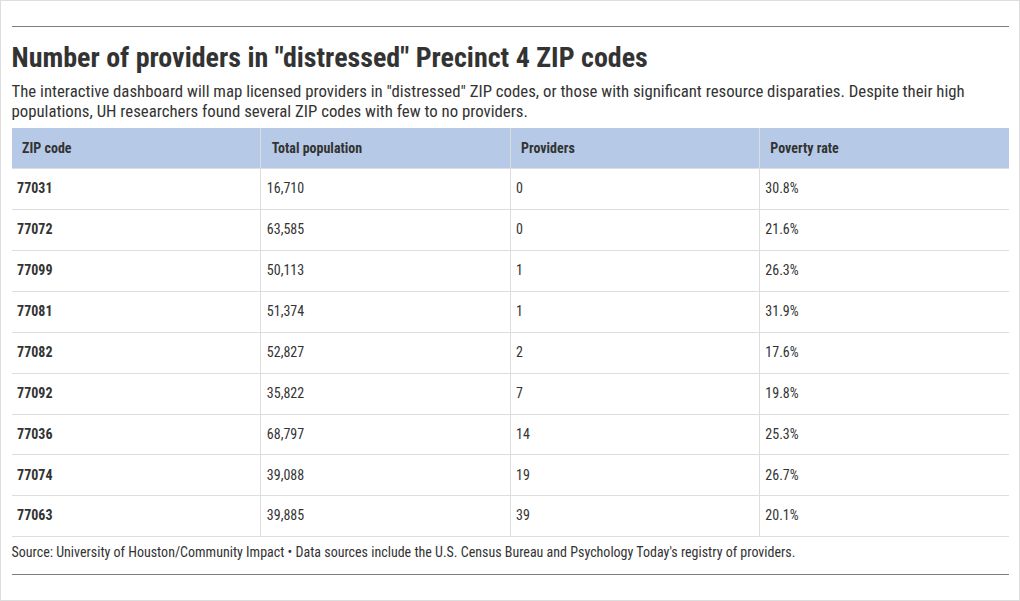
An analysis of nine distressed ZIP codes in Precinct 4 identified 83 licensed mental health providers—including psychiatrists, counselors, therapists and social workers—serving a combined population of more than 418,000 residents. Kelly said the data could explain why some providers in the area build up months-long waiting lists.
“[We’re] actually seeing those gaps and showing our policymakers that this is a real problem, not just something we think or we’ve heard,” Carmack told Community Impact on Feb. 16. “There are mental health gaps in services in these places, and the common thread is that distressed nature of the community.”
 Latest update
Precinct 4 is in the process of surveying residents to better understand stigmas and barriers to care that exist at the ZIP code level, policy advisor Larisa Baretto told Community Impact. She said UH will collaborate with Precinct 4 staff to release hyperlocal reports based on the survey results so future investments can be tailored to specific neighborhoods.
The survey is available in English, Spanish and Mandarin and will remain open for the next four to six weeks, Baretto said. She said the project is fully funded through UH’s Organized Research and Creative Activities Program, or ORCA.
The ArcGIS interactive dashboard is in development, Precinct 4 staff and UH researchers confirmed. Kelly said residents in distressed portions of the precinct will be able to select their ZIP code and view the closest mental health providers in their area.
Additionally, Kelly said the tool is designed to be digitally replicated so researchers and policymakers across the country can localize the map to their region.
“If you’re in a small rural community … some of those smaller communities may not have the resources to work with a university,” Kelly said. “We [will] have this out there so those places can see what’s going on in their neighborhoods.”
More to come
Baretto said the interactive dashboard of service providers will be made public by June. She said Precinct 4 plans to continue holding workshops after the launch to teach residents how to use the tool and continue the dialogue about mental health.
Precinct 4 staff will share more information about upcoming mental health workshops on the precinct’s website and social media, she said.
“We’re very hopeful that having this type of information will be able to inform investments and any partnerships we have in the future so that we can support a more coordinated approach to behavioral health and justice system planning,” Baretto said.