
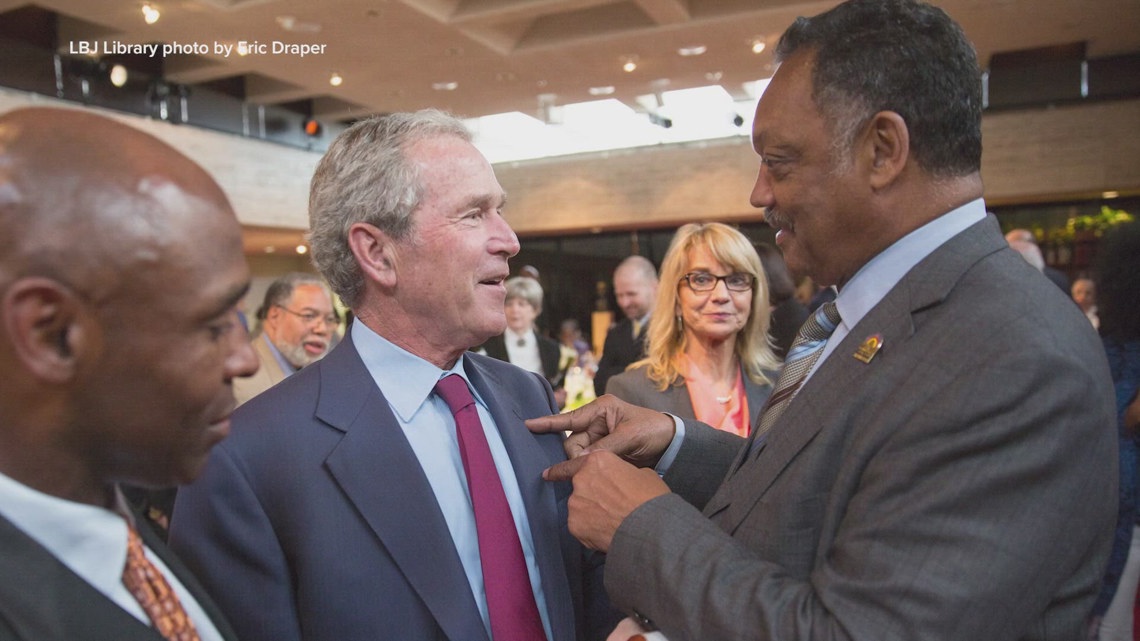
One elected official and community leader from Austin recalled meeting the civil rights leader and spoke about his legacy on Central Texas.
AUSTIN, Texas — Central Texans who knew or met Rev. Jesse Jackson are paying tribute to the civil rights leader, remembering his decades-long fight for voting rights and equality.
Jackson died early Tuesday at age 84.
Outside an East Austin polling place on the first day of early voting, State Rep. Sheryl Cole reflected on Jackson’s legacy and the timing of his passing.
“It’s fitting that we should be discussing him on the first day of early voting because he was an advocate for voting rights,” said Cole, D-Austin.
Cole said she and her husband learned about Jackson’s death early that morning.
“He also knew Reverend Jackson, and we just said a quiet little prayer that he’s in Heaven,” she said.
A personal meeting with ‘a giant’
Cole met Jackson in 2021 when the Texas Legislative Black Caucus broke quorum and traveled to Washington, D.C., advocating for federal voting rights protections.
She described the impact of meeting him.
“You feel like you just met a giant in person,” Cole said.
That same year, Jackson marched from Georgetown to the Texas Capitol, continuing a voting rights fight he had carried for decades.
It was one of several times since the early 1980s that Jackson crossed paths with Nelson Linder, president of the Austin chapter of the NAACP.
“He was always energetic, always reaching out to people, always accessible and always informed,” said Linder. “He took his charge very well from MLK. He went to a whole ‘nother level.”
He pointed to Jackson’s international work in South Africa and the Middle East.
Linder said Jackson’s legacy in Central Texas includes expanding voter access, advocating for educational opportunity and uplifting low-income communities.
Preserving history at the LBJ Library
Inside the LBJ Library, photos document Jackson’s last visit during the Civil Rights Summit in 2014, which included then-President Barack Obama and three former U.S. presidents.
On Tuesday, Museum Curator Lara Hall showed KVUE items donated from Jackson’s two presidential campaigns in 1984 and 1988, now used as educational tools.
“It’s used a lot in the education department, again, to sort of help students think critically about how elections are run and sort of how messaging works,” Hall said.
For Cole, Jackson’s presidential bids and decades of activism paved the way for future leaders.
“He paved the way for Barack Obama, and he paved the way for many African American politicians and others,” she said.
Moments after reflecting on Jackson’s legacy, Cole walked inside to cast her vote, on a ballot that now carries her own name.