
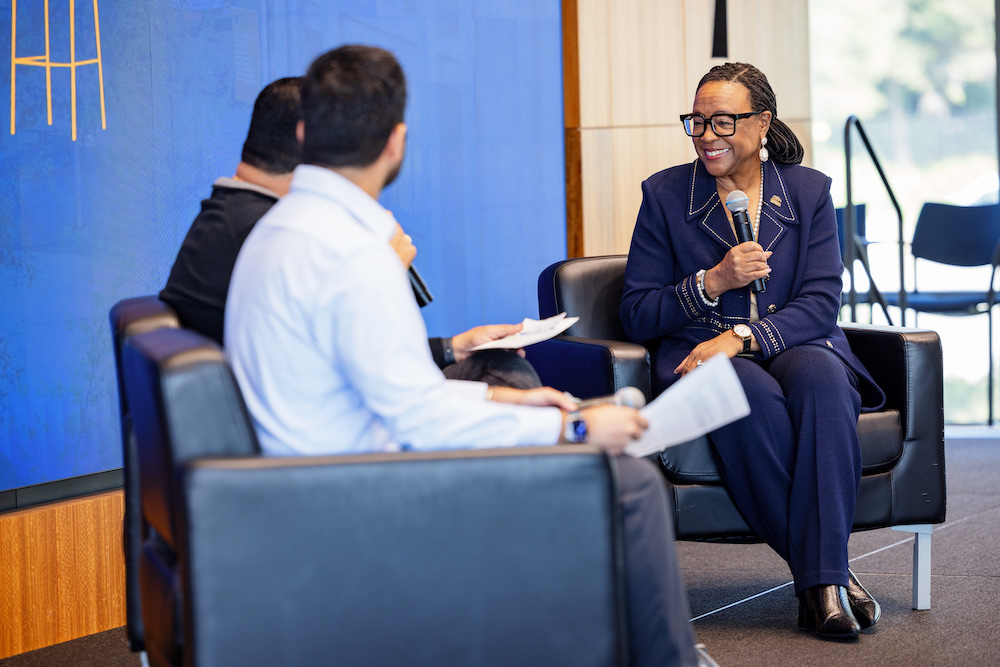
 Cynt Marshall, former CEO of the Dallas Maverick’s, at the Feb. 5 Dean’s Speaker Series. Photo: Katelyn Tucker
Cynt Marshall didn’t realize she was making history when she became CEO of the Dallas Mavericks.
But when she discussed her appointment in a later interview with the “Today” show she was succinct about what it meant to be the first Black female CEO in the NBA.
“It’s 2019. I shouldn’t be the first of anything,” Marshall, BA 81 (HR management), recalled at the Feb. 5 Dean’s Speaker Series talk, co-sponsored by the Center for Equity, Gender, and Leadership, in conversation with Aman Tiku, MBA 26, and Ravi Malhotra, EWMBA 26. “I wanted it to not be a second thought that a woman can be great in this job…I didn’t really take it as pressure because I’ve been a Black woman my whole life, right? I took it as an opportunity to show people that, yes, these jobs are for everybody, and then an opportunity to show the little boys and girls you can do whatever you want to do.”
Watch the video of Marshall’s talk:
Marshall stepped into the role in 2018 following a decades long corporate career—after receiving a call from then-owner Mark Cuban. The Mavericks were facing a crisis following a Sports Illustrated investigation detailing nearly two decades of misconduct on the business side of the organization. Though Marshall initially hesitated, conversations with employees convinced her she could make a difference.
“There was a problem to be solved, and I knew if I brought some folks together, we could get it done,” she said. To rebuild the organization’s culture, she started by having one-on-one meetings with every employee, drawing on a leadership philosophy she developed early in her career called “the “three Ls: Listen to the people, learn from the people, and love the people as people—not as employees.”
Marshall traced that philosophy back to her earliest role at AT&T, where she joined the fast-track management program after graduation. While she wasn’t entirely sure how to do the job when she started, she understood that leadership was about serving people.
“I show up on my first day at work, and I told them, ‘I don’t know anything about this, but I’m here to serve,’” she said. “And they laughed and said, ‘We know that. We know you don’t know anything about it, you’re 21 years old.’ They taught me everything I needed to know about leadership.”
Over the course of 36 years at AT&T, Marshall moved across roles in engineering, recruiting, and human resources, building a broader understanding of how the organization operated at structural and technical levels. “Get to know the company you’re working for,” she advised. “Yes, you have your niche, but I wanted to know everything about the company…Because I was open, willing to listen to my mentors, and willing to try two completely different things, it literally laid the foundation for me to have an exceptional career. ”
Marshall applied that same approach to learning the business of professional sports: She saw the Mavericks as not just a team, but a major business operation responsible for coordinating sponsorships, media, operations, marketing, and fan engagement.
That philosophy was especially important during periods of uncertainty, including during the COVID-19 pandemic, when the organization had to operate without fans while continuing to make a profit. Marshall compared navigating those challenges to a game, finding new ways to sustain the organization despite the disruption.
While she retired from the Mavericks at the end of 2024, she still consults through her firm, Marshalling Resources, which she founded in between her time at AT&T and the NBA. She also serves on corporate and nonprofit boards. She’s also the author of the 2022 memoir “You’ve Been Chosen: Thriving Through the Unexpected,” about her personal and professional journey.
“I want people to say, ‘She left it better than she found it,’” Marshall said. “That’s all I want to do, is leave people and things better because they met me.”
Listen to Marshall’s talk on the Dean’s Speaker Series Podcast:
JENNY CHATMAN: Hello, welcome to this spring’s first Dean’s Speaker Series. We’re so glad to have you here. Welcome. I’m Jenny Chatman. I’m the Haas School dean. It is wonderful to see you all. We have a magnificent lineup this semester, thanks to our wonderful student team who suggests incredible names and gives us the courage to ask them. And we’re starting off with an incredible guest here today. Well, I shouldn’t say she’s a guest, because she bleeds blue and gold. She actually has a watch on that’s a Cal watch. I wanna find out where you got that. That’s really very nice. OK. So I’m so excited to introduce Cynt Marshall. She’s a Cal alum. She’s spent her career focusing on building and developing workplace culture, which makes me very happy, as you know. She has, when she was CEO of the Dallas Mavericks, she led with authenticity and empathy to unite the organization, prioritizing diversity, equity, and inclusion, so much so that the Mavericks became a model for the NBA teams, winning the league’s Inclusion Leadership Award twice, which is quite magnificent. Cynt was also the senior vice president of human resources and chief diversity officer at AT&T, where she cultivated a strong workplace culture that placed the company on Fortune’s 100 Best Companies to Work For list for the first time ever. Of course, she didn’t stop there. Cynt went on to found Marshalling Resources, a consulting firm specializing in leadership development and culture transformation. She’s been widely recognized for her contributions to business and sports. She was named one of 15 of the world’s most inspiring female leaders in Forbes, and one of the 30 most powerful women in sports by AdWeek. She’s the recipient of Black Enterprise’s Women of Power Legacy Award, and she serves on several boards—I actually didn’t have enough fingers to count—including the UC Board of Visitors, the Naismith Memorial Hall of Fame, and Yahoo, among others. Cynt was honored as the Cal Alumni of the Year in 2025. Go Bears. Amazing. And so, Cynt, we know you are incredibly busy. We could not be more grateful for coming and spending some time with us so that we can learn from you. Thank you for being here.
CYNT MARSHALL: Thank you.
CHATMAN: OK. So let me give you a quick note about how we roll here. You have a card on your seat. If at any time during our conversation you have questions that come up, please write them down on the card, and Sarah and Carrie? No. Sarah and Holden will be picking them up, and then we’ll sort through them. Kelly McElhaney is gonna do a Q&A this time, which is fantastic. And so, let me now turn it over to our MBA students, Aman Tiku and Ravi Malhotra, who are going to lead the discussion today. Thank you.
AMAN TIKU: Great. So as the dean mentioned, my name’s Aman Tiku. I’m a second year in the full-time MBA program, and Cynt, we’re super excited to have you here and be able to learn from your incredibly diverse experiences.
MARSHALL: I’m excited to be here. Thanks for inviting me. Thanks, sister. I love you. Yes. And I’ll get you this watch. Yes. Yes. I’ll get it for you. And thank all of you, I want to thank all of you for being here, and it just feels so good to be back on campus. I love this place.
RAVI MALHOTRA: Thank you, dean, for the quick intro. I’m Ravi Malhotra. I’m an Evening and Weekend MBA student at Haas, and also a member of the Dean’s Speaker Series Board. I’m a CPNSE in the state of California and I currently work as head of accounting at a company called HeartBeam, which is solving the problem for cardiac care and to save human lives. And we are very excited to have you here and on behalf of the dean and this team, it’s really an honor to have you here—
MARSHALL: Thank you.
MALHOTRA: —today to talk through your journey, your leadership, and, you know, talking to our community about it. So, very excited. And thanks to all of you for being here to support us and listen to Cynt’s journey.
Let’s get started. We first of all would love to know the audience, to hear your story. You grew up in Richmond, California, and became the first of your family to graduate at UC Berkeley. What is the one early experience you’ll say that has informed your professional values, Cynt?
MARSHALL: When I think about just my upbringing and I think about how I ended up on this campus, and the day I stepped foot on this campus, I will never forget it. I was looking up at the Campanile, looking up at Sather Gate. Everything was just so big for me. I’m this kid out of the Easter Hill public housing projects in Richmond, and I just knew it was a moment in time where I was living somebody’s dream, and I was told to also have dreams. And I was also told, and I’ll give you my four words right now that I live by: dream, focus, pray, and act. And so, people had these big dreams for me. I knew I had to have dreams for myself, and I had to be big, and I thought about all of the people who poured into my life to get me to that point, and that continued here on this campus. People poured into me, my zip code didn’t matter, so it was just like the four educators who pretty much saved my life. I found the same on this campus. People didn’t care about my zip code, they didn’t care where I came from, they just told me to do it, and I just took advantage of it. And so, one of the values that I truly live by is around teamwork, and about collaboration and coming together, and knowing that everybody has a role to play and we’re all to do something for each other, and that is what happened to me on this campus. I ended up just doing all kind of fun, amazing things because people just told me to go and do it. I ended up in a sorority, learned a lot about teamwork, and just, you know, the sisterhood and all that. So, that’s what I took from here, is that we all need each other and if we all work together, we truly can help dreams come true, not just for ourselves but for other people.So, this is about helping your dreams come true.
TIKU: That’s great. Thank you for sharing that. And you mentioned teamwork as well, and we’re really excited to talk more about some of your leadership and your experiences working with others to transform cultures.
MARSHALL: Yes.
TIKU: So, we want to start somewhat at the beginning. You had a great success in your 36-year career at AT&T in inline staff, technical, and nontechnical roles.
MARSHALL: Yes.
TIKU: Tell us about some of your favorite roles and what you’ve cherished most from those experiences.
MARSHALL: Oh, I love that question. I had 15 different jobs at AT&T, three different states, six different business units. I came in on a fast-track management program, and I’ll never forget, I was recruited right here on campus, and so this was way back in the day.
OK, I had 13 job offers. And I said, “I want the job that pays me the most money” because I wanted to help, you know, my mom get out of the projects. I mean, she didn’t need my help, but I wanted to. And I want a job where I can be the boss. Now, I’m 21 years old, OK? But I wanted to be a supervisor, and the reason I did, because for me, being the supervisor meant you could serve people. And so, I knew at a very early age from my experiences growing up in leadership positions, my experience here, that leadership was about service, and so, I wanted to serve. So, I ended up accepting a job at AT&T in their fast-track management program, and I supervised 30 long-distance operators. So you guys don’t even know about that, OK? It was way back in the day where you called O, where you dial O. And so, these were women who—primarily women—who worked the short evening shifts. So they worked six hours because seniority, but they got paid for eight, and so, very seasoned. And so, I show up my first day at work, and I tell them, “I don’t know anything about this, but I’m here to serve.” And they laughed and said, “We know that. We know you don’t know anything about it, you’re 21 years old.” They taught me everything I needed to know about leadership. They brought me different challenges to help them through. I was open to them, and I ended up learning a lot about taking risk, and they had some changes that they wanted to make, and I was 21 years old, and so I would just go flying off talking to my bosses, and then when my bosses would say, “No,” I’d come back and they’d say, “No, go again, and do it this way, and do it this way.” And then, the union would talk to me, and I developed back then, in that job, a leadership philosophy that I use to this day, and it’s the three Ls, and—and if you see videos and stuff out there, you know I talk about this all the time—that, in order to be a very effective leader, and I’ve been blessed to have been that in my career, I have to do three things extremely well. That is: Listen to the people, learn from the people, and love the people. Listen to them at a level where I can hear what they’re not even saying, learn the job, and so at AT&T, I actually went to pole climbing school so I could learn what was really happening on the ground even though I was four levels above the people, and then, to love the people as people, not as employees. I learned that in my first job, at AT&T, and so, I loved that job because it taught me how to lead and it helped me develop my leadership philosophy. My second job was an engineer, and I loved that job because it taught me the company. And that’s what I always tell people, “Get to know the company you’re working for.” Yes, you have your niche, but I wanted to know everything about the company, it’s a technical company, so I was an engineer, and then I left there and went to human resources to be a recruiter for the engineering department, and that’s when I learned about not just the technical aspect of the company, but the structure of the company. So my first three jobs, because I was open, willing to listen to my mentors, and willing to try two completely different things, literally laid the foundation for me to have an exceptional career. So, I love all three of those jobs, and I loved all 15 of my jobs.
MALHOTRA: That’s amazing, and I can see that the importance of learning in your career has contributed a lot
MARSHALL: Yes.
MALHOTRA: So let’s switch gears to the second stint you had. After a long career at AT&T, you took a very different, highly public role as the CEO of Dallas Mavericks.
MARSHALL: Highly public.
MALHOTRA: Yes.
MARSHALL: Like I’m in the witness protection program right now, but highly public.
MALHOTRA: And let me just tell you, because I didn’t know anything about basketball if you asked me five years ago, and now my kid is playing one, so I get to know everything about basketball.
MARSHALL: Oh, you get to know everything now.
MALHOTRA: Pretty much.
MARSHALL: You’re an expert.
MALHOTRA: So yeah. And then following the claims of you joined the company following the claims of sexual harassment for decades in the organization, what gave you the confidence to step into such a high stakes role at that stage of your career? If you can share some thoughts.
MARSHALL: I’ll definitely share some thoughts. So first of all, so again, like you said, I had my 36-year career, retired, starting my own consulting company, and actually was on the phone with one of my clients when my cell phone kept going off. And I have four kids, two of them were in college.I actually thought it was one of my kids texting for money, ’cause, you know, just blowing up my phone. And so, I literally gave my husband my cell phone, and I said, “One of the kids needs money. Take care of it.” And he came back a few minutes later, and he said, “This dude doesn’t need any money. It’s Mark Cuban calling you.” OK, don’t laugh at me, don’t judge me. I said, “Who is that?” I didn’t know Mark Cuban. And so, he’s trying to tell me who it is, and then, he said, “There’s some kind of crisis going on.” So one thing led to another, he called my son, cause I still wouldn’t call him, right? Cause I got my consulting business, it’s like, everything is working for me. So I ended up talking to him, and I ended up going to see him. And in fact, I told him I could not come and see him when he wanted to talk to me because I had a mammogram scheduled, and I had learned the hard way what happens when you don’t take care of your medical business, cause, of course, you know, I’m a cancer survivor. So he said, “Well, I’ll come out there.” I’m like, “No, you don’t need to, like, come to the mammogram, OK?” And he wasn’t trying to. He was trying to make it easy for me. The Mavs were in a crisis, and someone had given him my name. And so, when I ended up going to see him on my way there, cause preparation is huge, I read the article, and I had my husband read the article. And by the time I got to the building, I had actually decided I wasn’t going to talk to him. And my husband, who was decked out in Dallas Mavericks colors—literally decked out in Mavs colors, and he said, “No, let’s, we have to go in there and talk to him.” So we went into the building, and I spent 55 minutes with Mark. And as he described to me what was happening in the organization, which was, a Sports Illustrated article had come out, and it was basically almost 20 years of sexual harassment, misconduct, inappropriate behavior on the business side. And the more he talked about it, and he described why he asked me to come and see him, that he needed a leader. I said, “I don’t know the business of basketball. I am a fan.” In fact, when he called me, I actually had on Golden State Warriors sweats and a Cal-Berkeley baseball cap, right? So, and my husband’s like, “You got to change clothes.” So, I said, “I’m a fan, but I don’t know the business of basketball.” And he said, “That’s OK. We’ll teach you the business of basketball.
I need a leader.” And the more he described what was happening in the building, the more I thought, “OK, just, maybe I will do this.” So I told him I’d go home and pray about it, but two women stopped me as I was leaving his office and told me their stories. And as they’re telling me their stories, they started crying and said, “We think you can have an impact on us.” And coincidentally, I had written a blog and posted it that morning, called “Impact.” And they said it four times, and I said, “I better go home and really think about this.” And I did. I came back the next day, I was in the building for three hours, and Mark didn’t even know I was in the building. Employees just pulled me into the office, and because I have learned to listen, I just sat there for three hours listening to them. And when I really thought about what they needed, I said, “I am actually uniquely qualified to do this. I know how to lay out a vision, and that’s what they need. This place needs a set of values, and I know the importance of having a set of values, living by a set of values, but leading by a set of values, and working every day, and serving customers based on values. And then, I know how to pull a team together because I’m about teamwork. I actually think if I get the right people around the table, and the other people who need to leave out of here, we actually can create a great place to work.” And we had done it at AT&T, and I thought, “OK. Somebody will teach me the business of basketball.” And I ended up saying yes, and now I do know the business of basketball—and the place operates with a vision, values, and a workplace promise that says every voice matters and everybody belongs. But it was all of my experiences coming together, and some convincing from Mark that it wasn’t a hindrance not knowing the business of basketball. And I am a quick learner, and I love to learn, so for me, it was also an opportunity to learn, at 58 years old at the time, to learn something new. So, but I was uniquely qualified to do it, so I ended up saying yes, so that’s what gave me the confidence. But I had to understand what the problem was, and I’ve always been a person not to really chase success. I look for impact, and look for problems that I can solve, and it was a problem to be solved. There was a problem to be solved, and I knew if I brought some folks together, we could get it done. And we did, and I’m about, you know, a happy workplace. And here it is, you have these people. I did one-on-ones with every single employee. My first 90 days, every single employee. And I’d start out, one way, I would say, “Give me your life story.” And so they’d say, “Oh, this is my seventh year at the Mavs,” “My 10th year at the Mavs.” And I said, “Were you born here?” Like, “Give me your story; I want to know your story.” And I just start falling in love with these people. And then, I would end my sessions the same way. I’d say, “Tell me where you see yourself five years from now, personally and professionally, because my job as the leader is to help you accomplish that.” And the more I talked to these people, I just loved them. So then, I remember calling in the women, the folks who I brought in with me, and I said, “I love these people, and they deserve a great place to work. They deserve a great career in sports and entertainment the way we had a great career in communications.” And I just asked my team, “Are you all in? Don’t do it for me, do it for them.” And so, they were all in, and we put together a 100-day plan, and we got it done. Yeah. That’s the story. It was that simple. Yes.
TIKU: Thank you for sharing that really moving story about, you know, the cultural transformation at the Mavericks. We, you know, you’ve been previously named as one of the most powerful women in the sports business, and you—
MARSHALL: That’s what they say.
TIKU: And you mentioned before, you didn’t know much about the basketball side of business, right? What have you found intriguing about the industry in your years of experience while there, and what do you think it takes to be successful in the business side of sports?
MARSHALL: Love that. I truly love our industry, No. 1, because I think it is the great unifier. Sports brings people together. You go to a game, you go to an outing, and it doesn’t matter, you know, people’s political beliefs, their socioeconomic status. I mean, none of that matters. People are cheering for the same team. And so, I love that about our industry, and so, and then we get a chance to take that unity and do something special with it in the community and otherwise. So, I love that. What I also love about it is just what it brings in terms of skillsets, just the teamwork, the discipline, the desire to win, knowing how to lose gracefully, all of that. I also like the fact that it is truly a business, and I’m a corporate person, so I’m about profit and loss. And some people will say, “Oh, yes, well, to own a team is just somebody’s hobby.” Well, if I’m running it, it’s a business because it is a business, and it was a $4 billion business. And so, I love that we get a chance to run a business but also have fun. It’s a lot of work, a lot of games, a lot of stuff that goes into it, but it’s fun. What I also love about it, and this is what I did not truly know, is the ecosystem. Everything that goes into it, all the people who touch it, the agents who touch it, all the media and broadcasting aspect of it, the marketing piece, the sponsorship piece, all the sales, the everything behind the scenes. I had no idea all of that happened for these players to hit the court. So, I love all the diversity of it from the standpoint of all the different piece parts, and as a leader, how you have to bring that whole ecosystem together to be profitable, but then also to win. So, it actually ended up being much more exciting than I thought it was going to be. I loved it. And it’s a great industry to be in, because it really is entertainment. It is about putting on a show. My team, we had 82 games. My team was responsible for the 41 home games, and we had a lot of things that we had to do for the away games too, but I would tell my team, “We have 41 parties to throw for 20,000 people, and everything has to be perfect from the beginning to the end.” And so, that’s how we approached it, that we had a party to put on, and it was fabulous.
MALHOTRA: That’s so amazing. Like, throwing one party for a big family or something is challenging. I think doing that for, I can imagine, the way you put in, it’s pretty interesting doing that.
MARSHALL: And you have a lot of metrics that you’re trying to figure out. OK, you need the place full because you. You gotta make money, so you’re looking at the drop count, who’s showing up, how do you get them there, all of that. And then you have something hit like COVID where you can’t bring people into the arena, but you still have to make money. So then you have to figure out, OK, so how do we do that? How do we bring the games to people? How do we figure out how to make money? And then you have to get innovative, and then you have to figure out with your sponsors how to make sure that their advertising and their logos are showing up on this virtual court. I mean, it just takes you to a whole new level, and we actually ended up still being profitable during COVID. But you just deal with it. It’s like anything else. It’s a game.
MALHOTRA: I think you talked about, earlier on, about making an impact and the importance of impact in your life, and I think you have been previously named one of the most powerful women in sports business. What have you found intriguing about the industry specifically, and what does it take to be successful in this business side of sports? You shared some of it already, but I think anything specifically you’ll say for the people who want to be part of that community, any tips for them?
MARSHALL: Well, I think, and I alluded to it with the ecosystem, there are so many things you can do, and that’s what some people don’t realize. Like, I had to hire a general counsel. I have the human resources team, which is kind of the engine for the whole place. We have our analytics team. Then, oh, and that’s just on the business side, you have all that. And then, you have your sports professionals, your medical people, and all that. People see the 15 players sitting there on the bench, but there is so much. So if you think about it just a corporation, all the different functions, the support functions, and all that, that all is operating on a sports team, and then a whole lot more. So I would ask people to really stop and study the sports and entertainment industry, and you will find a place there. I don’t care what your major is, you will find a place in that industry, and it’s a growing industry. We’re not even just going to talk about what’s happening with women’s sports and how that is growing. And, in fact, where is where is Kellie out there? Yes. You all know about LAWS, right? Leadership Academy for Women and Sports, Women for Sports? What is happening right here? OK. You know all about that? How many of you know about LAWS is launching? OK. Oh, it’s amazing what is happening there. So, even when you just think about what is happening with women’s sports and the economic impact of that, how it’s bringing more careers for people, it’s amazing. So, this is the time, too, to get involved in this industry.
TIKU: Great. Yeah, and on the industry point as well, I think it’s important for everybody in the audience also to learn that you were the first Black female CEO in NBA history. And so, we are really also curious to understand how you navigated the pressure of being in that role, knowing that your leadership could inevitably be scrutinized differently compared to others.
MARSHALL: OK. So first of all, I’m used to working in a male-dominated environment. As a woman, and a Black woman, I’m used to being under scrutiny. I mean, story of my life. I didn’t know that I was the first black female CEO of an NBA team until Craig Melvin from the “Today” show actually told me in an interview, and he asked me the question. So I’m in New York, because it was big deal, cause the the whole scandal was a big deal. So then, I had all this media stuff to do to just kind of try to help with our brand, and that was part of our strategy. And so, Craig asked me the question. He said, “How is it being the first Black female CEO of an NBA team?” And I responded, I said, “I actually don’t believe that.” And I got the job in 2018, but it was 2019 when I did the interview. And I said, “It’s 2019.
I shouldn’t be the first of anything in 2019.” And he said, “Well you are, so what are you going to do with that?” And I thought about it, and I said, “You know what? I better do a good job. In fact, I better do a great job.” Because now people are watching, and I want it to be to where it’s not even a second thought that a woman can be great in this job, not even a second thought that a Black woman can be great in this jobI want it to the point where I do such a great job that people are looking for people that look like me to do this job. And so I didn’t really take it as pressure because I’ve been a Black woman my whole life, right? So I didn’t take it as pressure; I took it as an opportunity to show people that, yes, these jobs are for everybody, and then an opportunity to show the little boys and girls you can do whatever you want to do. There’s no job that’s off-limits. So it was actually fun. Even sometimes when I didn’t want to be high profile, when I didn’t wanna go out and do certain things, my team would always say, “Cynt, you gotta do it for the boys and girls. You gotta do—you’re a role model. I’m like, “OK. I’ll go and do it.” So, I actually took it as a very positive thing once I got over the shock of the fact that I was first.
MALHOTRA: That’s so amazing, and I think taking it a bit further, given the meteoric rise of professional women’s sports, how do you see this moment shaping broader social impact and also benefiting communities beyond athletics?
MARSHALL: I love where we are with women’s sports right now. Just from a pure community standpoint. Well, let’s start just with role models. I love the fact that people are starting to see leadership in a different way, that with women’s sports, you’re seeing and just, not just women’s sports, but women in sports. You’re seeing leaders that, you know, come out, and they look different. And so, that’s something we want our kids to see because we want people to aspire for these positions. So, when you see women in these leadership positions, you see women playing these sports, these young girls know, “OK, I can do that.” So, I like that just from a pure responsibility standpoint, from a representation standpoint. What I also love about what’s happening with women’s sports is just the economics of it all. I mean, this is a time where people are investing. I mean, I’m actually on a board: Ariel Investments, so Project Level, where we just announced a fund around women in sports. I love the money that is going into this and how women and others will basically benefit from that. So we all know this. To invest in a girl, to invest in a woman is an investment in society. We know that. We know the role that women and girls play in society. And to see that we’re taking that to a whole new level when it comes to sports is exciting, very exciting, to me. And then, the opportunities that it’s giving people who are in the pipeline right now, who are sitting out here, who decide, “You know what? I want to own a team.” I tell people, “Don’t just stop with the CEO. Own the team.” I mean, think, have that mindset that you want to own one of these teams, and yeah, the women’s team, but also a men’s team, too. And then, I like the fact that the men are getting behind it. It really is bringing everybody together, which I also look for that too, the fact that it’s really promoting inclusion. And then, it’s another opportunity to have those teams also invest in the community. So, from a community investment standpoint and economic development standpoint, what it’s doing, think about the ecosystem that’s being developed with these teams coming in. The different agencies and the different businesses, the small businesses that are being born now because of the rise in women’s sports, now it has its own ecosystem, just like what’s happening, what has happened on the side for the men. That’s great for our economy, meaning it’s great for people in their careers and their lives. So it’s just good all the way around. There’s no downside to it, and it’s an exciting time to be involved in it.
TIKU: That’s awesome. Yeah. On the career advice side of things, obviously, your career has remarkable longevity and reinvention over time. We’re curious to know how or what kind of advice you would have for all the young leaders here in the room to think about timing. When to stay somewhere, when to pivot somewhere else, when to say yes to something unexpected?
MARSHALL: What I would say, and I have been the beneficiary of having people pour into my life to tell me to always stay open. And that’s what I will tell all of you, to stay open to the possibilities. I never had it on my list that I was going to be the CEO of an NBA team. I just got a call. But I was open and I was ready to do it. Your skills are transferrable.
There are some basic things you need to have around just being able to learn. Being able to have, you know, effective communication. To, you know, great interpersonal skills.
Emotional intelligence is huge. And yes, we know how to do spreadsheets and all that, but the spreadsheet might get you in the door, but it’s the emotional intelligence, the ability to gain trust from people, leading with values. Those are the things that will keep you there and that will get you elevated. So, be open to the opportunities, but bring a certain skillset with you and really focus on values, trust, emotional intelligence. Not just the spreadsheet, but you’ve got to know that, too.
MALHOTRA: On the organization side, I think some of the people here might be starting their companies soon or they may be already started. If they are leading the organization through significant change, how do you ensure the short-term results stay in line with the long-term vision of the company? Your thoughts on that.
MARSHALL: I am very big on checkpoints. So when we were at the Mavs, we had our, you know, we laid out a vision. We had our values, our workplace promise and all that, and then we laid out a business plan. And we created the business plan with everybody involved. I’m very much into the business plan has to have input, so our process gathers input from every level, so it’s not a top-down business plan. And so, once we all come together, and I will do things, like my team would have people come in. We’d put our hand in paint. We’d put our handprint up on the wall, all that kind of stuff to basically say, “We’re all in.” I need to know that people are all in. And once we do that and we lay out the plan, we lay out the strategy, we lay out the tactics and all that, we have regular checkpoints, and in our case, we call them huddles. And so, we check it. And if people start giving readouts on things that aren’t a part of the plan and all that, we always say, “Let’s go back to what our purpose is.” Always go back to the purpose, to the vision. Now yeah, you have to change, you have to be able to pivot, but regular checkpoints to make sure that we’re all in line and we’re focused on that long-term vision, because it’s so easy for people to get off track. But you have to have the regular checkpoints, because if you don’t, you’ll end up working on things that have nothing to do with your purpose, with your strategy, and what you’re supposed to be working on. And my huddles are usually weekly. Yes.
TIKU: Great. Thank you for sharing that. As we begin to wrap up, you know, this part of the Speaker Series—
MARSHALL: I don’t want to leave.
TIKU: More to be done. We were curious as well to understand, you know, when people think about your leadership across diverse business environments over decades, what do you hope to be remembered for the most?
MARSHALL: I have the same answer for that professionally as I have personally. And so, I’m going to tell you what I’ve always told my family and what I’ve told the people who I’ve been blessed to have on my team. I want people to say, ‘She left it better than she found it, and she left me better than she found me.’ And I actually just got a LinkedIn message a couple weeks ago, where this woman, well, I didn’t get the message. This woman is commenting on something, some article that’s out there. And this woman comments, and she said, “I want to tell you a story from many, many years ago when I met Cynt Marshall.” And I started reading this. And I’m like, I hope it’s good, right? And so, she tells this story, and I can vaguely remember it. She tells this story about when she had just started her career, and in our law department, and she said she didn’t have the kind of clothes she thought she needed to wear. And so, she’s going through this whole thing, and she said, “And I got on the elevator with Cynt Marshall, who was my boss’s boss’s boss’s boss.” So it’s like four bosses in there. She says, “And I never will forget how she looked over at me, and she called me by name, said she liked my scarf, and went on to talk to me about what I was working on.” She says, “And then she saw me again, and did the same thing, and I realized she actually knew me and cared about me.” That I’m worried about how I’m gonna show up, I’m worried about all this stuff as a new employee, and here, this woman at that level actually saw me, and she gave me just what I needed to kinda shift my mindset and realize that I added value in this company. Now, you know I was not thinking I was doing all that when I stopped and spoke to this woman and complimented her and knew her name. I mean, I know the employees. But for her to be telling that story, and that had to be 15 years ago, it brought me to tears when I read it. And she talked about being better. I said, “That’s all I want to do, is leave people and things better because they met me.” That’s all I want. That’s our purpose. That’s all I want.
MALHOTRA: I wish we had more time and just wanna end with our final question, which we are asking all the Dean’s Speaker Series guests this academic year. The question is: What matters to you most if you had an extra week in your life right now with the—
MARSHALL: Where’s Kelsey, my chief of staff? She’d love it if I had an extra week in my life.
MALHOTRA: And she’ll be happy.
MARSHALL: She’d schedule more meetings.
MALHOTRA: But I think we’ll keep it free.
MARSHALL: She said vacation, she’d give me a vacation.
MALHOTRA: Yeah. And let’s assume you have an extra week with nothing on there, and nobody’s gonna grab that time from your chief of staff team, with no specific responsibilities or obligations, what would you do with that time, and why?
MARSHALL: I actually know exactly what I would do with that time, OK? So I have this vision, and it has nothing to do with work. I’m a big advocate for children who need permanence and stability. All four of my kids are adopted out of foster care. And so, I have this vision, and it’s based on two books that I read before, “Bring on the Blessings” and “Hope Meadows,” and I want these villages set up for kids who are “unadoptable.” So it’s usually like the preteens and the teenagers, and then there are people who want to love them, the people who loved up on me. Teachers, I mean, I love educators, I just truly think educators are the best people on the planet. OK? Because they don’t get paid a whole lot of money, but they are pouring into you and investing in you. And so, I would get educators, social workers, people who just want to pour into these kids and who haven’t given up on them, and I would create these communities and these villages where instead of people in the system giving up on the kids, they’d have communities to live in so that they could thrive. And I would start that in California, North Carolina, and Texas, so the three places I’ve lived, and then, we would scale it. So that’s what I would do. I would go talk to people who have started this and people who are interested, and I would literally take that week and lay out a blueprint. And then gather the money, and we launch it. That’s literally what I would do, is lay out that plan.
KELLIE MCELHANEY: So I get to pick the best questions from you all, which is a lot of fun. This is my favorite, to be honest. “Looking back at your career, what was your one 3-point moment?” Or I should say, one of your 3-point moments?
MARSHALL: One of my 3-point moments is when we got the call from the Great Place to Work organization, and actually, they’re headquartered right here in the San Francisco Bay Area. When we get the call saying that AT&T had made Fortune’s 100 Best Places to Work list for the first time ever in the history of the company because of the work that we did and the team that I pulled together, once we actually decided to focus on employee feedback and stop ignoring what the employees were telling us, and got serious about taking care of our people. And we didn’t do it to make a list, but it helped that it made the list. So that was my 3-point moment.
MCELHANEY: You mention this word a lot, and I think this was the first question that came in, and it ends with, but I’m gonna start with, “Loving people as people seems to be something we see less and less of today.” So, how do you advise this student about finding and/or drawing the line at organizations to have leaders who lack the enthusiasm and the love? Was that too long of a question? Just, how do you find jobs that are led, at organizations that are led by people like you?
MARSHALL: I’m sorry. How do you find?
MCELHANEY: Where do you draw the line when you don’t see organizations who are led by people who have the enthusiasm and the love?
MARSHALL: Well, sometimes they just don’t. And usually when I take over an organization. And I talk about my three Ls and what my expectations are, usually probably half my leaders around the table, say, “Cynt, you need to help me.” Like, we really need to spend time together. So I can understand what you mean by about, the listen piece they get, they learn from the people they get is to love the people as people. And so, sometimes people don’t get that, and you try to work with them. And you don’t always work for people like that, and that’s something you have to know. I mean, you don’t always get a chance to pick your bosses and so you’re blessed when you’re in an organization where they truly care about people, and it translates into results because usually when you have organizations that don’t care about the people, they don’t last too long. The results show up.
MCELHANEY: Following up your, to your Maverick story, how do you create a team? So when you went into the Mavericks, how did you create your team? Were they internal? Were they external? And what did you look for in the people?
MARSHALL: OK. It’s a mix. And I always, no matter where I am, I have something that I always have: the HR person, my lead HR person keep is I call the moving and shaking and moving around report because I believe that people need opportunities. So I brought some people in with me, obviously, because I had to. I had to bring in a chief human resources officer. I had to bring in a chief ethics officer. They didn’t have a General Counsel. So I had to bring that in. So some jobs I had to bring in my own chief of staff. And then I got a chance to meet people to see, OK, who are the high potentials here? Who has an opportunity to kind of rise. Even though it’s a crazy situation, something good always comes out of a crazy situation. So who has the opportunity to rise? So we did promote some people and then of course I had to bring in some others. We did some lateral moves and, and I’m always very aware. I am 100% obsessed with making sure everybody is getting opportunity because I truly believe that the people who are in there working hard, you need a pipeline, and they need to be able to see opportunities in there. So it wasn’t just that we kind of gutted everybody and brought in new people. I did have to escort the people out who had been, who had engaged in misconduct. So it was a fair amount of exits at the beginning but then other people kind of came up, which was great. So it was all of it. It was a mixture of promotions, laterals bringing people in from the outside. It was all of it, which was great.
MCELHANEY: So I have three questions left. This kind of follows on. It’s great with your leadership being as kind as and intentional as it has been. How do you maintain that when you grow from five to 10 to much larger cultures that you’ve created? What’s been your experience balancing culture with leadership growth?
MARSHALL: It’s all of it. It is actually, it’s the foundation. You have to have a great culture, and I am so focused on making sure. I tell our team, “Our values will not just hang on the walls. They will operate in the halls.” And those values are, they spell “CRAFTS”: character, respect, authenticity, fairness, teamwork, and safety, both physical and emotional safety. We hire by that. We live by that. We lay out our business plan by that. All of our actions are done that way, and I love it when you hear employees start to call things out saying, “I don’t know if that’s emotionally safe.” Or, “Cynt, I don’t know if that reflects, you know, integrity.” You want more of that. As you grow, you have to have that or you will not grow effectively. So it’s not one or the other. You don’t sacrifice culture because you’re trying to get results. Culture will help you get the results.
MCELHANEY: This is probably a follow on to that, and I promise this is not my handwriting. Do you believe inclusive value, inclusive-driven cultures can be a competitive advantage in business and professional sports? Are there times when professional pressures kick out the inclusive part of it?
MARSHALL: No, you, I’m, I’m all about inclusion and, and you know that. I mean, you know that. And what I tell people is, and I actually have spent a lot of time helping people understand the difference between diversity and inclusion. And diversity is, you know, it’s the ingredients, OK? But inclusion is the recipe. It’s how we mix it all up so that we can all work together. It’s taking everybody’s differences and not just the ethnic differences, the gender differences. It’s all the differences. Our backgrounds, where we come from. It’s all that. I mean, if you talk to people in this room, you would just learn all kinds of things about their backgrounds that we all throw in the mix to help make decisions about customers we serve, sponsors we need to get, how we’re showing up in the community. You need all of that in the mix, and you need to hear from all of that in order to have a successful business. So it’s all about inclusion. Everything is about inclusion.
MCELHANEY: And Cynt, you know that this is my favorite Cynt question. Being in a leadership position at such a young age, did you ever face skepticism or have people underestimate you due to your age?
MARSHALL: All the time. All the time. And I tell people, I used to think it was a blessing to be young, gifted, and Black, OK? But not everybody saw it that way. And so, yes, I did have a lot of situations that we don’t even have time to talk about where people questioned me because I was so young. But they saw that I wasn’t arrogant, that I was open to learning, that I was there especially as a leader to serve them, it was amazing how people would rally around me. And then, I mean, I literally had people on my team, all older than me, who were pushing me to get promoted, and I never went for a promotion in my entire professional career. I never sought a promotion. In fact, I turned down four of them in my career because there was something else I wanted to learn in the business. But people would come to me with jobs. My team members, older than me, would push me because they wanted to see me elevated. They wanted to see me with more responsibility because of the kind of leader that I was. So early in my career, some people didn’t like it. As they got to know me, it actually worked out OK.
MCELHANEY: Cynt, thank you so, so much. I didn’t introduce myself. My name is Kellie McElhaney, and I founded Center for Equity, Gender, and Leadership, and I’m professional faculty here. But just some themes. I’m really lucky that I get to spend time with Cynt. She talked about the boards she serves on. She serves on Kellie McElhaney’s personal board of directors. She didn’t mention it cause the pay is still really low. But maybe some day. But, “pour into people,” is something that I really, just really resonated that you said, Cynt. The, “listen to, learn from, and love the people.” I love that you talk about “we” with you and Kenny. It’s all the way through your book. Kenny is just as much a part of this book as Cynt is. Impact over chasing success. Looking for problems to solve. The question, “Give me your story?” I teach a course around storytelling, origin leadership story. It’s so powerful, and the fact that she remembers this, I mean, that is the sort of leadership stuff that sticks with people. Always stay open, but my favorite part of this book, it’s pretty daunting.
I know, I’m supposed to say it in the microphone.
MCELHANEY: To wear red shoes on Berkeley’s campus, but Cynt came into my class on women and leadership about 10 or 11 years ago, and told the red shoe story, which was that, at some stage during her career, she was told to take down her braids. I love that you used the word “blessed” so much today. She was told not to use the word “blessed” in her work language, and not to wear her red shoes, and she told this story in my undergrad course, and just a year ago, I shared with Cynt, I had one of the women that was in that class, a woman of color, who came back to a Haas event and said, “I will never forget you bringing” I thought she was saying me, but it was not. “It was bringing Cynt Marshall into class and telling the red shoe story.” And I looked down, and the woman had red shoes on. So, thank you, so much. And that’s her book. Thank you, Cynt.
MARSHALL: I love you. I love you. I love you.