
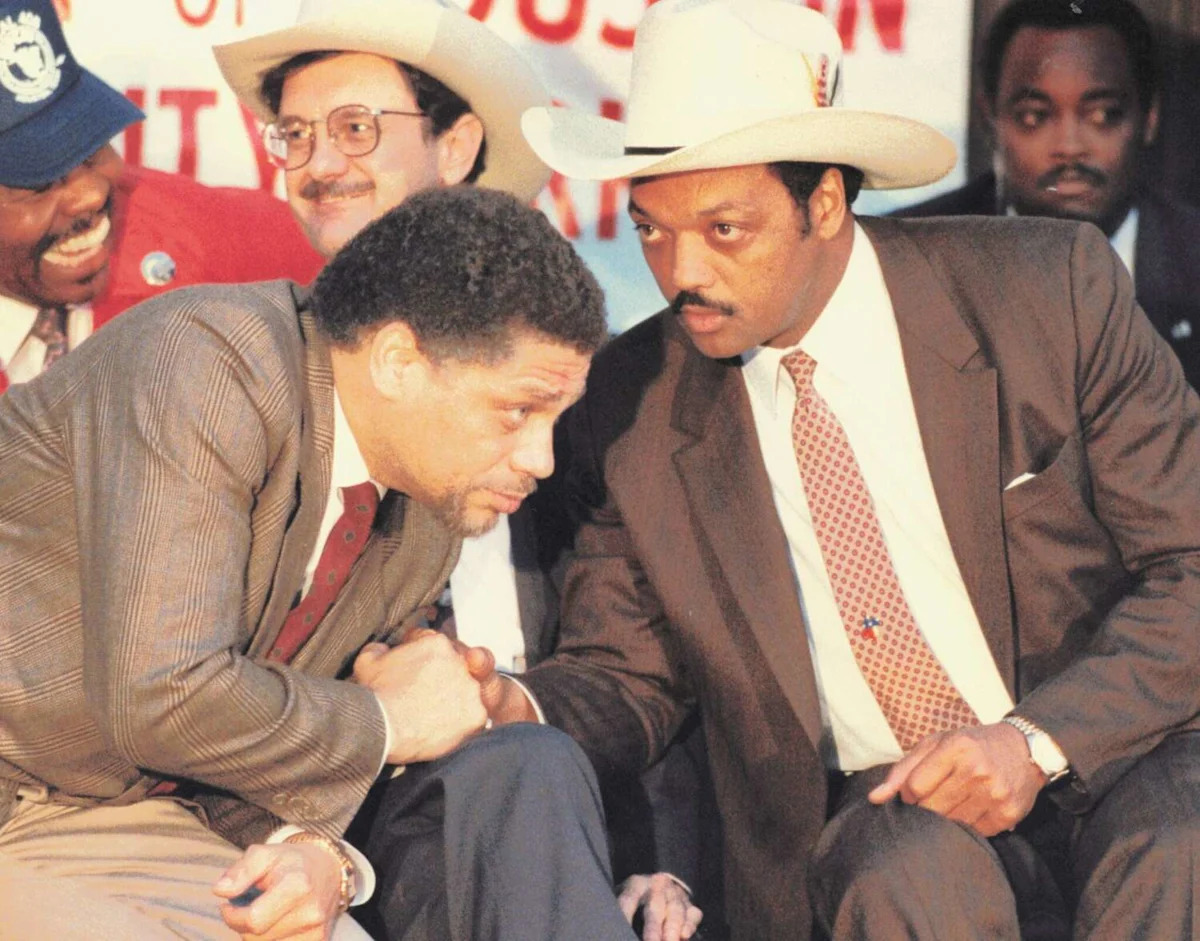
The photo has softened with time, its edges blurred by the years, but the moment is still clear. Two men stand shoulder to shoulder, their hands clasped together and lifted high in unity.
They were the Rev. Jesse Jackson and the late Congressman Mickey Leland at the podium in Houston. I can’t remember the exact year now, only the feeling. I was a journalism student then, standing somewhere in the crowd and caught up in the electric energy of the event.
Jackson’s voice roared across the room like a wave as he repeated his impassioned familiar refrain “Keep hope alive!” and “I AM somebody!”
RELATED: The Rev. Jesse Jackson dies at age 84. Here are the times he visited Houston.
It was a promise of hope, more than a rally.
When I learned of the death of the 84-year-old civil rights leader today, I found myself searching for that photo with no luck. I know it’s somewhere, tucked in a bin of a hundred other images, that weave together my life story.
For generations, Jesse Jackson was a champion for the poor and underserved. In 1971, he formed Operation PUSH (Power United to Save Humanity) to advance economic empowerment, civil rights and corporate accountability. In 1984, the year he launched his historic run for U.S. President, he started the National Rainbow Coalition. He ran again for president in 1988.
Jackson embraced the rainbow as a metaphor for unity. His work was rooted in standing up and speaking up for those who had nothing.
Houston was a regular stop on his travels to fight injustice as he stood beside the Rev. Martin Luther King Jr. and the late Rev. Bill Lawson, founder of Wheeler Avenue Baptist Church, who was one of the few local ministers willing to accept Dr. King into his church. King’s last visit to Houston was to put on a fundraising concert featuring Aretha Franklin and Harry Belafonte.
That friendship with Lawson connected Jackson to Houston’s Black community for decades.
One of the most significant Houston moments came during his second presidential run. On March 8, 1988, Super Tuesday, Jesse Jackson and his wife Jackie clasped hands in triumph at the Albert Thomas Convention Center, now Bayou Place.
After the collapse of Enron in 2001, Jackson and the Rainbow PUSH coalition launched a “Journey to Justice” bus tour that started at Antioch Baptist Church in downtown Houston and ended in Washington, DC. Several buses were loaded with Black Enron employees who lost everything – their jobs and pensions – in the company’s accounting debacle. The buses stopped at various civil rights monuments along the way.
Harris County Constable James “Smokie” Phillips was part of Jackson’s security detail that rode with him on one of the buses. Phillips was also with Jackson at the execution of 38-year-old death row inmate Shaka Sankofa, formerly Gary Graham, in Huntsville in 2000. The case drew international attention because Sankofa was just 17 years old at the time of his arrest for murder during a robbery in Houston. He was convicted on the basis of one eyewitness and no forensic evidence.
“Jesse Jackson was about equal treatment for everybody. He believed everyone deserved a seat at the table to enjoy the benefits of America,” Phillips said.
In July 2018, Jackson joined Harris County Commissioner Rodney Ellis and several other community leaders for a roundtable discussion on economic injustice in Houston. They addressed a lawsuit against Harris County’s cash bail system, and Jackson spoke about the importance of registering two million Latinos to vote.
Then in August 2024, Jesse Jackson, who had been diagnosed with Parkinson’s disease, appeared, though frail, at the funeral service for Rep. Sheila Jackson Lee at Fallbrook Church.
I would imagine it’s hard for younger generations to watch old videos of Jackson during rallies of his heyday and understand what he meant to so many people.
He was not just some old man spouting political rhymes. He was a loud speaker for those across the country who felt unseen and unheard. He showed up, from urban neighborhoods to Native American reservations to poor farm communities. He empowered children of color to believe that they had chance at the America Dream.
He never wavered.
This article originally published at The Rev. Jesse Jackson left an indelible mark on Houston, and the fight for justice.