
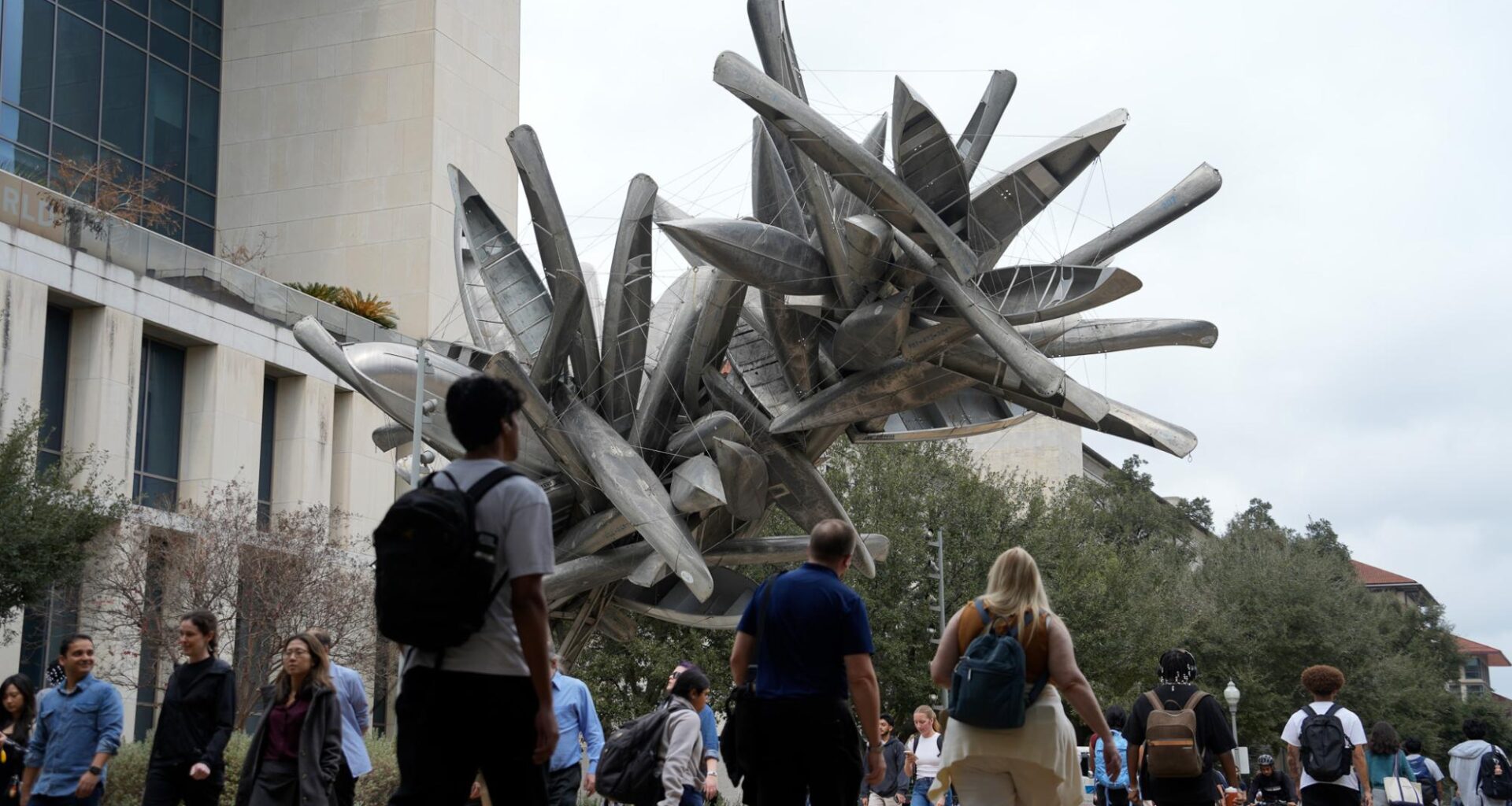
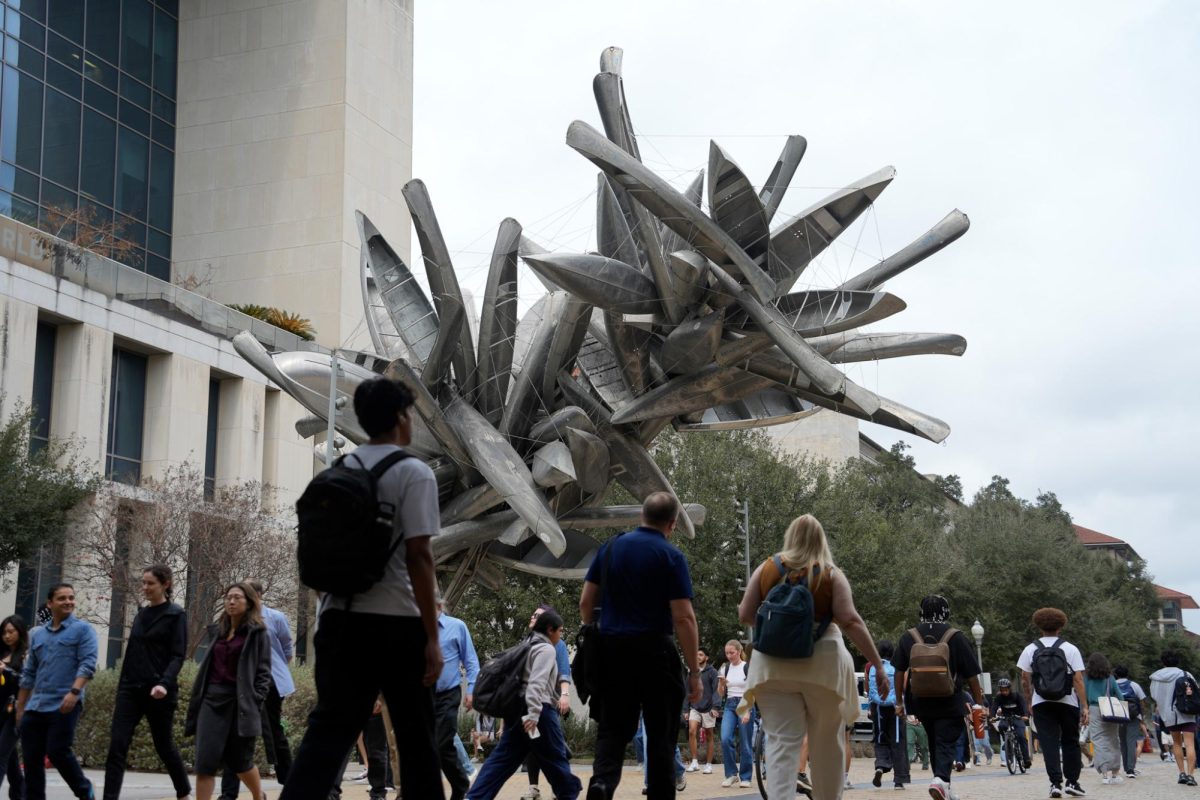
People at walk under Nancy Rubins’ sculpture “Monochrome for Austin” (2015) next to the Norman Hackerman Building at UT Austin on Feb. 10, 2026. As a part of the College of Fine Art’s Landmarks program, the sculpture has become a frequent desination for campus tours.
Eye-catching campus art often fades into the background of students’ minds. Whether it’s bronze statues or multimedia art installations, their presence is a defining factor of UT’s campus. Bringing awareness to the history of campus art installations and their place within the community can help students feel more connected to the University.
The Landmarks public art program displays about 50 modern and contemporary works of art across campus, ranging from large-scale sculptures like “Monochrome for Austin” by Nancy Rubins to experiential installations like “The Color Inside” by James Turrell. After the University adopted an “Art in Public Spaces” policy, which dedicated 1-2% of capital improvement costs to purchasing public art, Landmarks launched in 2008 with 28 sculptures loaned from the Metropolitan Museum of Art.
An Phung, digital content coordinator at Landmarks, shares that when the program determines whether an artwork is the right fit, they consider its physical compatibility with a space, the body of work that the artist already has and how the themes that the artist portrays complement a certain site and the community there.
“Especially (for) students who are majors in these disciplines, we hope that (the artwork) isn’t a disruption in their day, but something that makes them stop and wonder, ‘Why is this here? How is this piece of art relevant to my life, too?’” Phung said.
Intentional and accessible public art offers a break from the stresses of life to deeply connect with the art and campus. Engaging with public art can calm or intrigue us by reflecting on why an artwork makes us feel a certain way and how it impacts our perception of UT.
“When there are world-class art pieces brought to campus, you get a greater appreciation for the importance of UT and the power that UT has to bring these great artists in,” Phung said.
While Landmarks’ artworks focus on who inhabits the campus today and schools of thought contributing to advancement, historic campus statues express UT’s longstanding legacy of excellence and reinforce the University’s values. For example, “The Torchbearers” sculpture by Charles Umlauf depicts one runner passing a torch to another, symbolizing the collaboration, resilience and inheritance of knowledge from one generation to the next. The Barbara Jordan (2009) statue by Bruce Wolfe depicts Jordan looking into the eyes of her viewer, symbolizing a legacy of firsts as an African American woman and calling audiences to make a difference.
“In the vein of striving for excellence in a way that can change the world, I think experiencing art in various capacities can spark creativity and have us reflect on various identities and cultures in a way that takes you beyond campus,” said Chase Cobb, academic program coordinator at the Environmental Science Institute and art tour lead.
Campus artworks not only function as reminders of the successes of past alumni and notable figures, but also as portrayals of community perspectives on UT’s future.
“Art is a really important form of media to create a community, and I think that murals are such a big part of that,” said Abigail Norris, biology sophomore and president of the Street Art Muralist Organization. “They’re in such prominent places and so public, and I think that encompasses everything art should be about: it’s for the people, it’s by the people.”
Although many students may be unaware of the presence and meaning behind campus art installations, slowing down to see a public artwork and even read its description can help you feel a greater sense of belonging at UT.
Williams is a psychology and government freshman from Richmond, TX.