
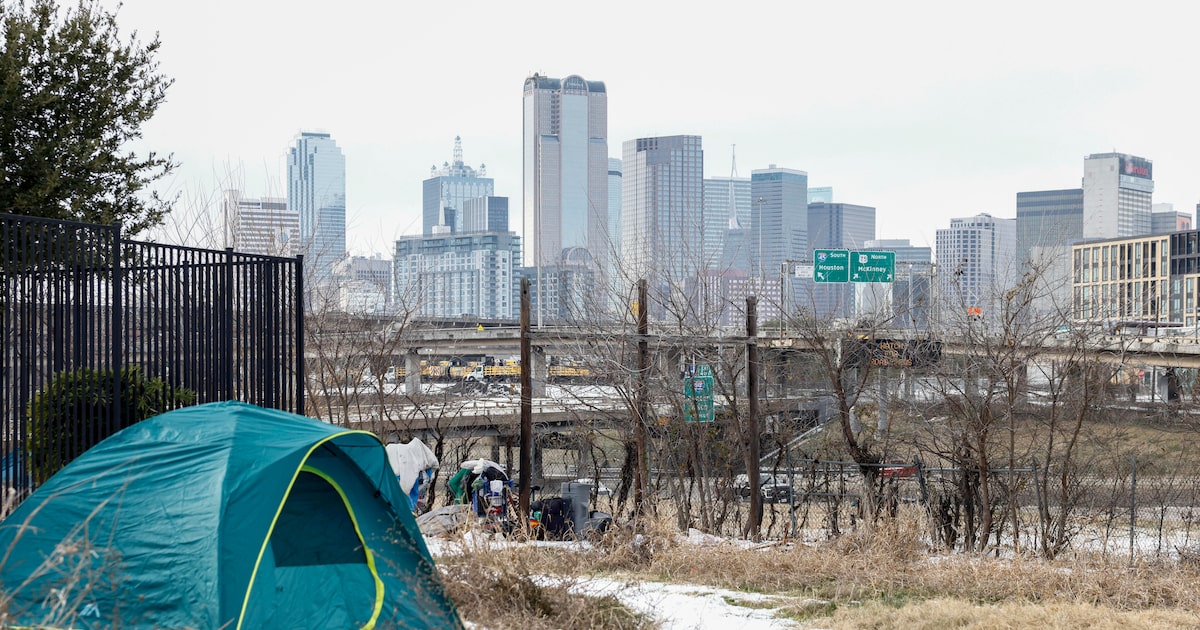
As temperatures plunged ahead of last month’s winter storm, Dallas police closed encampments in South Dallas. Our newsroom colleague Chase Rogers reported that police notified Housing Forward, the region’s homelessness response agency, at least six weeks in advance of the operation.
Dallas has pledged to end street homelessness downtown, an effort that has made visible progress clearing encampments around City Hall and the central library. That approach should extend to the rest of the city as well.
But when some people who were displaced in the January operation sought shelter, they found beds already full, and ended up back on the street where they started.
What happened between notice and execution of the operation?
In a joint statement after the Jan. 22 operation, the city and Housing Forward acknowledged “coordination gaps” that resulted in what Housing Forward president Sarah Kahn described to us as “more of an enforcement-led response,” something she said is “not reflective of the protocols that we have designed and strengthened with the city of Dallas.”
Opinion
These types of coordination gaps aren’t a good look for the city.
Kahn told us enforcement is not meant to lead the process but to follow it. “It’s critical that it’s paired with creating permanent pathways off the street, so that we’re not just essentially moving people from block to block,” she said.
Police officers tasked with enforcing city ordinances should not be cast as villains for carrying out that responsibility. The deeper issue is making sure enforcement is paired with real exit pathways off the street.
It is not humane to let people continue to live outside, but it is also not effective to move them without a clear path for where they will go next. Homelessness is a complex problem that needs to be addressed with an approach that knits together enforcement, housing and support.
The city and county have each contributed $10 million to the second phase of the Street to Home Initiative. Hopefully this continued investment will help the city better pair enforcement with meaningful solutions.
As all this was happening, the city’s Housing and Homelessness Solutions Committee has struggled to get a meeting on the books. Bickering at a meeting in December led to an early adjournment. A January meeting was canceled due to bad weather, and a special-called meeting at the beginning of February was rescheduled. After nearly two months of disruption, the committee finally reconvened last week.
If Dallas is serious about resolving street homelessness, city leaders must at least show up consistently and on time to meetings. Moving toward ending homelessness across the city won’t be an easy undertaking, but it definitely won’t happen without regular meetings to align strategies and communicate protocols.
We welcome your thoughts in a letter to the editor. See the guidelines and submit your letter here.
If you have problems with the form, you can submit via email at letters@dallasnews.com