
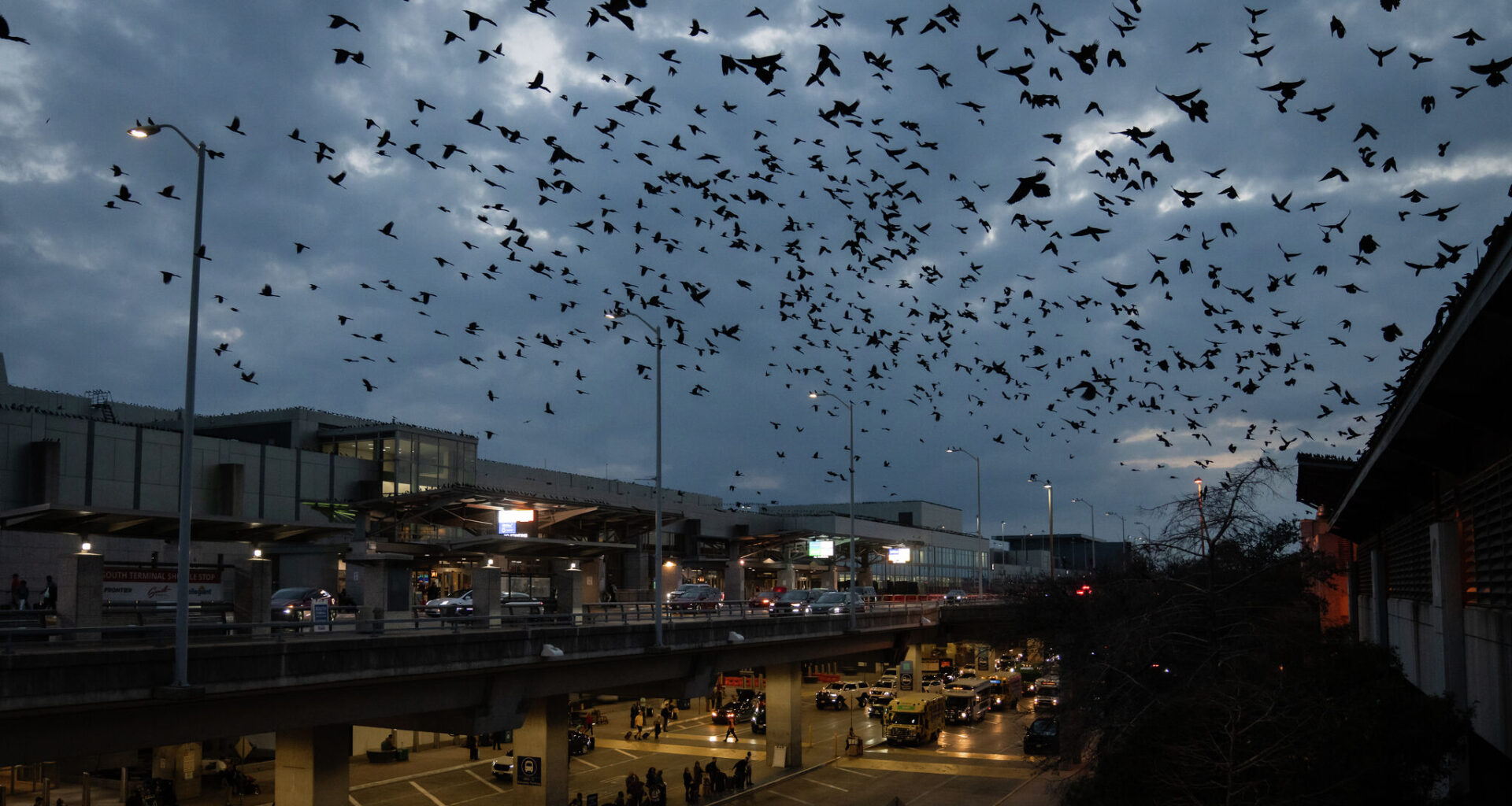
Thousands of great-tailed grackles gather at Austin-Bergstrom International Airport to roost, Feb. 13, 2026. The city-dwelling birds prefer busy human areas for their roosts as high traffic wards off natural predators. Gathering in such large numbers also helps the birds rest safely.
Sara Diggins/Austin American-Statesman
Like something out of a Hitchcock horror movie, they look and sound intimidating as they hunker down in seemingly infinite flocks. Perched on trees and utility lines, they cackle and wheeze and screech. Inevitably, they leave behind a messy stink.

Vast numbers of gregarious Central Texas grackles — the separate common and great-tailed species — assemble by the thousands at night, especially during the winter. Their vocalizations can be heard blocks away. In hues from muddy browns to iridescent purples, grackles seek safety in numbers, for the most part, but perhaps warmth and socializing as well.
Article continues below this ad
Closely identified with Austin, the grackle is immortalized in the form of a giant kinetic sculpture at the city’s Central Public Library. In life, they greet visitors and newcomers like some riotous unwelcome wagon at Austin-Bergstrom International Airport.
“It was one of the first things that I noticed when I got off the plane in Austin,” says Sanchali Singh, this newspaper’s new audience growth editor. “When I was coming back from the airport last night, there were so many birds in those trees that it literally smelled like a bird pet store.”
Turns out, the airport is a natural spot for them.
Thousands of great-tailed grackles gather at Austin-Bergstrom International Airport to roost, Feb. 13, 2026. The city-dwelling birds prefer busy human areas for their roosts as high traffic wards off natural predators. Gathering in such large numbers also helps the birds rest safely.
Sara Diggins/Austin American-Statesman
“Oh, the mighty grackle: Behold!” jokes Jennifer Bristol, naturalist and author of the books “Cemetery Birding” and “Parking Lot Birding.”
Article continues below this ad
“Such an interesting bird. They often congregate during the winter for safety, especially from an increase of other wintering birds such as hawks and owls. Power lines near a busy road, trees in a parking lot all seem like unlikely places to find flocks of birds; however, those human gathering spaces also mean a lack of predators that are actually a threat.”
Bristol enumerates other reasons why the airport is so attractive.
“Lots of humans, trash, mowed spaces with insects, very few, if any, cats and a fairly predator-free airspace as long as they avoid the edges where the hawks like to hunt in the fields.”
Article continues below this ad
Thousands of great-tailed grackles gather at Austin-Bergstrom International Airport to roost, Feb. 13, 2026. The city-dwelling birds prefer busy human areas for their roosts as high traffic wards off natural predators. Gathering in such large numbers also helps the birds rest safely.
Sara Diggins/Austin American-Statesman
Thousands of great-tailed grackles gather at Austin-Bergstrom International Airport to roost, Feb. 13, 2026. The city-dwelling birds prefer busy human areas for their roosts as high traffic wards off natural predators. Gathering in such large numbers also helps the birds rest safely.
Sara Diggins/Austin American-Statesman
Airport traffic passes below as thousands of great-tailed grackles gather at Austin-Bergstrom International Airport to roost, Feb. 13, 2026. The city-dwelling birds prefer busy human areas for their roosts as high traffic wards off natural predators. Gathering in such large numbers also helps the birds rest safely.
Sara Diggins/Austin American-Statesman
Birds begin perching on top of the terminal building after a day of hunting as thousands of great-tailed grackles gather at Austin-Bergstrom International Airport to roost, Feb. 13, 2026. The city-dwelling birds prefer busy human areas for their roosts as high traffic wards off natural predators. Gathering in such large numbers also helps the birds rest safely.
Sara Diggins/Austin American-Statesman
A female grackle perches as thousands of great-tailed grackles gather at Austin-Bergstrom International Airport to roost, Feb. 13, 2026. The city-dwelling birds prefer busy human areas for their roosts as high traffic wards off natural predators. Gathering in such large numbers also helps the birds rest safely.
Sara Diggins/Austin American-Statesman
Thousands of great-tailed grackles gather at Austin-Bergstrom International Airport to roost, Feb. 13, 2026. The city-dwelling birds prefer busy human areas for their roosts as high traffic wards off natural predators. Gathering in such large numbers also helps the birds rest safely.
Sara Diggins/Austin American-Statesman
Thousands of great-tailed grackles gather at Austin-Bergstrom International Airport to roost, Feb. 13, 2026. The city-dwelling birds prefer busy human areas for their roosts as high traffic wards off natural predators. Gathering in such large numbers also helps the birds rest safely.
Sara Diggins/Austin American-Statesman
Thousands of great-tailed grackles gather at Austin-Bergstrom International Airport to roost, Feb. 13, 2026. The city-dwelling birds prefer busy human areas for their roosts as high traffic wards off natural predators. Gathering in such large numbers also helps the birds rest safely.
Sara Diggins/Austin American-Statesman
A bird is silhouetted by a streetlight as thousands of great-tailed grackles gather at Austin-Bergstrom International Airport to roost, Feb. 13, 2026. The city-dwelling birds prefer busy human areas for their roosts as high traffic wards off natural predators. Gathering in such large numbers also helps the birds rest safely.
Sara Diggins/Austin American-Statesman
Travelers enter the airport as thousands of great-tailed grackles gather at Austin-Bergstrom International Airport to roost, Feb. 13, 2026. The city-dwelling birds prefer busy human areas for their roosts as high traffic wards off natural predators. Gathering in such large numbers also helps the birds rest safely.
Sara Diggins/Austin American-Statesman
Birds begin to find their spots to rest as thousands of great-tailed grackles gather at Austin-Bergstrom International Airport to roost, Feb. 13, 2026. The city-dwelling birds prefer busy human areas for their roosts as high traffic wards off natural predators. Gathering in such large numbers also helps the birds rest safely.
Sara Diggins/Austin American-Statesman
Two birds come in for a landing as thousands of great-tailed grackles gather at Austin-Bergstrom International Airport to roost, Feb. 13, 2026. The city-dwelling birds prefer busy human areas for their roosts as high traffic wards off natural predators. Gathering in such large numbers also helps the birds rest safely.
Sara Diggins/Austin American-Statesman
Birds come in to land for the night at the airport terminal as thousands of great-tailed grackles gather at Austin-Bergstrom International Airport to roost, Feb. 13, 2026. The city-dwelling birds prefer busy human areas for their roosts as high traffic wards off natural predators. Gathering in such large numbers also helps the birds rest safely.
Sara Diggins/Austin American-Statesman
Thousands of great-tailed grackles gather at Austin-Bergstrom International Airport to roost, Feb. 13, 2026. The city-dwelling birds prefer busy human areas for their roosts as high traffic wards off natural predators. Gathering in such large numbers also helps the birds rest safely.
Sara Diggins/Austin American-Statesman
Airport traffic passes below as thousands of great-tailed grackles gather at Austin-Bergstrom International Airport to roost, Feb. 13, 2026. The city-dwelling birds prefer busy human areas for their roosts as high traffic wards off natural predators. Gathering in such large numbers also helps the birds rest safely.
Sara Diggins/Austin American-Statesman
Grackles gatherings then and now
Where in Central Texas do grackles like to congregate in the winter?
In the past, major flocks could be found:
Article continues below this ad
On the University of Texas campus, with its multitude of mature live oaks.
Around the Texas Capitol, which is surrounded by trees and lawns.
The former American-Statesman parking lot near Congress Avenue and Riverside Drive.
Some of the largest winter flocks have congregated at Zilker Park.
Anywhere along the Ann and Roy Butler Hike and Bike Trail around Lady Bird Lake.
Opportunistic feeders, grackles have always liked Texas school campuses, bird feeders, hamburger stands, shopping centers anchored by grocery stores and eateries with patios that somehow turn into on-demand grackle buffets.
Landowners fight back with loud noises, bright lights, marching bands and trained raptors. If the tormenters keep it up, grackles do eventually move.
Airport traffic passes below as thousands of great-tailed grackles gather at Austin-Bergstrom International Airport to roost, Feb. 13, 2026. The city-dwelling birds prefer busy human areas for their roosts as high traffic wards off natural predators. Gathering in such large numbers also helps the birds rest safely.
Sara Diggins/Austin American-Statesman
We asked readers where they have congregated lately.
Article continues below this ad
“The Home Depot parking lot in Hutto!” writes Joe O’Connell.
“We used to have grackle nests in the big oak at the O. Henry Museum,” says Martha George Withers. “When you walked by, they would attack from behind. An Australian visitor suggested wearing a hat with pompoms or eyes on the back — the birds would think you are watching. It worked! I got into the house unmolested.”
Withers adds: “Oh, and the Allendale H-E-B used to have them in the hundreds!”
“Rainey Street had massive plagues of grackles in the trees nearest the lake,” writes Mary Herr Tally, “but I think they moved away during the worst of construction, like we did.”
Jes Garcia, bluntly: “Wal-Mart.”
“H-E-B of course,” writes Candyce L. Rusk. “And my backyard, noon time in March. They know the schedule.”
George Duron: “East 51st Street and Cameron Road.”
“Sometimes they flock in downtown trees along the sidewalk,” writes Linda Ball. “They used to flock on the state parking garage across from us sometimes, but I haven’t seen them since the futsal and pickle ball courts moved in. Some businesses get folks to shine green lights at them to move them. They used to congregate in the UT stadium and they used these rifles that made a lot of noise but I assume didn’t shoot anything. It was disconcerting to see the rifle guys walking around.”
“Leaving work from Dell Computers in Round Rock, making a left out of Building 2 on Dell Way, within a half a mile, there’s a stoplight with a QT (gas station) on the right,” writes Cathy Bradley, “and there are hundreds and hundreds of grackles up on the electrical lines at that stoplight.”
“All of a sudden, my yard!” writes Janelle Buchanan. “We’ve never been visited by grackles before — this is downtown, near the Capitol — but now we have congregations of them, especially in the morning. They’re too big for our feeders, but they have no problem swarming all over the spilled seed on the ground and hogging the large water saucers we have on the ground. I’ve never minded grackles — actually like the big loudmouths — but I don’t want them to run off the smaller birds.”
Birds begin perching on top of the terminal building after a day of hunting as thousands of great-tailed grackles gather at Austin-Bergstrom International Airport to roost, Feb. 13, 2026. The city-dwelling birds prefer busy human areas for their roosts as high traffic wards off natural predators. Gathering in such large numbers also helps the birds rest safely.
Sara Diggins/Austin American-Statesman
What other experts say about grackles
The smaller common grackles, as their name implies, are widespread through most of the eastern United States and Canada. Many of them, however, migrate southward from summer ranges to Texas during the winter.
Article continues below this ad
Kind of like the human newcomers at the airport, the larger great-tailed grackles are relatively recent arrivals in Texas cities. They have pushed northward from Mexico and South Texas in part because our growing cityscapes are good for them.
In his excellent guide book, “The Birds of Texas” (Shearer Publishing), John L. Tveten, longtime columnist for the Houston Chronicle, reports that great-tailed grackles had reached Austin by the 1920s, at just about the same time the state capital could be rightly called a city, not a town.
“Grackles have multiplied in Austin and throughout Texas during the past 80 or 90 years, adapting to suburbs with lawns and mown spaces,” write Robin W. Doughty and Matt Warnock Turner in “Unnatural Texas? The Invasive Species Dilemma” (Texas A&M University Press). “They are native, although the northern edge of their range barely reached South Texas in 1900. Seeds and insects on suburban lawns, irrigated campuses, parks and croplands have lured them northward to be one of North America’s successful bird species.
Article continues below this ad
“Grackles have also adopted a habit of dumpster-diving and pecking scraps from encrusted food containers behind fast-food outlets.”
In a sense, we have nobody to blame but ourselves for these avian invasions of our parks, campuses, bird feeders, shopping centers and, yes, airports.