
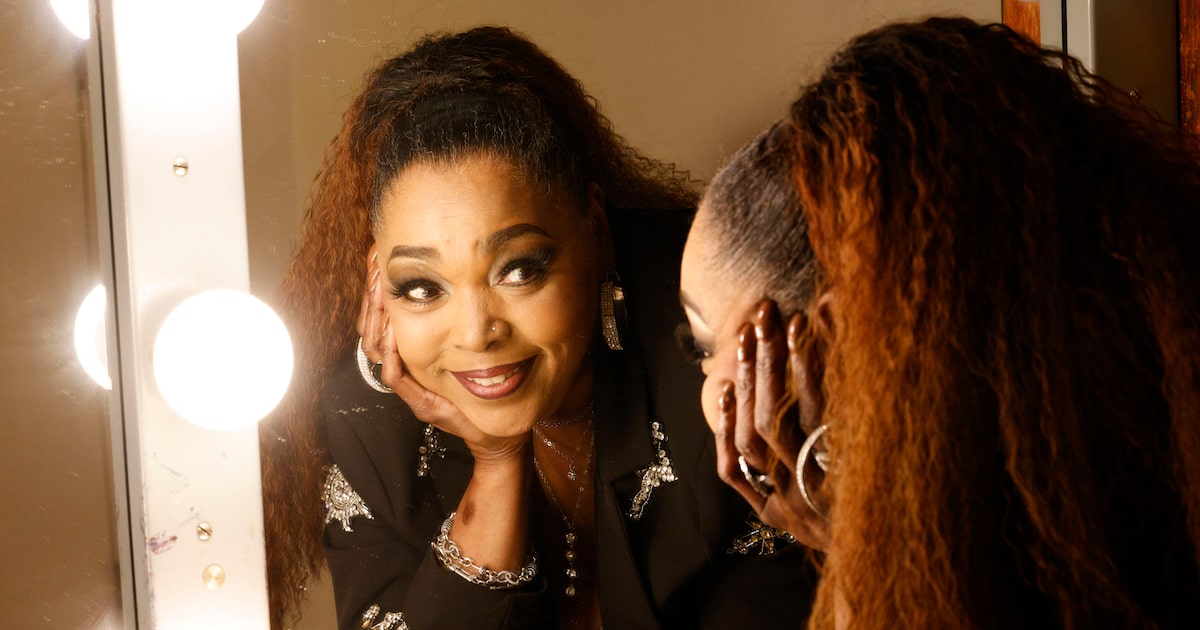
At 6’1”, Liz Mikel didn’t have a choice to stand out, but she did choose to lean into it. “If a mountain range could belt a bawdy song,” a critic once wrote in this paper, “it would sound like Mikel.”
For more than 30 years, she’s been a towering presence in the Dallas theater scene, where her long list of credits reveals a woman who can pull off soul-stirring drama (A Raisin in the Sun), crowd-pleasing comedy (Steel Magnolias) and foot-stomping blues (Ain’t Misbehavin’). Now 62, she is that rare hometown hero with a national profile. For three seasons on Friday Night Lights, she stole scenes as the ferocious mother of high school football star “Smash” Williams. She’s lit up Broadway twice. But local audiences may know her best from the two decades she played the Ghost of Christmas Present in Dallas Theater Center’s A Christmas Carol.
Her latest show, a one-woman feat called Where We Stand, is among the most challenging of her career. For 70 minutes, she is the sole driver of the drama, playing the main character, a man who strikes a deal with an ominous stranger, as well as the townspeople responding to his gamble. She sings, she chants, she debates in the town square. Debuting at DTC on Feb. 25 after a run at Stage West in Fort Worth, Where We Stand is a fable told in dense, poetic prose, but central to its message is that the audience members must feel a part of this drama, because as controversy mounts, they will vote on the main character’s fate.
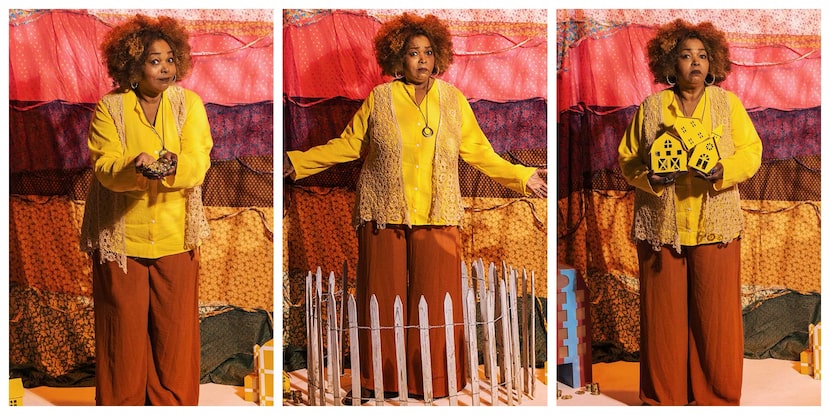
Liz Mikel stars in the one-woman play “Where We Stand,” opening at the Dallas Theater Center on Feb. 25.
Evan Michael Woods
News Roundups
On the afternoon I see the play, Mikel has command over the crowd from the moment she enters. First we hear her singing — the rich round notes of a gospel voice unaccompanied — and then we see her moving along the rows of chairs, as she keeps singing a refrain. She takes the hand of a woman in the audience, and gives her a nod so warm and inviting it’s like she transmits a message with her eyes: Come on, now, join me. The woman starts singing, and then more voices start singing, and suddenly I am singing, the room transforming from solo performance to collective song as though we’ve all been hypnotized.
Mikel’s summoning is so gentle, so graceful that it’s like she cast a spell, turning us from spectators to participants. This is the lesson of the play, but also of Mikel’s long career, marked both by triumph and trial: We’re all in this together.
‘A 6’1” Black ballerina’
Liz Mikel grew up in Dallas in the early ’70s, dreaming of being a ballerina. “I didn’t know I was gonna grow up to be this size,” she says, giving one of her cackle-laughs as we sit in Sons Coffee in Fort Worth.
Her father owned nightclubs. Her mother was a professor at Bishop College. “But I was artistic from the moment I knew I was on this earth,” she says, in her velvety alto. She was three when she saw Swan Lake and begged her mother for dance lessons. Finally her mom relented, enlisting Ann Williams, a colleague at Bishop College who would later create Dallas Black Dance Theatre, to train her 5-year-old girl.

Liz Mikel, at 7 years old.
courtesy Liz Mikel
“The music and my body connected,” Mikel says. She kept dancing en pointe, even as she sprouted past six feet. She danced at Booker T. Washington and then at El Centro, where she won the Miss El Centro pageant. She brought the house down with a Patti LaBelle version of “Over the Rainbow” that ended with her in the splits. She was a crowd-pleaser by nature, but the ballet world proved a tougher sell.
“A 6’1” Black ballerina,” she says, like, doesn’t that say it all? Too much of an uphill battle. She switched her major to theater. She wanted a home on the stage.
‘I don’t want you to be Mama on the Couch’
Mikel dove into community theater in the ‘80s, a decade when Dallas, whose public image was very white, thanks to the Ewings, saw the rise of Black performing arts institutions. Mikel worked with Curtis King, who was growing the Black Academy of Arts and Letters into a cultural force. She worked with playwright Dianne Tucker, whose Dallas Drama Company became a home base for Black actors.
In her mid-20s, Mikel landed the plum role of gospel legend Mahalia Jackson in a play by Tucker, but she got fired after missing rehearsals. In her personal life, she’d hit a crisis. Her father had died. She’d gotten married at 20, but the relationship was strained. She’d never been cut from a show. It rattled her.
“Then God, in his infinite wisdom, was like, I’m gonna introduce you to the man who’s gonna change your life,” she says.
Akin Babatunde was a New York playwright and actor who’d been recruited to Dallas by then-DTC director Adrian Hall, in part to help mentor young Black talent. Babatunde still remembers the 20-something Liz Mikel auditioning for an upcoming show.
“I saw that spark of an artist wanting to be an artist,” says Babatunde, who has since worked with Mikel in several productions, including Where We Stand. “I felt something unique and open.”
Mikel had long been a stellar performer, but Babatunde helped hone her gifts. Mikel still gets teary when she talks about meeting Babatunde.
“That man saw me,” she says. “He told me, I don’t want you to be dismissed as Mama on the Couch.” That’s a reference to the play The Colored Museum, which satirizes the stereotype of long-suffering mothers in Black theater. “I want you to be brilliant.”
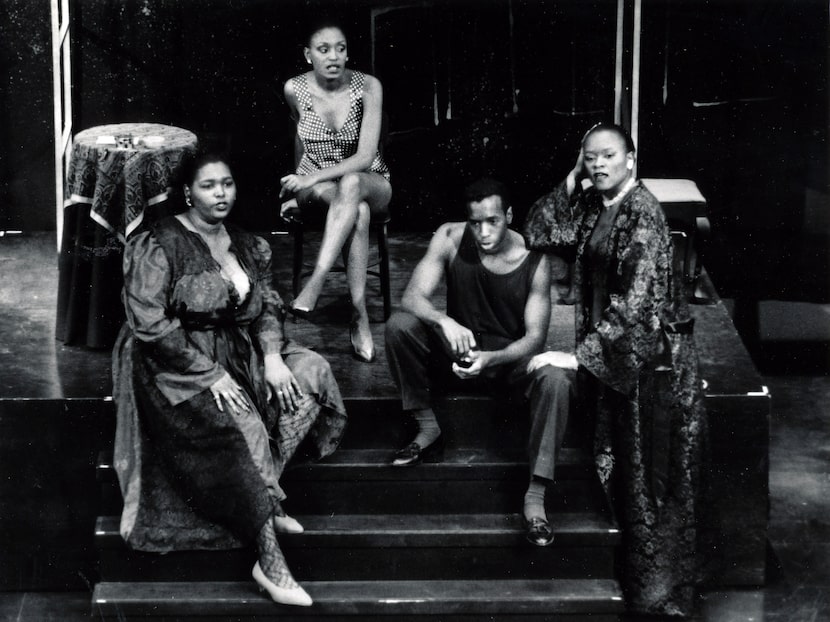
Liz Mikel (left) in a 1990 production of “Blues in the Night.”
JUAN GARCIA/Staff Photographer / 41760
He directed her in Blues in the Night, where Mikel was the sultry standout in a quartet of performers, and brought her into Vivid Theater Ensemble, his all-Black troupe under the umbrella of the Dallas Theater Center. He encouraged her to join actors’ equity, the union for stage performers; he wanted her to take her career seriously. When DTC started casting for A Midsummer Night’s Dream, Mikel felt too intimidated by Shakespeare to audition, but Tyrees Allen, a pioneer for Black actors in Dallas, helped her learn iambic pentameter. She got cast as a fairy, her first time in a mainstage Dallas Theater Center production. She played Eunice in DTC’s A Streetcar Named Desire, but that happened in part because Babatunde, who’d been cast in the show, told the not-entirely-sold director that he’d walk if she didn’t get the role.
The ’90s were a time of creative expansion for her, but financial hustling. She braided hair; she did fingernails; she sewed clothes. She’d gotten divorced, becoming a single mother with three daughters, and she leaned on her family. She did shows in Austin and Little Rock. She even ran a singing telegram business. She’d buy balloons at Party City to surprise someone’s honey with a serenade of “At Last” or “Let’s Stay Together.”
“You make the arts feed you,” she says. And thanks to a television show that entered the zeitgeist in 2006, the arts started to pay a decent wage.
Jesse Plemons, Martin Lawrence and subbing for Oprah
Friday Night Lights was a game changer — both in narrative TV and Mikel’s career. It was a show about small-town Texas, filmed mostly in Austin, far from Hollywood power corridors. “I don’t think anybody realized what a gem we had,” Mikel says.
She played Corrina Williams, the steely and nurturing mother of high school running back “Smash” Williams, who helps her son navigate the uncertain waters of young football stardom. She based the character on her sister, Brenda McKinney, an educator and visual artist. “She raised her kids with love and discipline,” Mikel says. “She just tells it like it is.”

Liz Mikel played Corrina Williams, mother of star football player “Smash” Williams (Gaius Charles) on “Friday Night Lights.”
courtesy Liz Mikel
The cast grew tight, and Mikel has been thrilled to watch her costars become marquee names. “Jesse Plemons was the baby of our set,” she says of the versatile A-lister who, at 18 during the first season, was one of the youngest cast members. “I’m so proud of him!” Mikel laughs remembering a time the show filmed in Dallas, and she invited people to watch her perform at a nightclub, but she didn’t expect to see the baby of the set walk through the door. She teased him from the stage. “What are you doin’?” He smiled. “I just wanted to hear you sing!”
Friday Night Lights opened the door to bigger projects. She appeared in Welcome Home Roscoe Jenkins, the 2008 Martin Lawrence comedy that features James Earl Jones, Mo’Nique and Michael Clarke Duncan. The filmmakers needed an actress tall enough to play the wife of the 6’5” Duncan. “We’ve been looking for you,” she remembers being told at the audition. “A big pretty girl.”
Around that time, she also began collaborating with Eve Ensler, the playwright who now goes by V. Mikel was tapped to take the stage at a star-studded performance of The Vagina Monologues in New Orleans in 2008. She was trying not to freak out among the heavyweights: Jane Fonda, Salma Hayek, Kerry Washington. Mikel was smoking outside as she watched Doris Roberts pull up in a car. “Oh my God,” she thought, “it’s Everybody Loves Raymond’s mama!”
Oprah was slated to perform. She was gonna meet Oprah! But actually, Oprah couldn’t make it, and in one of those show-must-go-on switcheroos, Mikel stepped up to play the role in Oprah’s place. No pressure, just subbing for one of the world’s most famous women. The monologue, about a Katrina hero known as Miss Pat who fed neighbors during the storm, became the climax of the evening, especially after the real-life Miss Pat came onstage.
Afterward, the famous names on the roster were in awe of Mikel’s electric performance. Roberts leapt to hug her with tears in her eyes. Fonda burst into her dressing room. “You!” she said, with admiration, and asked, “Do you have a card?”
And then everything burned
An artist’s fortunes have long been fickle, but what happened to Mikel next isn’t a normal plot twist. It was a bitter night in January 2010, and Mikel was asleep in the northeast Dallas apartment she shared with her 15-year-old daughter when a pounding on the door woke her. Was that the TV? No, the TV was off. She heard her daughter’s voice. “Mama?” Then her daughter’s voice grew panicky. “Mama!” Red-orange cinders dropped across the skylight, followed by bursts of flame.
It happened too fast to track. Later she would learn the building had a faulty flue, and a neighbor using a fireplace had accidentally ignited the insulation above her head. The roof was ablaze.
“We got to go!” Mikel barked, grabbing her jacket and purse as she and her daughter bolted for safety. She ran barefoot in her pajamas through the 16-degree night to reach her car. When she turned around to look at the building, she watched the roof collapse on the spot where she’d been sleeping.

Liz Mikel in 2010, standing in front of the rubble that was once her apartment in northeast Dallas.
“We lost everything,” she says. The catastrophe had a silver lining, though, because in the weeks that followed, the theater and music community rallied. Dallas Theater Center raised $12,000. Theatre Three and the Deep Ellum club where she sang also donated money. She had more gift cards than she knew what to do with.
She liked her new loft in South Side on Lamar better than her old apartment. “It was completely furnished by gifts,” she says, still taken aback by how the community carried her. “Completely furnished by people.”
To Broadway and back again
Her comeback over the next years was mighty. She made it to Broadway. Give It Up! was a boisterous modern update of Lysistrata, the Aristophanes play about withholding sex to stop a war. The show debuted at the Dallas Theater Center and wound its way from off-Broadway, where it was renamed Lysistrata Jones, to the Walter Kerr Theatre on the Great White Way.
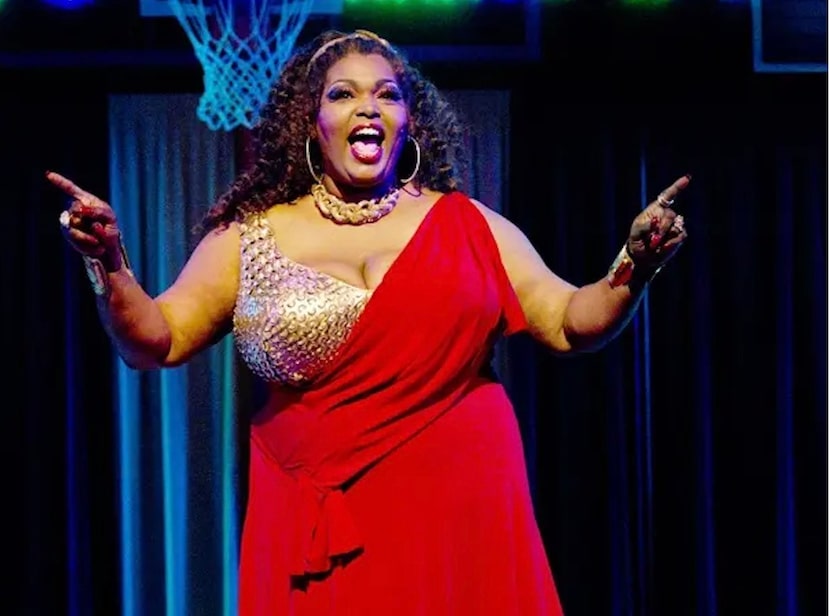
Liz Mikel as the narrator of “Lysistrata Jones,” the Broadway musical that began its run at the Dallas Theater Center as “Give It Up!”
courtesy Liz Mikel
Mikel was backstage on opening night, trying to stay calm. This was just another show, right? They’d been performing it for a while, right? That’s when she saw a bouquet of red carnations sitting by her makeup station. They were from Akin Babatunde, her mentor, the man who helped her become an artist. She burst into tears. “The butterflies in my stomach became hummingbirds,” she says.
Lysistrata Jones had a lot going for it, not the least of which was the majestic narrator played by Mikel. The show’s creator, Douglas Carter Beane, had a Broadway hit a few years prior with his remake of the campy ’80s roller-skating film Xanadu. New York Times theater critic Ben Brantley raved about Lysistrata Jones. He even gave a nod to “the commanding Liz Mikel.”
But Lysistrata Jones closed after less than a month. “I was devastated,” says Mikel. She wonders if they should have kept the original name. More likely, the culprit was that old Broadway bugaboo: no famous stars.
Although Mikel had come to New York hoping her acting career was set for a while, she found herself auditioning again. It wasn’t entirely a waste. She got cast in the 2013 film The Secret Life of Walter Mitty. The size of the role didn’t matter (she played TSA Skeleton #2); what mattered was that she had fight left in her.
“You have a career in Dallas,” a friend finally told her. “New York’s not going anywhere.”
And so she returned to Dallas, where the next years brought a barn-burner performance in A Raisin in the Sun at the Wyly Theatre and parts in movies like Get On Up, the James Brown biopic starring Chadwick Boseman, and Miss Juneteenth, a coming-of-age film made in Fort Worth with a cameo by Opal Lee, the grandmother of Juneteenth. New York did not go anywhere — and eventually, she made it back.
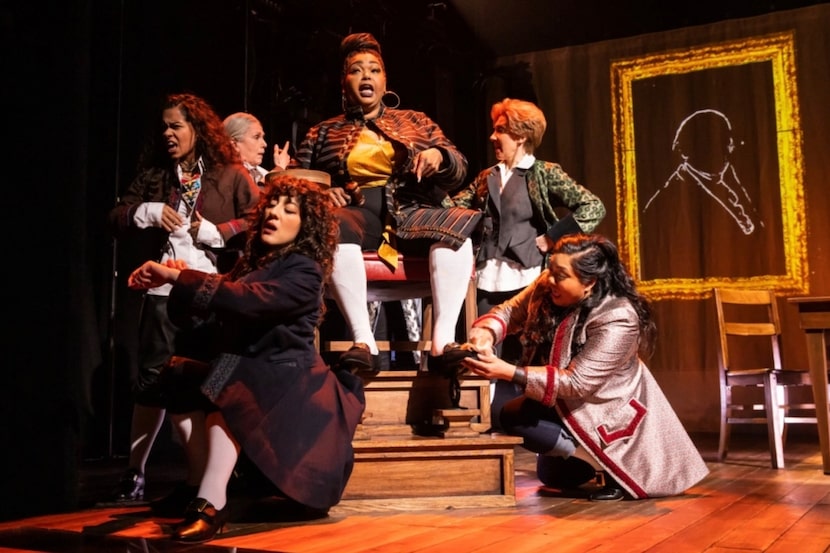
Liz Mikel, center, in “1776,” the musical revival about the Founding Fathers that ran on Broadway.
courtesy Liz Mikel
She played John Hancock in a Broadway revival of 1776 that opened in 2022, co-directed by stage veteran Diane Paulus and starring female, nonbinary or trans cast members. “The idea was to breathe life into the Constitution and Declaration of Independence with actors who were not thought of when those words were written,” Mikel says. Paulus learned about her through Mikel’s work with V (the playwright formerly known as Eve Ensler), and Mikel was impressive enough to land a bigger role in the 2023 touring production. She played Ben Franklin.
Another challenge, another success. As Franklin once wrote, at least according to lore, “When you’re finished changing, you’re finished.”
The artist stretches
Where We Stand is a test on another level. The show is directed by Mikel’s mentor, Babatunde. “Any time I want to stretch myself as an artist,” she says, “I work with that man.”
In 2024, Babatunde directed her in a one-woman show about Fannie Lou Hamer, the civil rights activist, and it became one of her proudest performances. That show featured a musical ensemble behind her. In Where We Stand, she’s all alone.

Liz Mikel at Kalita Humphreys Theater, Feb. 11, 2026, in Dallas.
Chitose Suzuki / Staff Photographer
“There’s not a single word that can be taken for granted,” she says, “not a single moment onstage I can’t be present.” On the afternoon I saw the play, she was sweating through the last half, dabbing her forehead with a tissue like she was in the middle of a marathon — and in a way, she was.
The show, by South Carolina-based playwright Donnetta Lavinia Grays, is about mercy and justice. The language has mystic overtones and rhythmic sections; it might be better felt than understood. Few actors can pull off this high-concept portrayal, but she kept us in her palms the whole time.
It is the cliffhanger of each production whether the crowd will punish or absolve the main character. As for Mikel, her fate in the theater community no longer hangs in the balance.
 Hepola: Ali Larter on her feisty ‘Landman’ role: ‘She was shocking to people’
At a Dallas event for Canyon Ranch, the actress talks about finding her character in animal print, her chemistry with Billy Bob Thornton and tips for aging gracefully.
 Hepola: The globe-trotting, incredibly expensive life of a young Dallas racing talent
At 11, Liam Nachawati is chasing a dream to race in Formula One. Time will tell if he’s got the skill — or the millions of dollars it might cost.