
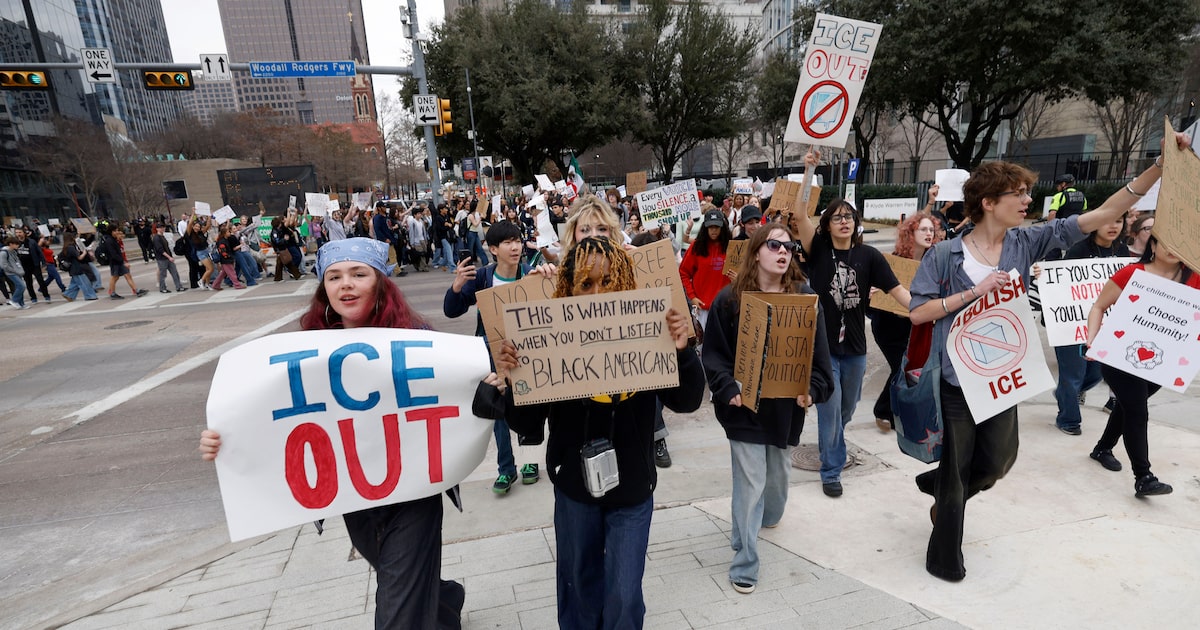
Any other Tuesday, Paola Ramirez would have been at lunch. But Feb. 10 wasn’t any other Tuesday.
The 16-year-old walked off campus and into the streets, alongside hundreds of her peers from Booker T. Washington High School for the Performing and Visual Arts. As skyscrapers towered over them, their cheers, chants and stomps wove through downtown Dallas.
After a slew of ICE walkouts in Texas, state officials have threatened to clamp down on students, educators and districts. Legal experts and advocates worry about a worsening climate to practice a fundamental American ideal: the right to free speech.
Over her shoulders, the straps of a small pink backpack. In her hair, red and white lacy ribbons threaded through two braids in an Indigenous Mexican hairstyle. And in her hands, a poster with a message.
In capital letters, harsh strokes of black paint spelled out: “Por qué callar si nací gritando.”
The Education Lab
Why be silent if I was born screaming?
In the wake of the recent ICE crackdown in Minneapolis, students across Texas and the country are, like Ramirez, facing potential consequences for making their voices heard. In Texas, high-ranking state officials, including Gov. Greg Abbott and Attorney General Ken Paxton, have threatened sanctions against students and schools that facilitate their protests.
Texas officials have threatened to strip funding from districts, decertify teachers and replace elected trustees with a state-appointed board of managers. In an already volatile political moment, this crackdown on student protests has — once again — escalated a debate over free speech in public schools. School administrators are squeezed between upholding the First Amendment rights of students and caving to pressures from Texas leaders who have warned of state takeovers.
“A lot of people say, ‘Kids should be seen and not heard,’” Ramirez said. “We’re using our First Amendment right, our constitutional right. We are part of ‘We, the People,’ too.”
Texas officials have started to pounce on calls to impose consequences. Paxton is probing Dallas ISD for “facilitating and failing to keep students safe and accountable” during the protests, he announced Monday. Dallas ISD, North East ISD in San Antonio and Manor ISD near Austin must hand over documents regarding excused absence policies, security protocols and internal communications about the protests, he said.
Related
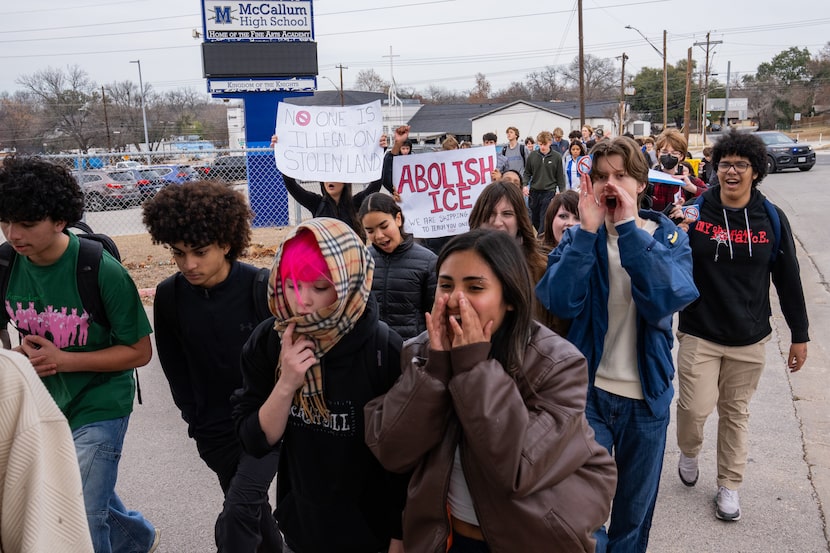
McCallum High School students walk out of class in protest of ICE in Austin, Texas, Friday, Jan. 30, 2026. (Mikala Compton/Austin American-Statesman via AP)
Mikala Compton / AP
Paxton’s demands come on the heels of a similar investigation he opened into Austin ISD on Feb. 2. Tensions ratcheted up after students walked out of the classroom to the Texas Capitol in January, leading Abbott to urge officials to take action.
“AISD gets taxpayer dollars to teach the subjects required by the state,” Abbott wrote Jan. 30, “not to help students skip school to protest.”
On Feb. 3, the Texas Education Agency issued guidance on the walkouts, warning districts that “facilitating” protests could lead to funding loss, investigations and state takeovers. A group of Texas House Democrats asked Education Commissioner Mike Morath on Feb. 9 to clarify what “facilitating” the walkouts entails. They sought more information about what conditions would trigger a state takeover.
The agency had not issued a response, a spokesperson said last week. TEA did not respond to multiple emails asking whether it will soon.
School districts have issued their own emails to parents and students about repercussions. Before Booker T. students left school grounds, Dallas ISD had advised families of TEA’s guidance on walkouts without specifying what repercussions the district would impose, if any.
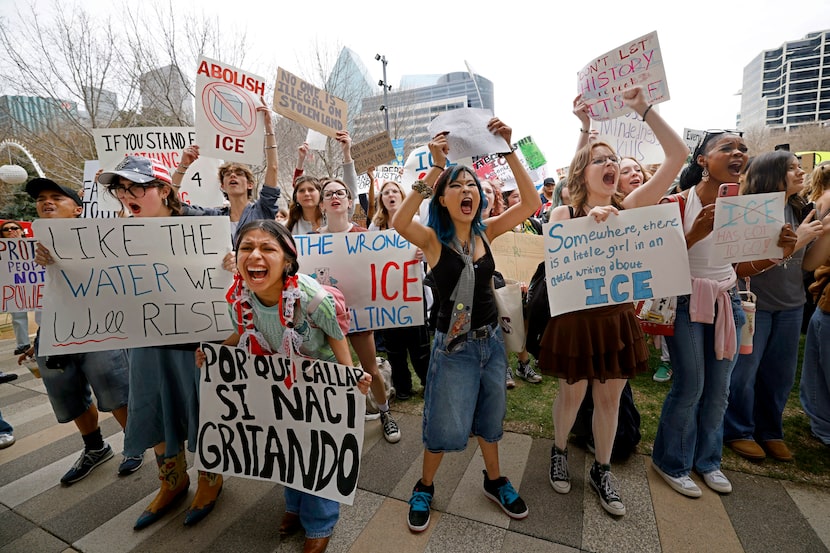
High School students including junior Paola Ramirez (second from left) and sophomore Jada Ferraro (third from left) protest over immigration policy at Klyde Warren Park during a walkout of Booker T. Washington High School for the Performing and Visual Arts on Feb. 10, 2026, in Dallas.
Chitose Suzuki / Staff Photographer
Related
 Experts, advocates worry about ‘chilling’ of rights
Legal experts and First Amendment advocates have said the flurry of threats infringes on the right to free speech. For them, the ICE walkouts are the most recent flare-up in an intensifying debate over expression in schools, leading to comparisons with the pro-Palestine protests on college campuses and investigations into teachers commenting on Charlie Kirk’s assassination.
In the 1969 case Tinker vs. Des Moines, the Supreme Court ruled that districts could not punish students for political activity after students protesting the Vietnam War wore black armbands to school.
Caro Achar, an engagement coordinator at the ACLU of Texas, said the recent guidance from state officials is an “immediate chilling of student speech.”
“If free speech or expressive activity is only condoned when it is aligned with those in power, then it’s no longer being treated like a right,” she said. “It’s being treated like a privilege.”
Students can practice free speech during school hours, as long as it does not create a “substantial disruption,” said Watt Lesley Black Jr., a professor of education policy and law at Southern Methodist University.
But what counts as “substantial disruption” is up for dispute.
“If three or four students get up and quietly walk out of class, it’s a momentary distraction,” he said. “But is it a substantial disruption? Is the teacher able to keep teaching 10 seconds later?”
Related

School officials need to separate the “conduct from the speech,” Black said. No matter the reason a student is skipping class — whether to attend a protest or grab lunch — the punishment, he said, needs to be the same.
School districts caught in a crossfire
Facing pressure from the state, school administrators are caught in a difficult position, Black said, making it easier to pursue rash decisions that do not respect students’ First Amendment rights.
The prospect of a state takeover because of ICE walkouts is unprecedented, Black said. During a takeover, TEA appoints a new board of managers and a new superintendent to govern the district. The state has intervened in districts for reasons such as fiscal mismanagement, cheating scandals and consistently failing academic performance at a campus.
Fort Worth ISD moved under state control in October, while Houston ISD, the state’s biggest district, was taken over in 2023. For both, TEA cited poor academic performance at one or more campuses.
“The fact that those takeovers have happened,” Black said, “makes the threat of a district takeover like this seem more real to superintendents.”
In the past weeks, some schools have said students who walk out are subject to consequences outlined in their district code of conduct, which can include losing the chance to participate in prom and graduation ceremonies and removal from extracurricular activities.
Forney ISD officials said that their student handbook defines skipping class as an offense that could lead to exclusion from extracurricular activities, detention or in-school suspension. Garland ISD students who lead or organize “significant disruptions could face serious consequences,” a spokesperson said in an email.
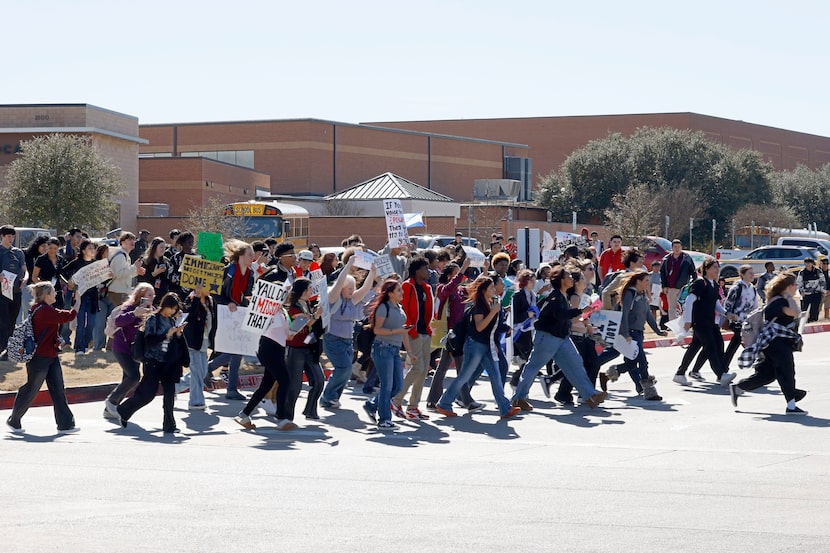
High School students walk out of Forney High School over immigration policy, Thursday, Feb. 5, 2026, in Forney,
Chitose Suzuki / Staff Photographer
Related

The ACLU of Texas emphasized that students have First Amendment protections, including the right to hand out flyers and petitions, post on social media and wear expressive clothing, as long as the activity doesn’t disrupt the functioning of the school.
While safeguards exist, students should familiarize themselves with their district’s policy regarding school absences and suspensions, Achar said. Protests that happen outside of school and outside school hours are more akin to an “everyday Texan” engaging in a protest, she added.
“Protest activity during school time is a decision that every student has to make for themselves — what risk they’re willing to take and weighing the cost and benefit of that,” she said.
Why students want to keep protesting
Brody Jones, a senior at Boswell High School in Fort Worth, said several of his peers received in-school suspensions, similar to a day-long detention, for walking out. While he acknowledged that leaving school violated the code of conduct, he called the punishments “unjustifiable.”
Eagle Mountain-Saginaw ISD declined to comment on specific incidents. In a letter sent to families, the district said if a student leaves campus, their absence will be counted as unexcused, and they could face unspecified “additional disciplinary consequences” pursuant to its code of conduct.
But the threat of an in-school suspension doesn’t deter Brody from continuing to protest, he said. He’s inspired to come out after seeing “the atrocities that ICE has committed in Minnesota,” he said, and the fear of his loved ones, scared to leave their homes.
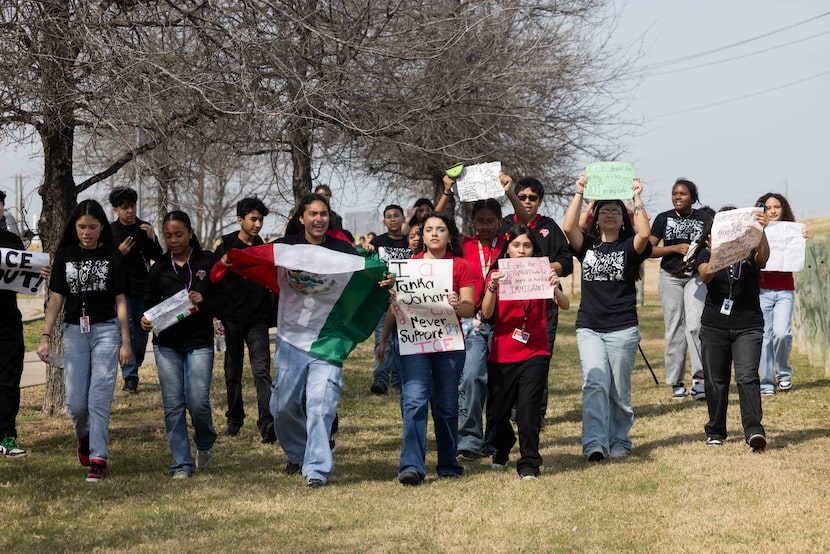
Dallas Environmental Science Academy Middle School students chant as they approach Margaret Hunt Hill Bridge while marching in protest of Immigration and Customs Enforcement (ICE) on Friday, Feb. 13, 2026, in Dallas.
Juan Figueroa / Staff Photographer
“If we’re old enough to go to war, if we’re old enough to vote,” he said, “then we should be old enough to be able to speak out about injustices.”
While Brody wasn’t in class, the protest was a lesson in itself, said his mother Kimberly Savage. It’s up to her son, not her, whether he wants to bear consequences for his protest, she added.
“These kids are using their voices, they’re using their social media platforms, and they’re getting the word out,” she said. “It’s amazing.”
As for Booker T. student Paola Ramirez, she stayed out past the end of lunch, stretching into what would have been math class. The crowd of students that had flooded into Klyde Warren Park was gradually dispersing; some returned to the classroom and others lingered around the greenery.
“We’re all coming together, being here and doing our part for our people,” she said. “It’s beautiful.”
On this cloudy Tuesday, Ramirez wasn’t thinking about the possibility of repercussions; that was a matter for later. Throughout the week, countless other protests would spring up at North Texas schools.
But even as these protests continue, the legality of walkouts — and its implications for free speech — looms. It’s a question, Watt Lesley Black Jr. said, that may be left up to the U.S. Supreme Court justices to answer.
The DMN Education Lab deepens the coverage and conversation about urgent education issues critical to the future of North Texas.
The DMN Education Lab is a community-funded journalism initiative, with support from Bobby and Lottye Lyle, Communities Foundation of Texas, The Dallas Foundation, Dallas Regional Chamber, Deedie Rose, Garrett and Cecilia Boone, Judy and Jim Gibbs, The Meadows Foundation, The Murrell Foundation, Ron and Phyllis Steinhart, Solutions Journalism Network, Southern Methodist University, Sydney Smith Hicks, and the University of Texas at Dallas. The Dallas Morning News retains full editorial control of the Education Lab’s journalism.