
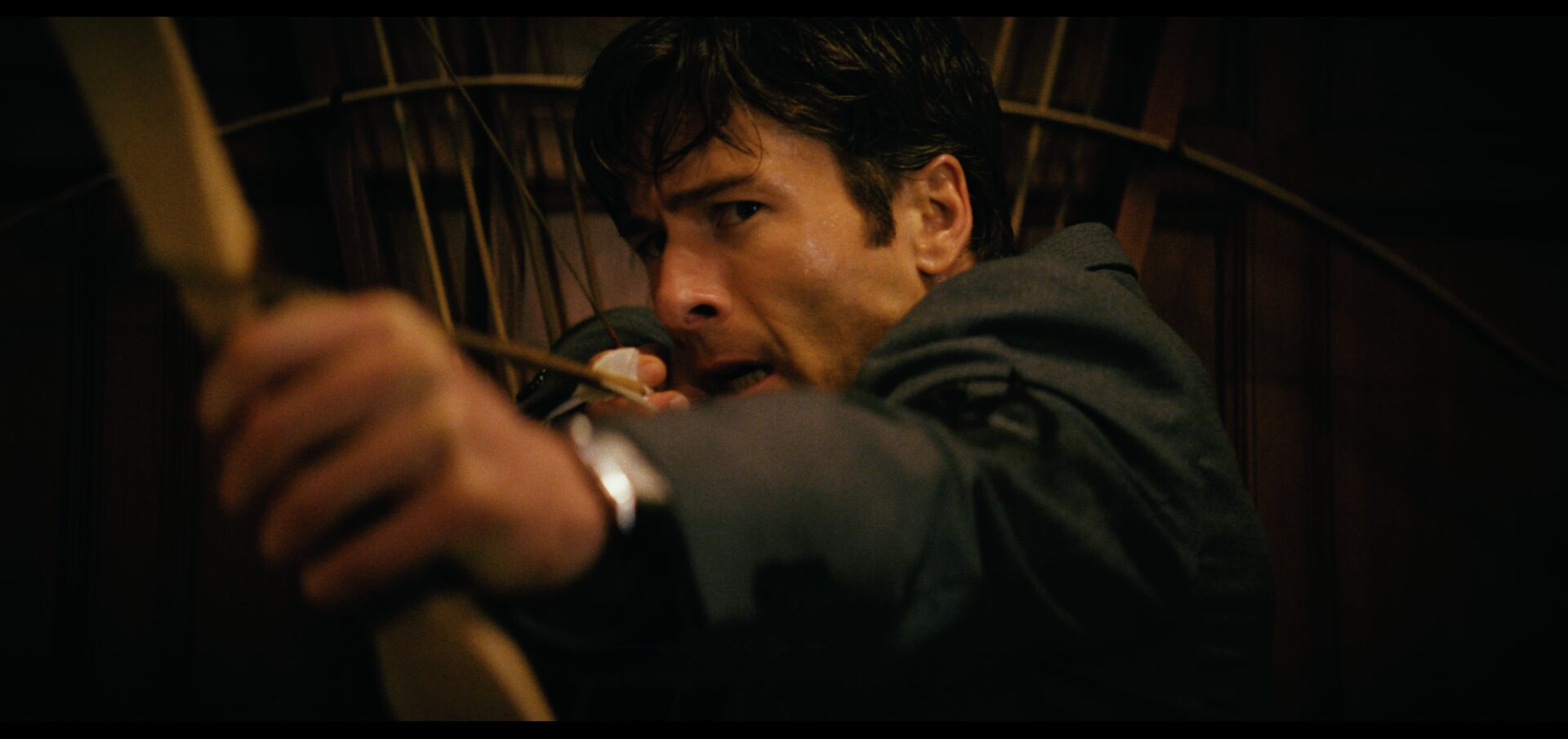
Glen Powell stars as Becket Redfellow in A24’s “How To Make a Killing.”
Courtesy of A24.
There’s a moment in “How To Make a Killing” when Glen Powell’s Becket Redfellow steps into frame in a slouchy beanie, canvas jacket and a film camera hanging across his chest like it’s part of the outfit. Not a tool, not even a prop. A signal. He looks like every soft boy within a five-mile radius of an East Austin coffee shop, the kind who orders iced matcha with oat milk, carries a copy of Bell Hooks’ “All About Love” and performatively listens to Clairo. It’s funny at first, then revealing. Becket isn’t just dressing the part. He’s building a version of himself people will trust.

Powell plays him with an ease that borders on dangerous. Becket is broke, disowned and circling a family fortune that never wanted him. The plan is simple and extreme: remove the obstacles, inherit what’s left. What makes it work, at least on the surface, is how watchable Powell is. He leans into a softer, curated masculinity that feels current. It disarms you, even when you know exactly what he’s doing.
Article continues below this ad
The film arrives via A24, which continues in its indie arms race against NEON. Where A24 has leaned into polish and brand identity, NEON’s slate increasingly favors films that feel a little uglier, a little closer to the bone. “How To Make a Killing” wants to sit in that space. Whether it fully earns it is another question.
Because beneath its sharp edges, the film is working with familiar DNA. The hyper-ambitious, morally empty white man clawing his way up while ignoring the damage behind him has been done, and recently. “Marty Supreme” pushed that archetype into something exciting, powered in part by Timothée Chalamet. Here, the arc is more explicit, less inventive. Becket does not spiral so much as proceed, each decision colder and more calculated than the last.
Still, Powell is the reason you stay.
Curated masculinity, performed vulnerability
Glen Powell in A24’s “How To Make a Killing.”
Ilze Kitshoff/Courtesy of A24.
Even as the character reveals himself to be increasingly hollow, Powell leans into a kind of soft-edged charisma that feels distinctly of the moment. This isn’t the hyper-masculine antihero of TV past; this is a curated vulnerability, a man who understands the optics of sensitivity.
Article continues below this ad
The beanie is not a joke. It’s strategy. Becket’s short-lived soft boy phase is a kind of social camouflage, a way to slip into rooms that would otherwise clock him as exactly what he is. And the film is smart enough to know it. The camera across his chest suggests sensitivity, observation, maybe even depth. None of it is real, but it works on the people around him, especially the cousin he is trying to impress.
Becket’s cousins feel pulled from the same ecosystem as “Succession.” They are rich, brittle and desperate. Power is the only language they speak, even when they pretend otherwise. Becket’s difference is that he understands branding. He doesn’t just want the money. He wants to control how he is seen while getting it.
If Powell is playing dress-up, Margaret Qualley’s Julia is playing chess.
Article continues below this ad
Margaret Qualley and old money texture
Margaret Qualley stars as Julia in A24’s “How To Make a Killing.”
Ilze Kitshoff/Courtesy of A24.
Qualley, removed from her dark brunette cool in “The Substance,” is almost unrecognizable here: brassy highlights, calculated posture, a kind of upper-middle-class Jersey polish. Julia is positioned as an antagonist, but the film can’t quite convince you to see her that way. If anything, she’s the only one who understands the game without pretending otherwise.
Julia doesn’t chase power the way Becket does. She lets it come to her, often by nudging others into doing the worst possible thing — cue Steely Dan’s “Dirty Work.” When she blackmails Becket or casually destabilizes him in his own space, the film briefly snaps into focus. Her ambition is cleaner, more efficient. If Becket is willing to kill for control, Julia understands that control often comes from letting other people self-destruct.
Article continues below this ad
The supporting performances feel true to old money narratives. Topher Grace is unexpectedly effective as a megachurch figure who feels engineered from fragments of Joel Osteen and pop celebrity, all glossy surfaces and strange, half-explained lore. Ed Harris brings a familiar, grounded menace to the family patriarch, the kind to casually own passed-down World War II-era rifles.
Topher Grace plays Pastor Steven J. Redfellow in A24’s “How To Make a Killing.”
Ilze Kitshoff/Courtesy of A24.
There are flashes of something sharper in the film’s view of American privilege. Nepo babies drifting into finance jobs they did not earn. Art-world types turning proximity to chaos into capital. It recognizes these patterns but stops short of pushing them somewhere more uncomfortable.
The structure does not help. From the opening image of Becket behind bars, you can sense the shape of the story. The final turn gestures at surprise but lands softly. It recalls the slick misdirection of “Glass Onion: A Knives Out Mystery” without the same bite, with a touch of the cool remove found in “No Other Choice.”
Article continues below this ad
What lingers is that image of Powell in the beanie. Not because it’s funny, though it is. Because it feels accurate. The film may not fully reinvent its premise, but it understands this: in a culture obsessed with authenticity, the most effective disguise is knowing exactly how to perform it.