
Gov. Greg Abbott issued a stern warning to school districts statewide this month, threatening to take over those which “encourage” students to participate in walkouts protesting White House immigration enforcement operations.
“Today, in classrooms across Texas, tomorrow’s leaders are learning the foundational, critical thinking skills and knowledge necessary for lifelong learning, serving as the bedrock for the future success of our state and nation,” the Texas Education Agency said in a recent press release.
“It is in this spirit that school systems have been reminded of their duty and obligation to ensure that their students are both safe and that they attend school, with consequences for students for unexcused absences.”
The threat hasn’t stopped the protests. Hundreds of students walked out of East Central High School on Feb. 13, and pupils from 50 San Antonio schools plan to march to the Alamo on Feb. 16, according to a recent press statement.
While these walkouts have been short-term affairs, Abbott and the TEA appear eager to intervene regardless of whether they signal any real district dysfunction.
Historically, the TEA only seized districts over severe issues like plummeting student performance. Recently, though, the agency has threatened to replace elected boards with state-appointed bureaucrats for relatively minor issues — such as North East ISD’s allegedly lax enforcement of the state’s new cell phone ban.
The state’s saber-rattling coincides with the rollout of Abbott’s signature school voucher program, which uses taxpayer money to subsidize private education for up to 100,000 children. Opponents argue the program drains resources from already underfunded public schools, especially those in rural districts.
The timing isn’t lost on former South San ISD teacher Ruben Garcia.
“This is all part of an attempt to try to get as many experienced teachers as possible to leave … to replace them with inexperienced teachers who are then not going to be able to have the experience or knowledge to push back against administrators or provide a real, effective education,” Garcia told the Current. “That way, when things get bad enough, they can push for privatization, because I think this has a lot to do with the vouchers push that Greg Abbott had.”
Garcia left teaching this year after the state seized his district. While he admits South San ISD faced legitimate issues — it was mired in a $12 million deficit and nine superintendents went through its revolving door in 13 years. Still, he said the TEA takeover has been devastating.
“I don’t want anybody to get the impression that I’m suggesting things were perfect or great before [the takeover],” Garcia said. “What I want to make clear is the current leadership has made things so much worse.”
Neither South San ISD or the TEA responded to the Current’s requests for comment on this story.
Crisis at South San
Garcia isn’t alone in his assessment of the situation.
Just 3% of district teachers say morale has improved since the takeover, according to a 2025 survey by the South San Antonio AFT union. More alarming, 71% said they have considered quitting the teaching profession entirely.
At a December board meeting, teachers and union reps identified the primary culprit: state-mandated micromanagement. Garcia, another faculty member and AFT President Tom Cummins alleged the state-appointed District Educational Improvement Council (DEIC) illegally eliminated the mandatory 45-minute daily planning period for teachers.
“Our concern is that the process used to justify removing this right appears fundamentally flawed,” Cummins said. “Specifically, there was no formal vote by the DEIC, the agenda did not clearly identify the specific topic to be discussed, teacher representatives were given no opportunity to take the issue back to their campus, which has delegates, and they were obligated to do so.”
Without planning periods, teachers are forced to develop lesson plans from scratch using vague TEA outlines, according to Garcia.
South San ISD’s state-appointed superintendent, Saul Hinojosa, in a conversation with the Current, denied allegations that removcing teacher’s lesson planning time was illegal, and maintains the move was voted on and approved by the District Educational Improvement Committee. He also questioned the validity of the AFT survey results.
“That [survey] is not indicative of the entire district,” he said.
Nevertheless, former teacher Garcia said it felt as if the goalposts moved constantly. He suggested the DEIC appeared to want teachers to fail, quit or both.
“We were being threatened with write-ups and disciplinary action if we didn’t have two weeks of lesson plans laid out in advance in super-hyper detail,” Garcia said. “Even when we did turn them in, we would get constant comments, threats of write-ups. They’d say ‘Oh, well, how are you supposed to do this?’ or ‘how are you supposed to do that?’”
The restrictions extended beyond curriculum. Popular learning platforms such as Kahoot were banned without explanation, and teachers were required to get approval for any video two weeks in advance.
“Well, if I don’t know what I’m teaching two weeks in advance, exactly how am I supposed to know what video I’m going to show two weeks in advance?” Garcia asked, rhetorically.
“It was almost like getting videos banned without banning them.”
Garcia said he and fellow instructors were hit with new rule changes almost weekly. The DEIC even dictated classroom lighting and desk organization.
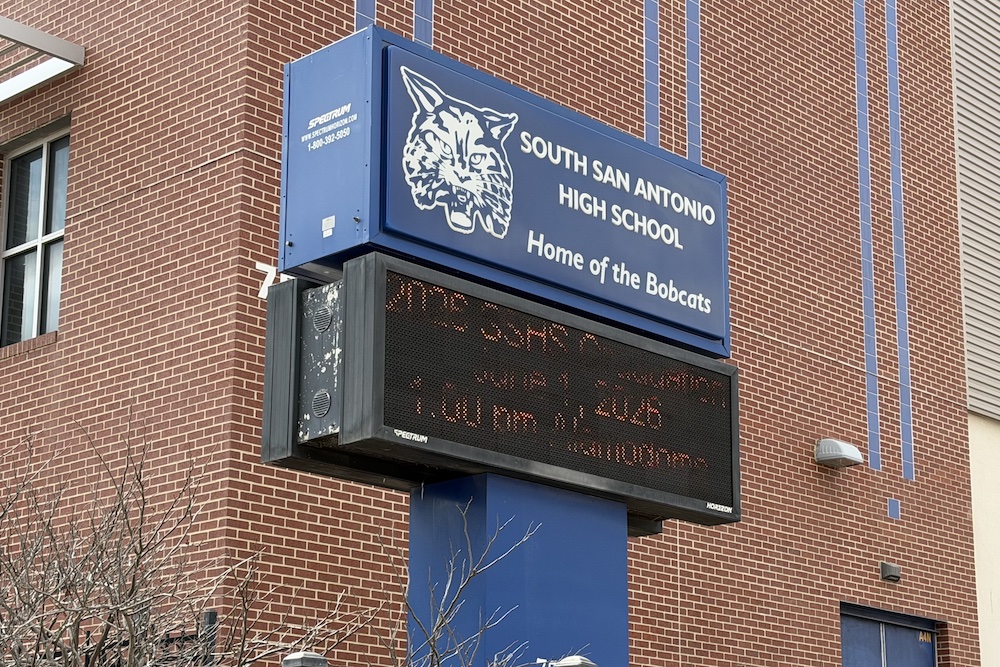
![“I don’t want anybody to get the impression that I’m suggesting things were perfect or great before [the takeover],” one former teachers said of South San's state takeover. “What I want to make clear is the current leadership has made things so much worse.”](https://www.newsbeep.com/us-tx/wp-content/uploads/2026/02/Bobcats-1.jpg) “I don’t want anybody to get the impression that I’m suggesting things were perfect or great before [the takeover],” one former teachers said of South San’s state takeover. “What I want to make clear is the current leadership has made things so much worse.” Credit: Michael Karlis
“I don’t want anybody to get the impression that I’m suggesting things were perfect or great before [the takeover],” one former teachers said of South San’s state takeover. “What I want to make clear is the current leadership has made things so much worse.” Credit: Michael Karlis
Classroom inexperience
The final straw for Garcia came when a DEIC official wrote him up for using an unapproved platform, despite noting in the same report that he did a “great job presenting the material.”
“I’m somebody who loved teaching up until this year. I was one of those,” Garcia said. “I was not planning on leaving the profession at the beginning of the school year.”
Garcia, who resigned as a 9th grade social studies instructor, said he’s worried he and others are now being replaced by far less experienced staff.
Last year, South San ISD laid off nearly 40 teaching personnel. At the time, Superintendent Hinojosa told KSAT the move was necessary to bring in better-qualified personnel.
“In order for kids to achieve, they have to have quality teachers in front of them,” Hinojosa said. “When teachers are not performing, then it’s our job to go find quality personnel to play a big difference [for] our kids.”
Yet, the district recently entered a five-year partnership with Teach for America, which places recent college graduates — often uncertified — into classrooms of inner-city schools.
“The teachers that Teach for America sends are not certified teachers, so they contradicted themselves within months of those statements,” Garcia said.
South San ISD is one of seven districts statewide now under TEA control, with four more takeovers planned this year. In those four districts, more than 80% of students are low-income, and the majority are Black or Latino.
Garcia warns that these districts should expect a culture of fear and a mass exodus of veteran educators.
“It’s just paperwork, micromanagement and threats,” he said.
Meanwhile, as public school morale craters, more than 87,000 students have already signed up for Texas’ new voucher program.
Sign Up for SA Current newsletters.
Follow us: Apple News | Google News | NewsBreak | Reddit | Instagram | Facebook | Twitter | Or sign up for our RSS Feed