
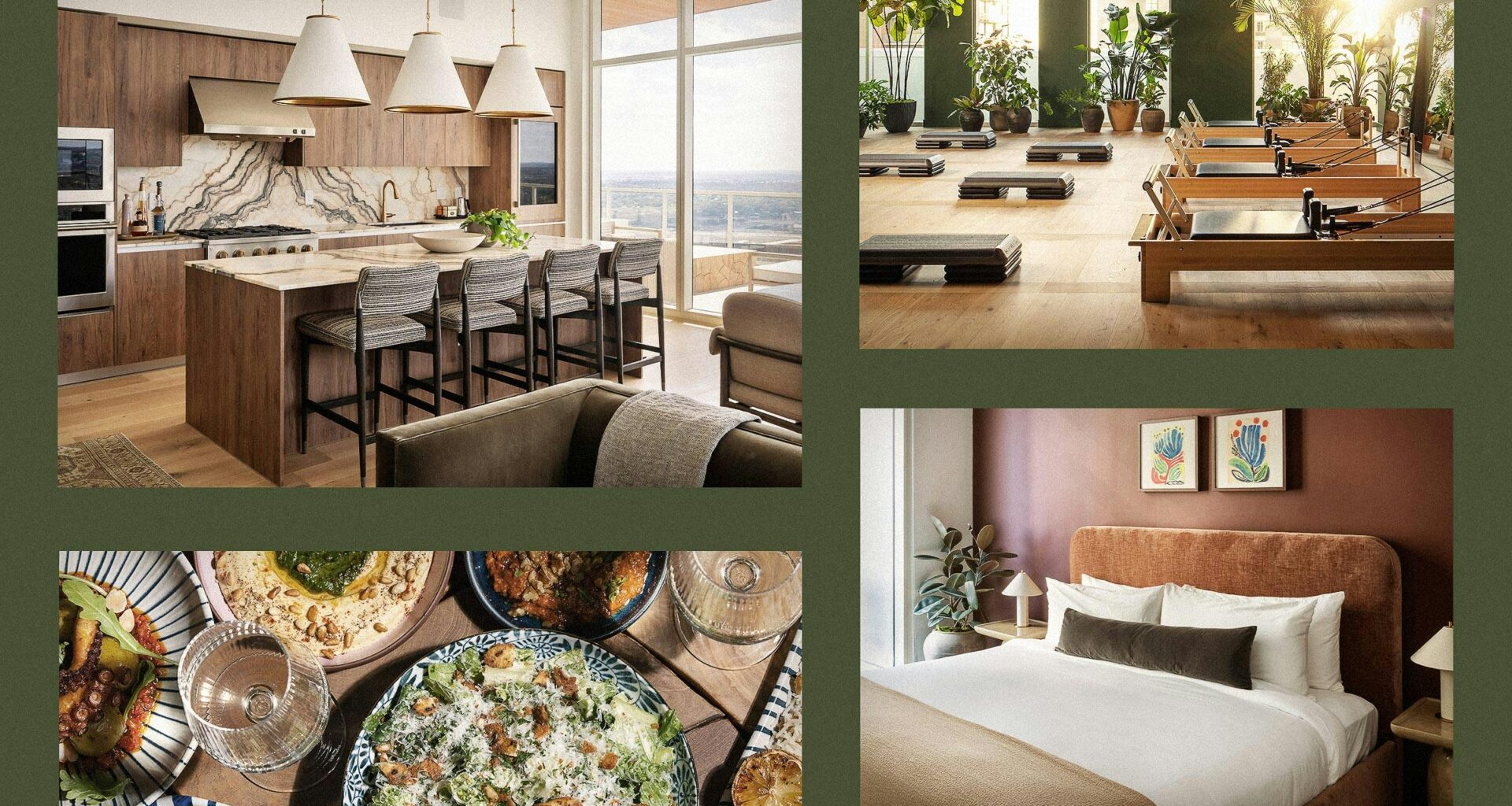
Depending on the length of your stay, or perhaps your point of view, Roost Rainey is either an apartment with a hotel-style concierge and amenities or a hotel with livable, apartment-style rooms, full kitchens, and laundry appliances. We’ve entered the era of the “apartment hotel,” an increasingly popular model that serves as hospitality’s answer to Airbnb, allowing patrons and developers alike to have it both ways.
Opened this January on Rainey Street, one of Austin’s busiest entertainment districts, Roost Rainey is a standout example of the national trend’s arrival in Texas. The apartment hotel has 59 rooms between the fourteenth and seventeenth floors of the new 48-story Paseo high-rise developed by Austin-based LV Collective. Guests can check in for one night or one hundred nights and stay in apartments with a variety of floor plans ranging from studios to four-bedroom suites. As in a hotel, they have access to 24-hour concierge service, a business center, complimentary Wi-Fi, and housekeeping (though on a weekly, not daily, basis). There’s an onsite coffee shop, Daydreamer, on the first floor, and two onsite restaurants, the Mediterranean Amaya, and an as-yet-unnamed Italian steakhouse. But units also contain washers and dryers, full-size closets, ovens, microwaves, and a coffee system valued at $1,000. Guests can also access a rooftop pool, a bike-share program, a fitness center, a yoga and pilates studio, a sauna and cold plunge, and classes from local, live-in artists.
The apartment-style amenities extend to the design of the hotel, executed by LV Collective, whose development portfolio includes student and multifamily housing throughout Texas and the country. Roost Rainey is LV’s first foray into hotel operations. With a warm palette of browns, oranges, and greens, a diversity of wood, leather, and ceramic textures, and enough real plants to merit a full-time caretaker, aesthetic attention was clearly made toward conveying an ineffable “home away from home” feeling. LV Collective executive vice president of design and curation Chelsea Kloss and her team sourced vintage artwork, pots, and furniture from antique markets in Round Top. “That’s how we get soul in the building,” Kloss says. “We feel like that is what makes a space feel like a home.”
Each bedroom in the apartment hotel comes with its own vintage rug and original artwork, providing a tactile, organic feel to the rooms, some of which contain exposed concrete and floor-to-ceiling windows. In the living room, guests can lounge on a sofa that’s actually comfortable, and in the kitchen, they can commune with a real, live plant. No one unit is built to look the same, a design imperative Kloss acknowledges was a heavy lift for her team. Such amenities—scarce in the sterile, cookie-cutter environments of many chain hotels—bely the lodging’s boutique, bohemian aesthetic.
Roost, a brand of apartment hotels from Philadelphia-based Method Co, operates apartment hotels throughout the country, including in five other states. The Rainey Street location, chosen for its “creative energy, walkability, central location, and storied character,” according to Method Co. CEO Randall Cook, is Roost’s first location in Texas. Established in 2014, the brand pioneered apartment hotels, a model that has become increasingly common, with brands like Kasa and Placemakr joining the field in 2016 and 2017, respectively. The San Francisco–based Kasa currently has locations in Austin and Dallas, while Placemakr, based out of Washington, D.C., operates apartment hotels in Austin and San Antonio.
Between 2021 and 2025, revenues for short-term rentals across Texas metro areas rose 53 percent to reach $1.345 billion, according to data from Source Strategies, which publishes an annual analysis of the Texas hotel market. This increase factors in companies like Airbnb, Sonder, and Kasa, but it doesn’t account for giant hotel chains like Hilton or Marriott, which are expanding their portfolios to include short-term rentals. Just last month, Hilton announced a partnership with Placemakr to establish the Apartment Collection by Hilton, which will launch in the first half of 2026 and utilize some existing Placemakr and Hilton inventory, including in Texas. Likewise, the Auberge Collection will open its own hybrid model in Houston in late 2027 with the Birdsall, a building featuring separate apartment and hotel offerings.
Todd Walker, senior vice president of Source Strategies, gives several reasons for the increasing popularity of the apartment-hotel hybrid. After the COVID-19 pandemic, he explains, labor shortages prompted hotel operators and developers to seek properties that could satisfy a demand for short-term housing for temporary workers: Think construction workers or traveling doctors and nurses. For hotel operators, short-term units are also appealing because they require less overhead; for example, fewer workers are required when the guest turnover is lower, and when rooms are cleaned weekly, rather than daily.
Developers also see opportunities for flipping existing structures into apartment hotels. “It’s really hard to build ground-up development now,” Walker says. “If you’re going to repurpose a building that’s already there, can you make it a prototypical, branded hotel? Not usually. But you can convert those rooms to apartment-style lodging.” He says he’s seen this particularly in Dallas and Houston, where hoteliers are planning for a temporary increase in visitors for the FIFA World Cup.
Cost savings can also extend to the guest. Staying in a unit with a full-size fridge, oven, and microwave means less money spent on food during the stay. “It’s a more flexible space that gives the consumer greater value for their money,” Walker says. That value increases, he says, if you’re traveling with family or for an extended time. According to a 2025 travel trends report from American Express Travel, multigenerational travel is becoming more popular.
Apartment-style hotel rooms are also advantageous in urban areas like Austin, where an influx of workers in the tech, medical, and business fields arrive each month. Gaby Sierra, Roost Rainey’s general manager, says a typical guest could be someone who is relocating but might not yet want to sign a one-year lease. “You get here, you set up your family, you start getting to know this space,” she says. “If you want to do nomad working, and you’re here for maybe a month, maybe three weeks, this would be the perfect opportunity to explore the city but also still feeling like you’re home.”
Rather than committing to a neighborhood, an apartment complex, or even a couch purchase, prospective residents can spend their first few months in a spot like Roost Rainey while planning where they want to settle more permanently. Likewise, the rise of apartment hotels can’t be separated from the changing work habits that followed the pandemic. Many more people work remotely and are able to move between cities—and residences—more fluidly. This felt borne out in the common area of Roost Rainey where, one mild day in January, clusters of people in their twenties and thirties typed away at laptops as if lounging in a (very well-designed) dorm lobby.
Here again, the design differentiates the Roost brand from hotel chains and other companies experimenting with the hybrid-hotel model. Kasa apartments and Hilton home suites offer apartment-style units, yes, but often with the same neutral-gray-white color palettes, basic furniture, and mass-printed artwork that typify a traditional hotel room. Nary a vintage rug in sight.
Read Next