
Houston’s life sciences market leaders went from pondering how to attract major players to scoring a $6.5B investment from pharmaceutical giant Eli Lilly in less than five years.
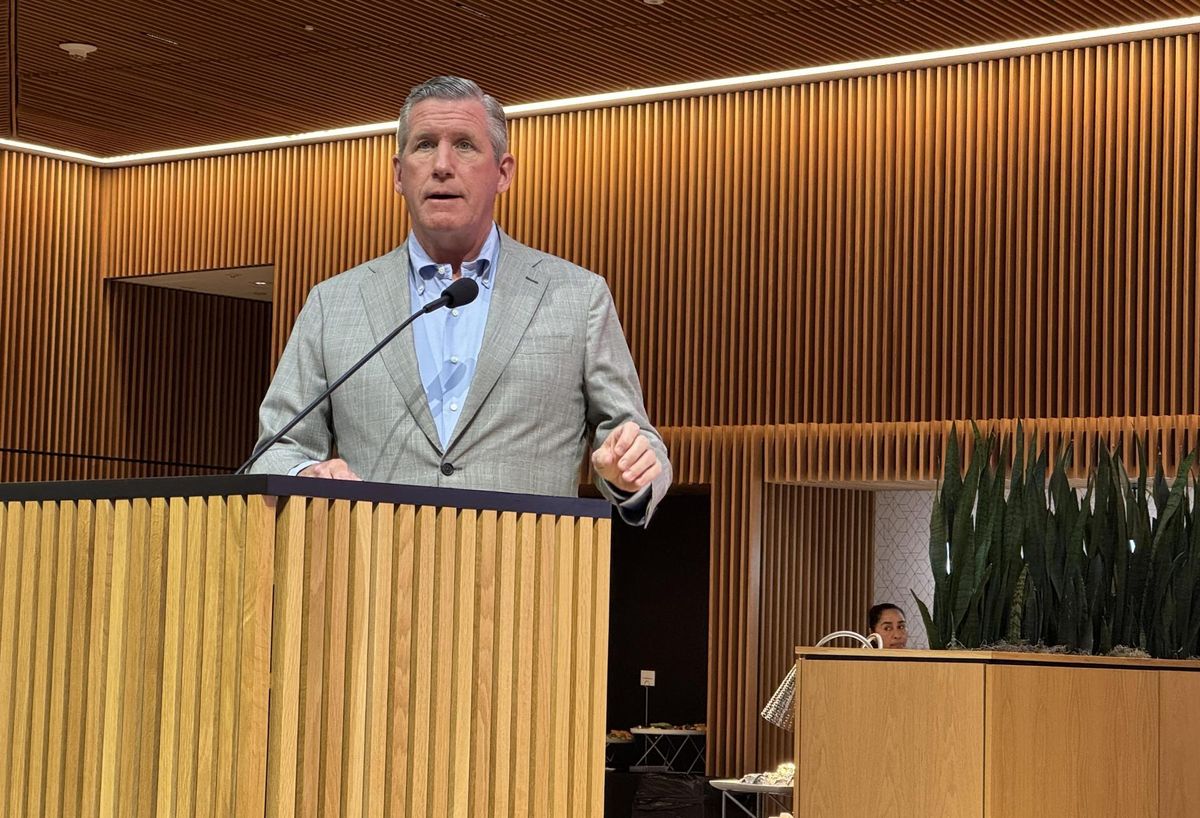
The next decade will move even faster, Texas Medical Center CEO Bill McKeon said at Bisnow’s Houston Life Sciences Conference on Tuesday.

Bisnow/Maddy McCarty
Texas Medical Center CEO Bill McKeon
The event took place at the TMC3 Collaborative Building in Helix Park, one of the game-changers for the region’s life sciences ecosystem. TMC3 and Dynamic One Tower opened in 2023 as the initial phase of the 37-acre Helix Park, providing for-profit and life sciences companies with their first access to TMC institutions.
“As someone who’s been here for over 30 years and remembers when this was a parking lot, [the building] we’re sitting in is my greatest inspiration in terms of innovation,” Joseph Petrosino, chief scientific innovation officer for Baylor College of Medicine, said at the event.
Groundbreaking will happen soon on the next phase of Helix Park, which will include a 250-room hotel, a 300-unit apartment tower and a 22K SF convention center, McKeon said.
Meanwhile, Eli Lilly is establishing a synthetic medicine active pharmaceutical product facility in Generation Park, McCord Development’s master-planned, 4,300-acre tract in Northeast Houston.
“Every day we get a win here in Texas, it elevates the entire ecosystem,” McKeon said. “[Houston] is the up-and-coming cluster in life sciences.”
McCord has given numerous tours of its site since Lilly’s announcement in September, McCord General Counsel Shawn Cloonan said. While not all visitors will set up shop, Lilly’s choice has spread the word and given Generation Park more opportunities to secure additional investment.
“I had it put to me recently by a site selector … It went from ‘Why Houston?’ To ‘Why not Houston?’” Cloonan said. “Market validation matters.”
But while it’s important to secure the first major mover, it’s really important to secure the second one, he said.
Bisnow/Maddy McCarty
AES Clean Technology’s Jeff Rozelle, Baylor College of Medicine’s Joseph Petrosino, McCord Development’s Shawn Cloonan, Lincoln Property Co.’s Gabe Lerner, HDR’s Meagan Gibbs and Paradigm Structural Engineers’ Kurt Lindorfer
It’s also critical that Houston delivers the ecosystem Eli Lilly needs to succeed, with supply chain vendors supporting large-scale production. It can be a symbiotic relationship, but given that Houston has a less established life sciences market than Boston and San Francisco, it carries some risk.
McCord began laying the groundwork for Generation Park to secure a large biomanufacturing investment more than a decade ago. Lilly has significant power and water requirements, making $250M in infrastructure investment at the site an attractive proposition.
Texas Medical Center built the 250K SF TMC3 completely on spec, meaning there were no leases in place, McKeon said.
“We ran the risk of building this entire building without having any tenants,” he said. “Now, you can see there’s hardly any real estate left in here. I think we have about 20K SF left in this building.”
The building was packed during its first year, and events are held daily or twice daily in the central auditorium, where the Bisnow event was held. The building provides a presentation and gathering space for the entire TMC campus.
Another recently announced project further expanding Houston’s life sciences corridor into Midtown is The Arc at the Ion District, a nearly 200K SF research, laboratory and office building being developed by Rice Real Estate Co. and Lincoln Property Co.
The Ion District is STEM-focused, and this expansion will allow Rice University students and graduate students to study, collaborate and develop talent in these buildings, Lincoln Executive Vice President Gabe Lerner said. Rice will anchor The Arc’s office space.
“We wouldn’t be doing a spec building if it wasn’t for Rice University, and leveraging not just their expertise, but their talent,” Lerner said.
Bisnow/Maddy McCarty
San Jacinto College’s Robyn Cardwell, Beacon Capital’s Monique Knighten, Sugar Land Office of Economic Development’s Alba Penate-Johnson, BioHouston’s Jeff Wade, Texas Medical Center’s Tom Luby and Transwestern’s Ashley Byrd
If you want something, you have to create a space for it to happen, Cloonan said. TMC did that through its development of Helix Park, which fosters collaboration critical to the life sciences industry.
The wins and developments in Houston’s life sciences market are showing the rest of the world that Houston is the next spot for life sciences innovation, McKeon said.
“We should all be proud of this because it takes a village to build it, and we’re really excited about it,” he said. “The next decade will be moving even faster than the past.”