
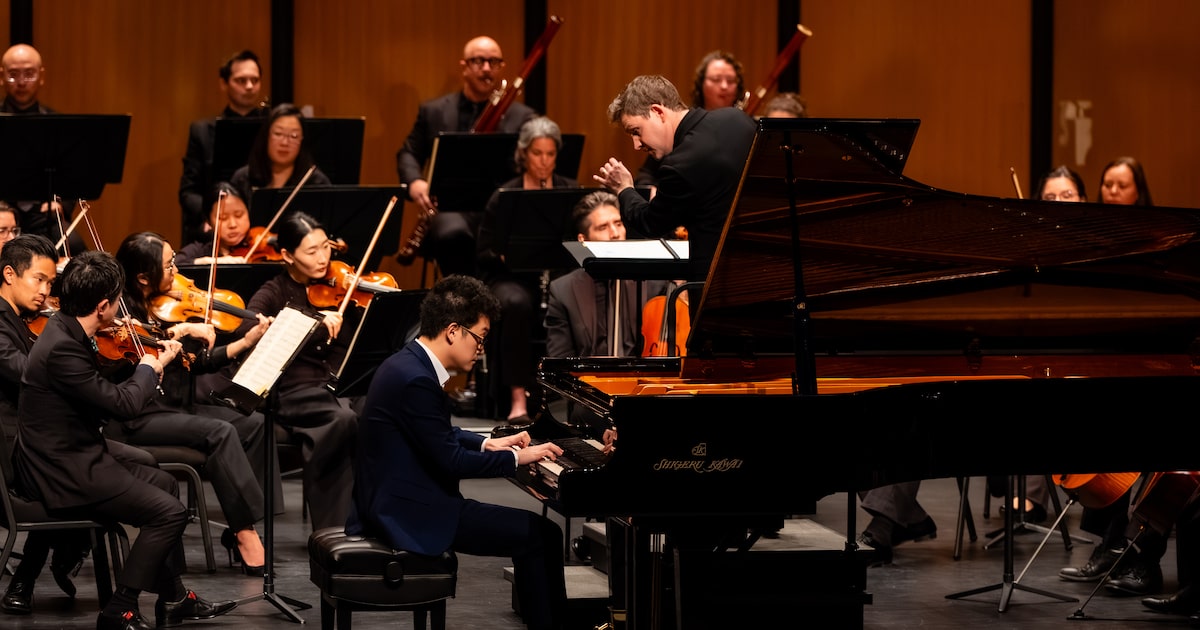
Some orchestral music simply sounds better performed by ensembles smaller than Strauss-size forces, and in cozier settings. That’s the welcome — and sometimes revelatory — experience supplied by the Dallas Chamber Symphony.
At least two of the three pieces on Tuesday night’s program, at Moody Performance Hall, were conceived for orchestras smaller than our symphonic norms. With 35 or so musicians, the chamber symphony could give early Beethoven (the Piano Concerto No. 1) and Schubert (the Fifth Symphony) an aural openness, an immediacy, hard to synthesize with twice as many (and more) players.
The 750-seat Moody supplied an apt balance of sonic presence and spaciousness, although in a hall with such strong bass response the double basses could have used lighter touches. The program opened with the very different but pleasant 12-year-old Canto by American composer Adam Schoenberg (no relation to the 20th-century Austrian composer Arnold Schoenberg).
The Schubert was the evening’s prize. With gestures clear but expressive, music director Richard McKay set lively tempos in all four movements, and gave the music shape and purpose. Even in the nominally slow movement, which McKay managed to make both songful and and buoyant, this is happy music.
News Roundups
By 1816, when the 19-year-old Schubert penned this symphony, the “Menuetto” was anything but a courtly dance — more a feisty scherzo. McKay properly took it at an athletic one beat per measure, not the minuet’s traditional three. In the finale he gave the music big breaths before each appearance of the contrasting episodes.
The performance of the Beethoven wasn’t in the same league. The soloist was Yi-Chen Feng, a prize winner of the chamber symphony’s Dallas International Piano Competition and several other contests. He played competently, of course, as did the orchestra, but I never sensed any special spark.
Tempos felt that hairbreadth too reserved. And Feng’s first-movement cadenza lacked the essential feeling of spontaneity or improvisation.
Schoenberg’s Canto was inspired by the birth of the composer’s son, and its nine minutes are mainly quiet and dreamy. Through hushed hazes of strings emerge gentle pulsings and flourishes of winds. A solo trumpet is given both distance and extra resonance by being played into the piano’s strings — which elsewhere are given harp-like hand strummings. The music gathers energies, but controlled ones, before fading away like a dream. The performance made an appealing case for the piece.
Applause between movements meant to be heard without interruption is a growing distraction around here. The chamber symphony has come up with an understated but mostly effective counter: a tiny hand-clapping emoji in the printed program after final movements. On Tuesday it worked except for a bit of applause after the Schubert Menuetto.
A board member’s spoken introduction, read off shuffled cue cards, didn’t encourage much enthusiasm. And McKay’s music-appreciation introductions weren’t as informative as they could have been. Strangely muffled amplification didn’t help either speaker.
CORRECTION, 11:31 a.m., Feb. 18, 2026: An earlier version of this review included a misspelling of Richard McKay’s last name.
 Review: Dallas Chamber Symphony was at its best in Mozart
The program included the original version of Tchaikovsky’s Rococo Variations.
 Review: A splendidly refreshing Dallas Chamber Symphony concert
The program included a rare performance of Poulenc’s Piano Concerto, with Anton Nel the spirited soloist.