
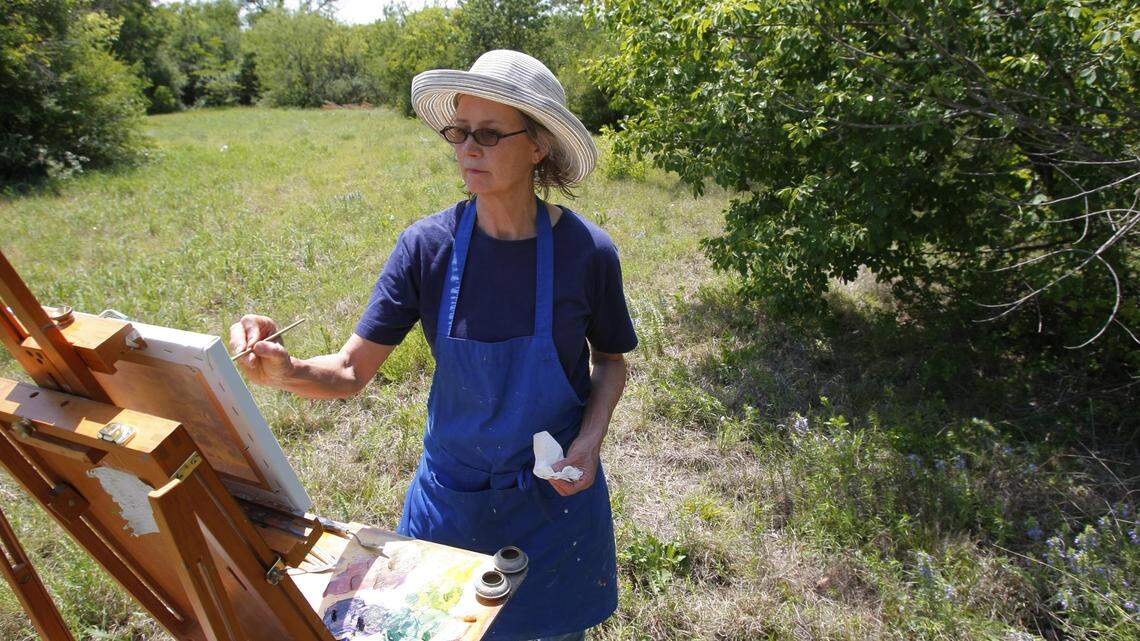
Artist Carol Ivey paints east Fort Worth scenery in this file photo from 2009. Ivey, known for her work that emphasized light and form, died Feb. 8.
Rodger Mallison
Star-Telegram
Carol Ivey, a beloved Fort Worth artist known for her paintings and watercolors that emphasized light and form, and who nurtured relationships with young and fellow artists and advocated for progressive causes, died Feb. 8.
She was 76.
Ivey was remembered by friends and colleagues as gregarious, warm, intellectually curious, perceptive and a talented artist committed to her craft and the artist community.
She displayed across the country in almost 70 solo and group exhibitions throughout her life. She was represented by Artspace 111 in Fort Worth and the Hunt Gallery in San Antonio and also displayed at Ro2 and Barry Whistler in Dallas, among others.
Ivey was born in Sherman, on May 2, 1949, to the late Richard H. Ivey and Juanita Ivey. The family moved across North Texas and eventually settled in Highland Park, where she graduated from Highland Park High School. She was accepted to and enrolled at the University of Texas at Austin, where she graduated with an art degree in 1971.
⭐ Our editors also recommend:
That’s where she met graduate art history student Karen Gregg in the university’s fine arts library.
Almost immediately, “we were like sisters,” recalled Gregg, who lives in Greenville, South Carolina.
“She was such a kind soul. She really was one of those people who makes you realize people can be good,” she said.
She was also perceptive, a trait visible in her artwork and personal life.
When a few young men were hassling them while on a spring break trip to Mexico City with Gregg, she didn’t go to the police. She offered to paint their portraits as a way to distract them.
“That’s the kind of person she was. She was so sweet in situations like that,” she said.
Austin artist Melissa Miller met Ivey in 1974. She was visiting former professor Charles Field, who was teaching at the University of New Mexico, where Miller was a student of Field’s. They reconnected when Miller moved to Austin in 1975. They rented and shared a studio space from 1977-1983.
“As a young artist in a state and city that historically offered little support to women artists, she moved forward with intention and resolve. She had a quiet confidence and an enviable work ethic,” Miller said.
She also didn’t fail to reach out to fellow artists for help, and to help them.
In 1977, she displayed a painting at the first Multi-Media Art Festival & Celebration of Women & Their Work, a multidisciplinary arts festival in Austin.
The next year, she became a leader of the pioneering arts organization.
“It was gratifying to see what we could accomplish together. It changed our wider art community, and it changed us,” Ivey told online art publication Glasstire.
That work became what is today the esteemed Women & Their Work, a nonprofit visual and performing arts organization. In 2021, the Smithsonian Institution acquired their archives.
Deborah Mersky was one of the artists she nurtured. She was nearly a decade younger than Ivey when she first saw one of her paintings at the Laguna Gloria, now part of the Austin Contemporary in the mid 1970s.
“Her colors made so much sense. It connected to the outside. She made a big impression on me,” the Santa Fe resident and artist said. “She was an intriguing artist.”
But they didn’t formally meet until Ivey moved to Seattle around 1980, where Ivey in part sought a vibrant art community, and where Mersky was studying toward her Master of Fine Arts at the University of Washington.
“She called me, we bonded and our lives intertwined,” she said. They eventually shared studio spaces in the bottom of a building with a large open window facing the mountains.
Given her early work focused on landscapes, mountains, forests and gardens, she could have easily embraced the new environment, which was far different from flat Texas.
Instead, she moved away from still life paintings and toward abstraction. Maybe it was the new location, Mersky suggested. “Maybe there was something about being in a new environment that allowed her to be in a new realm.”
Ivey was known for connecting people. But Mersky facilitated one of her most significant connections: Herb Levy, an experimental musician and fellow progressive activist.
When she moved to Fort Worth in 2000 to be near her mother and sister, Levy joined her. They married on May 17 of that year and were together until her death.
The city welcomed her, though Ivey, a social and gregarious person, made it easy for others to welcome. Levy brought his interests too, pushing the city to acknowledge and try out experimental music and visual art to mixed success.
She served on the Exhibition Advisory Panel of the former Fort Worth Community Art Center and on the steering committee for Emergency Artists Support League, which supported artists facing unexpected, costly emergencies. She taught courses in TCU’s Extended Education program, local community colleges, in Tuscany and at the La Romita School in Italy.
Like wherever else she lived, she mentored artists at various stages in their careers. In obituaries and essays, artists Christopher Blay, Bernardo Vallarino, and Ariel Davis, a student of Miller’s, celebrated her contributions to their lives.
She also earned some big accolades in Fort Worth. She was twice a finalist for the esteemed Hunting Art Prize, awarded annually to a Texas artist, and frequently swept the awards at Historic Fort Worth’s annual art auction Preservation is the Art of the City.
Neither Mersky, Gregg nor Miller knew why she reverted to still life paintings when she moved to Fort Worth, especially after 20 years of abstract painting in Seattle.
But even back to her early days as a painter, she was deeply aware of how natural light illuminates spaces and objects and creates meaning.
“The changing light kept her attentive, energized, and gave her work an emotional resonance that invites a deeply personal response from the viewer,” Miller said. Her early and late paintings remained “grounded in her steadfast interest in shape, form, color, and arrangement.”
But it was light that elicited dramatic reactions.
“Light dominated the experience of seeing her painting,” Mersky said.
While she never fully returned to abstraction, her still life paintings hinted at it. “They were reduced to lines, marks, shapes, and rhythms,” Miller said.
She also treated people like she treated the subjects of her paintings: with care. “No matter the subject — a chair, live or dead vegetation, a chipped tile — Carol gave it dignity and presence. Through her eyes we see not only her love of nature, but the beauty in what is overlooked, discarded, or ordinary, and the light that gives them form and life,” Miller said.
Gregg recalled she was a stalwart advocate for women’s rights, the environment and progressive politics as far back as college. She saw a broken world, Mersky said, which explained dead flowers and broken vases, and felt obliged to fix it.
But even her work most closely tied to traditional still life paintings focused on technique and objects didn’t lack meaning. As she described in her biography, she wanted to repair the world one painting at a time.