
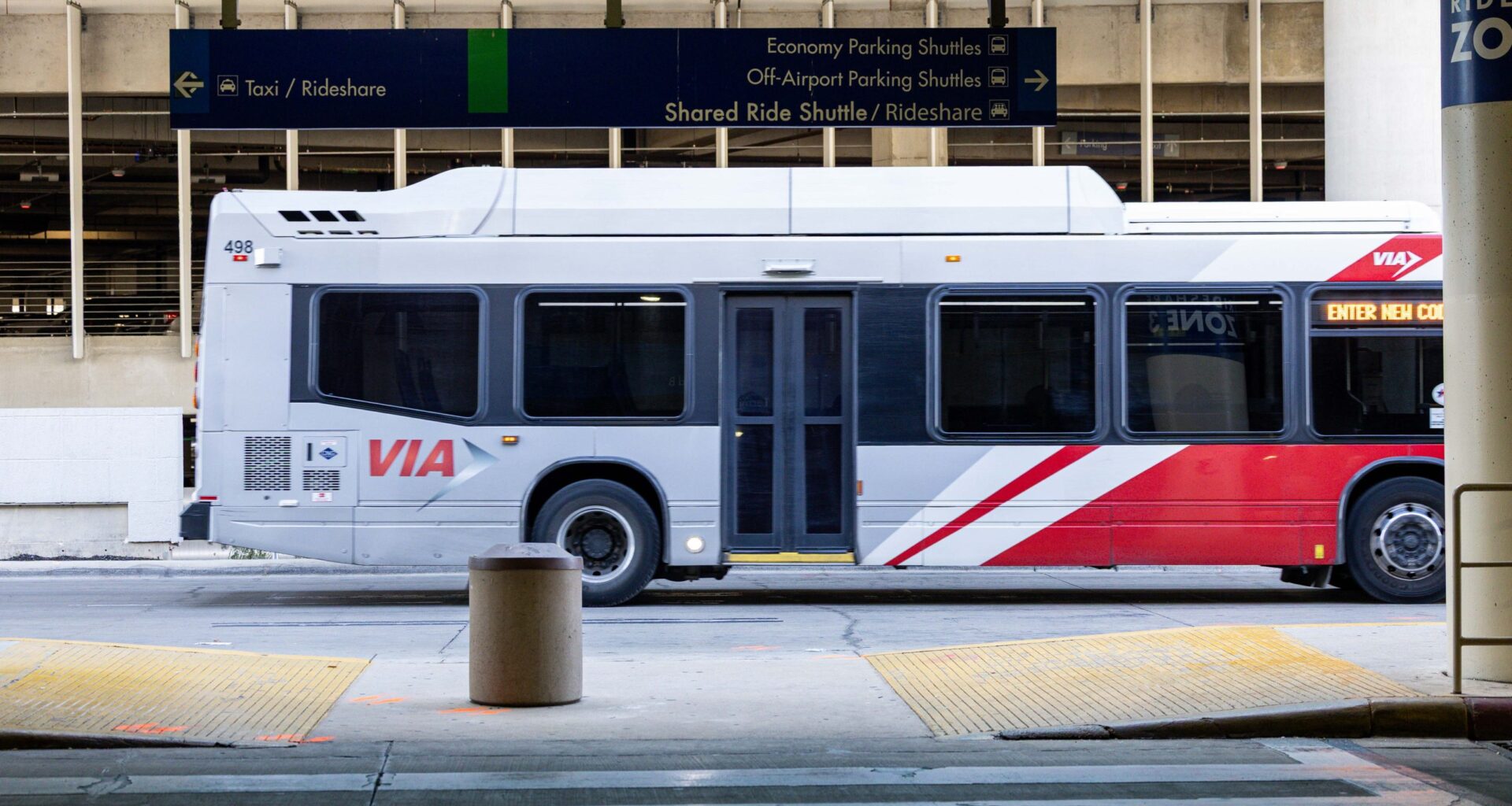
Several elected officials in San Antonio say VIA should offer free bus rides.
Mayor Gina Ortiz Jones asked VIA to design a pilot program for fare-free rides to potentially implement by July 1 at a recent San Antonio City Council B Session meeting.
The request had support from at least three other council members — Jalen McKee-Rodriguez (D2), Ric Galvan (D6) and Edward Mungia (D4).
“San Antonio needs to use all the tools at our disposal, including fare-free transit to improve ridership and address longstanding issues like access to food, health care and employment,” said McKee-Rodriguez in a press release on Monday. “A fare-free pilot is a good initial step, and I look forward to hearing VIA’s proposed way ahead.”
Jones asked VIA Metropolitan Transit, entirely funded by public dollars, to look into starting a six-month pilot program for the top five busiest routes.
A majority of VIA’s operating budget — 75.8% — is funded by sales tax revenue. This year, VIA started collecting between a one-eighth cent sales tax that had previously gone to the city’s Ready to Work program. That tax is projected to generate between $47 million and $48 million annually.
VIA currently charges $1.30 for a bus ride and $38 for a 31-day pass. The agency launched a pilot program for free student fares in January.
VIA President and CEO Jon Gary Herrera said fares make up about 5% of VIA’s revenue, around $18 million.
“$18 million is still $18 million,” Herrera said. “That’s a very important aspect of our budget, as small as it is.”
Jones asked VIA to present options for offsetting that 5% and Herrera brought up cutting VIA’s rapid bus projects.
“We don’t need a memo for that, we’d stop the Green and Silver Line, to be honest,” Herrera said.
“I’m sure there’s not just one thing you would look at. Please lay that out, how would you offset that 5%,” Jones replied.
The Green and Silver Lines are planned rapid transit buses that will go through downtown, one from north to south, the other from east to west. The bus lines will use raised platforms, dedicated bus lanes and synchronized traffic signals to move passengers more quickly.
Construction for the Green Line started in 2025 and the Silver Line will break ground in 2027. Both projects received funding from the federal government — $268 million is set aside for the Green Line, while another $134.7 million is going through congressional review processes.
In an email, VIA officials said they were concerned that removing fares could trigger reviews of those federal grants. VIA submitted a financial plan to the Federal Transit Administration that included fare revenue.
“Any material changes to that financial plan, including the removal of fare revenue without a stable and dependable replacement source in place, could trigger federal review,” said VIA Director of Communications Josh Baugh in an email.
Baugh said on Wednesday that the agency is discussing the mayor’s proposal with its board of trustees.
Jones said during the Feb. 11 meeting that free fares could increase ridership, reduce traffic and pollution and lower wait times at bus stops.
Other cities across the country are having the same conversations. Boston and New York are testing the waters with pilot programs or proposals. Kansas City did away with its fares in 2020, but plans to bring them back this year.
VIA is eyeing additional funding through a telecom tax that had previously been used for the Ready to Work program. That tax could generate $6 million annually, but council members would have to approve its use for VIA.
McKee-Rodriguez and Mungia both said the future of free fares would play a role in their decisions about if that tax is collected and where that money goes.
“Public goods are public goods and we shouldn’t be charging people to go to the library, to access their senior centers, to use their parks,” McKee-Rodriguez said. “To me it’s goofy to expect them to pay to get on a bus they’re already paying for.”
“If and when we evaluate the Telecom tax, I would expect some sort of deeper analysis into free fare, even if that’s not your recommendation,” Mungia said. “That’s a real issue for a lot of families in our community.”
The fare discussions come as VIA is launching historical updates to its transit system. The agency wants to grow from 900 to almost 1,200 bus drivers. VIA will host a job fair for hiring those drivers Wednesday, new hires could get a $4,000 hiring incentive.
VIA is also planning to reduce wait times on 72% of its routes to under 30 minutes in 2026 as part of its Better Bus Plan. That plan, which is reconfiguring routes and includes the new Green and Silver Lines, will be 65% by the end of the year, VIA officials said.