
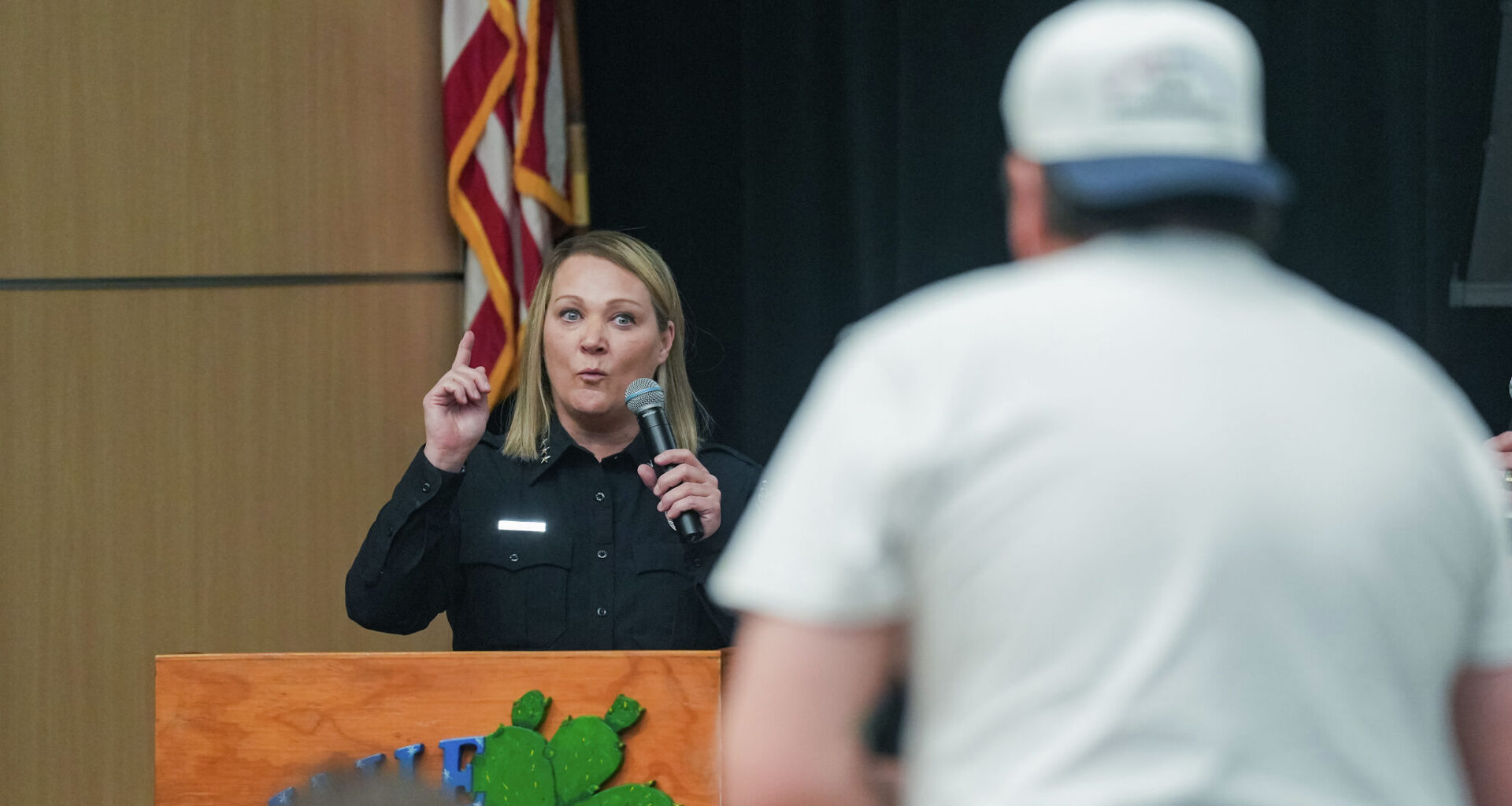
Austin Police Chief Lisa Davis addresses community concerns about Austin police officers cooperating with federal immigration agents during a Feb. 5 town hall at Govalle Elementary School.
Mikala Compton/Austin American-Statesman
Legal memos from the city are not infallible. I know this because in 2018, I won what many told me was an impossible legal fight on behalf of Lewis Conway Jr. against the city of Austin and the Texas Secretary of State.

Conway had been convicted of manslaughter as a young man and, after serving eight years in prison and 12 years of probation, he earned back his right to vote. I believed that meant that he was fully rehabilitated and possessed the right to run for Austin City Council. The city clerk’s office disagreed.
Article continues below this ad
Relying on legal advice from the city’s Law Department — which also cited guidance from the Texas Secretary of State — the clerk issued a legal memo that refused to place Conway’s name on the ballot. The message was unmistakable: the lawyers had spoken, and the matter was settled.
What followed was months of public debate and careful scrutiny of that legal opinion. Eventually, the city clerk reversed course and placed Conway on the ballot. That experience left me with a lesson that has shaped my legal career ever since: legal opinions, even from respected government attorneys, are not commandments. They are interpretations — shaped by perspective, institutional culture and sometimes an overly cautious reading of the law. When the stakes are high, Austin should not treat a single legal memo as unquestionable truth.
We now find ourselves in a strikingly similar position.
In January, the city attorney’s office issued a memo concluding that Senate Bill 4 requires the Austin Police Department to cooperate more freely with federal immigration authorities. APD Chief Lisa Davis has stated this memo effectively ties her hands, leaving her little choice but to allow officers to communicate with ICE agents and ask people they encounter about their immigration status.
Article continues below this ad
The city appears prepared to reshape local policing based on a single internal legal opinion. That should give us pause.
RELATED: APD’s new ICE policy goes further than SB 4 demands
The city can, and should, seek a second legal opinion from external counsel. This is not unusual or confrontational. Cities routinely hire outside attorneys when an issue is especially complex, politically sensitive or legally uncertain. I know this because I have served as outside counsel for municipalities, drafting independent legal analyses when they needed an additional perspective.
There are powerful reasons to do so here. This policy will affect the entire city — how officers conduct themselves, how residents experience policing and how Austin balances its progressive identity with state mandates.
Article continues below this ad
Moreover, this is not a simple municipal legal question. It sits at the intersection of federal immigration enforcement, state preemption, local autonomy and constitutional rights. These are precisely the kinds of issues where specialized constitutional and appellate expertise would be valuable.
A second opinion can also weigh questions like: What does minimum cooperation with SB 4 actually require, as opposed to what the city assumes it requires? Where does local discretion remain? What protections exist for Austin residents if federal agents overstep their authority?
ALSO READ: APD Chief Davis: Clarity on immigration rules is key to trust
Seeking independent legal analysis is a sign of responsible leadership. It acknowledges that the law is complicated and that reasonable lawyers can disagree. We learned this with Lewis Conway. Had we accepted the city’s original legal opinion without challenge, a qualified candidate would have been wrongly excluded from the ballot, and Austin’s democracy would have been diminished. A second look at the law did not undermine the city — it strengthened it.
Article continues below this ad
Today, the stakes are even higher. This is not about one man’s candidacy; it is about how Austin defines itself in a moment of political and legal tension and, at the very least, it warrants a second opinion.
Ricco M. Garcia is an attorney and former chief of staff for Texas Sen. Carol Alvarado. He served as general counsel for state Rep. Toni Rose when SB 4 was passed in 2017.