
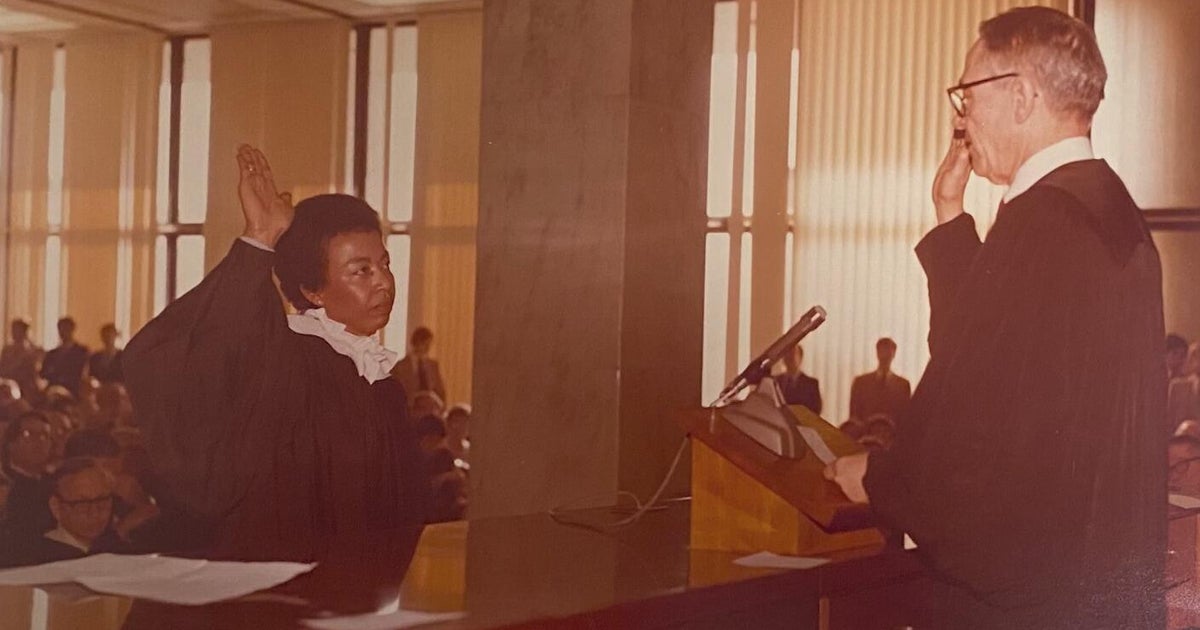
Now 83, trailblazing Black attorney in Dallas, Joan Tarpley says she never intended to make history, but she did.
“I was just trying to make a life,” said Tarpley. “And I think the interesting thing that I have experienced from being a first is that one sort of leads to another.”
From cotton fields to SMU law school
Raised as the only daughter of North Dallas cotton farmers, Tarpley says she was determined to build a life not limited by gender or race. But that was no easy task in Dallas, Texas, in the late 1950s.
After refusing her mother’s request to become a doctor, Tarpley settled on law school. She shared that dream with her employer: a wealthy, well-connected business owner.
“So, he picked up the phone and called him and said, ‘Hey, Charlie… I’ve got a young African American woman over here. Wants to come to SMU, and she’s worried she won’t be accepted,'” said Tarpley. “‘Charlie’ to him was Charles Gavin, the dean of SMU’s law school.”
Tarpley began law school, taking classes at night, while working full-time to help support her family. Soon her grades were so good that more doors were opened. She got a job on campus and was able to take classes full-time.
As the only Black woman at SMU’s law school in the early 1960s, she says most students were working too hard to harass her.
“I can’t remember who it was,” she said, recalling a later conversation with a classmate, “but we graduated by then. And his comment was, `Well, we all knew. We all always knew that you were very smart, smarter than we were. So, we just left you alone.”
Except for that one student. Tarpley recounted an experience after the assassination of Martin Luther King Jr. She’d been working in the law review office and a student popped in, singing.
“‘Ding dong, the king is dead… the king’s in the well, the king is dead,'” Tarpley recalled. “Of course… he was, without saying so, applauding that King was assassinated.”
Karma, however, is the most wicked of the witches. As fate would have it, she’d one day become that classmate’s supervisor.
First steps in Dallas law

Joan Tarpley
After graduating from SMU law in the top 10% of her class, a major law firm in Dallas was forced to allow her to interview and offered her a job… as a librarian.
“That was the point in time in my law journey that really infuriated me,” saidTarpley.
But she hadn’t gone to law school to become a librarian. She took a position with a Black-owned firm and became the first Black woman to practice law in Dallas County.
The farmer’s daughter wasn’t done shaping Dallas. The landmark case that desegregated the Dallas Independent School District schools? Tarpley was there.
Shaping Dallas: desegregation and magnet schools
“And [legendary federal judge] Barefoot Sanders leaned back on his chair on a Friday afternoon and said, ‘Listen, when y’all come back in here Monday morning, have a desegregation plan that you all agree to that I can sign.’ So that’s what we did.”
The result was DISD’s nationally recognized magnet schools, including the Booker T. Washington High School for the Performing and Visual Arts and the School for the Gifted and Talented at the Yvonne Ewell Townview Center.
“And Dallas’ Black community had a plan in which they were not bearing the brunt of the bussing,” said Tarpley.
She continued to make headlines and history.
First Black woman district court judge
“May 1, 1975, I became the judge,” she said. “I was sworn in.”
Tarpley would go on to become the first Black woman appointed as a district court judge in Dallas County. As they posed for pictures, she handed her Mom the gavel, hoping she’d finally forgiven her for not becoming a doctor.
She recalls that moment with quiet pride, sharing that the leadership of the Bar Association had been exceptional. Other members, she recalls, were quietly fuming.
“They resented not only the gender,” Tarpley said. “But they felt that the money, I think it was $30,000 a year, and they thought $30,000 a year was too much money, for not only a woman, but a Black woman.”
Tarpley, a quiet mix of grace and humility, drops names liberally when asked about her journey; the names of those who helped and who opened doors. In spite of the racial tension of the time, she says it was powerful white men who made her history-making journey possible.
Family pride and legacy
Her eyes filled with tears when she shared the moment that made her most proud: she had accompanied her father to a white bank. She said he was wearing his overalls, and “he was so proud to say, `This is my daughter. She’s a lawyer now.'”
“He was more proud than Mama,” Tarpley said.
Long since retired, Tarpley, also an author, spends her days reading, spending time with her doting only son, Ikoyi Winn, and playing bridge with friends.
As for the generations still looking to break down walls, her message is simple: first find that dream, then, “Eye on the prize.”