
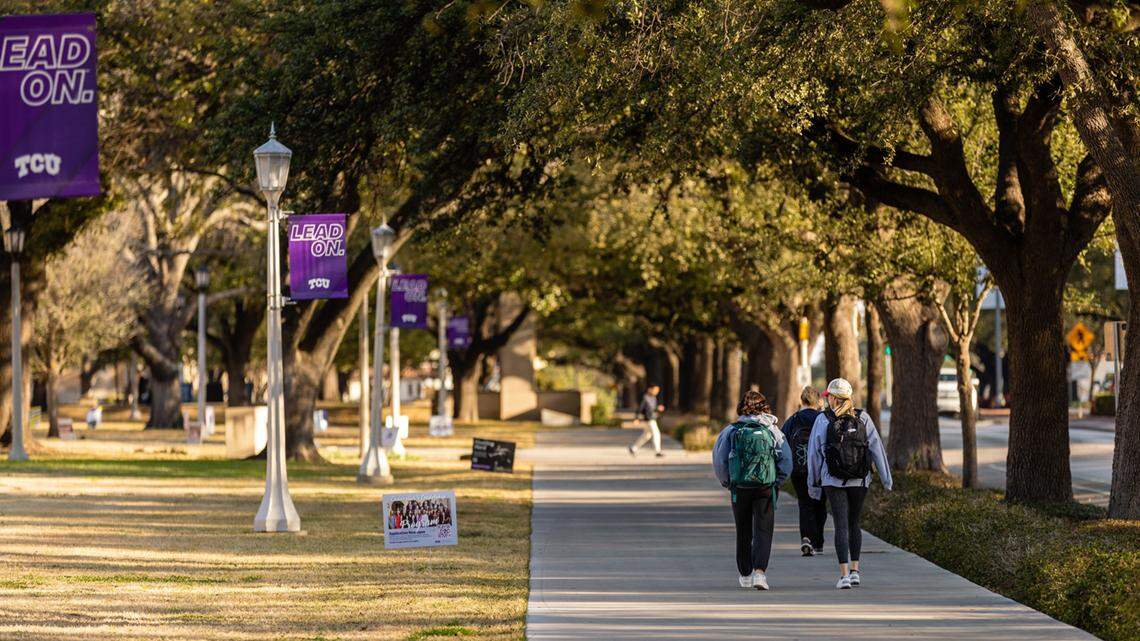
The campus of TCU in Fort Worth, Texas
Facebook/TCU – Texas Christian University
A college campus’ curb appeal can sometimes make or break a prospective student’s decision to attend.
That’s one reason why U.S. News & World Report publishes a list every year that highlights America’s most beautiful college campuses based on architecture, landscaping and picture-worthy sites. U
This year, North Central Texas is home to two of the 30 most beautiful campuses — including Fort Worth’s very own TCU.
The report highlights TCU’s historic buildings and iconic landmarks like Frog Fountain, one of the most recognizable symbols of the university for nearly 60 years. The writer also notes that the campus’ landscaping has been recognized by the Arbor Day Foundation as a Tree Campus Higher Education Institution for the eighth year in a row.
The Princeton Review has also recognized the TCU campus as the No. 4 most beautiful in the country.
The other Texas campus to make U.S. News & World Report’s “most beautiful” list is Baylor University in Waco, recognized for its uniform red brick buildings and Georgian inspired architecture.
[Related: As TCU grows, students worry school will ‘lose its charm’ ]
What makes TCU’s campus one of nation’s “most beautiful”
Anyone who has set foot on TCU’s 300-acre campus knows it has a mix of historic and contemporary buildings, more than 3,200 trees, lush flowerbeds and of course, that beautiful shade of purple.
Here are five things about TCU that we think make it such an attractive campus.
Students return to Texas Christian University campus for the first day of class on Monday, Aug. 19, 2024, in Fort Worth. Amanda McCoy amccoy@star-telegram.com Frog Fountain – Campus Commons
The $100 million Campus Commons is the central point of campus, tucked between dorm halls, the Brown Lupton University Union (BLUU) and Frog Fountain.
This space has a large lawn where students gather to study, hang out and celebrate concerts or other events. The centerpiece of the commons is Frog Fountain, a landmark that features four stylized flutes topped with lotus petals, a symbol of eduction.
The fountain was a gift in 1969 from Mr. and Mrs. H.H. Phillips of San Antonio. “The four stylized flutes represent classes — the tallest for seniors, the shortest for first-year students — and the water flowing between lotus petals symbolizes shared knowledge,” according to TCU Magazine.
Spring tulips
If the yellow-brick architecture of TCU Campus doesn’t impress you, the landscaping surely will.
The best time to see the colorful campus grounds may be in the spring, when over 20,000 tulips of all colors blossom.
The tulip tradition dates back to 1986. Every year, volunteers and groundskeepers plant the bulbs in December, and by March, TCU is painted in pink, yellow, white and of course, purple.
Mary Couts Burnett Library
The Mary Couts Burnett Library marks the start of the academic portion of campus where students take their classes.
The 100-year-old library is grand, with Roman style columns and a trek of stairs to the entrance. Though the library has had updates and additions, the Gearheart reading room features windows from the original building.
The Princeton Review has also ranked Mary Couts Burnett Library as No. 10 best college library in the country.
Fans in Frog Alley get their photos made with Super Frog. Paul Moseley pmoseley@star-telegram.com Frog Alley
If you’ve been to a TCU tailgate, you know Frog Alley. But for those who haven’t, this strip of Stadium Drive nestled between the BLUU, Schollmeier Arena and Amon G. Carter Stadium features historical statues and gorgeous landscaping.
An 8-foot tall Horned Frog statue adorns the front of the Schollmeier Basketball Arena. But as you walk, there are also bronze tributes to Gary Patterson, former TCU football head coach, and Davey O’Brien, a TCU football player and Heisman winner.
Worth Hills Greek Village
TCU campus has all sorority and fraternity houses located on campus in Greek Village, also known as Worth Hills.
Worth Hills is a newer addition to the campus that finished construction in 2017. The 106-acre area has a grassy courtyard next to a dining hall, four sophomore residence halls and the yellow-brick Greek Village.
Greek Village holds 13 sorority houses and 13 fraternity houses, some with a view of the Amon G. Carter Stadium. And it’s a short walk away from the Charlie and Marie Lupton Baseball Stadium at Williams-Reilly Field.
🔥 In case you missed it…

Fort Worth Star-Telegram
Ella Gonzales is a service journalism reporter for the Fort Worth Star-Telegram. She is part of a team of local journalists who answer reader questions and write about life in North Texas. Ella mainly writes about local restaurants and where to find good deals around town.