
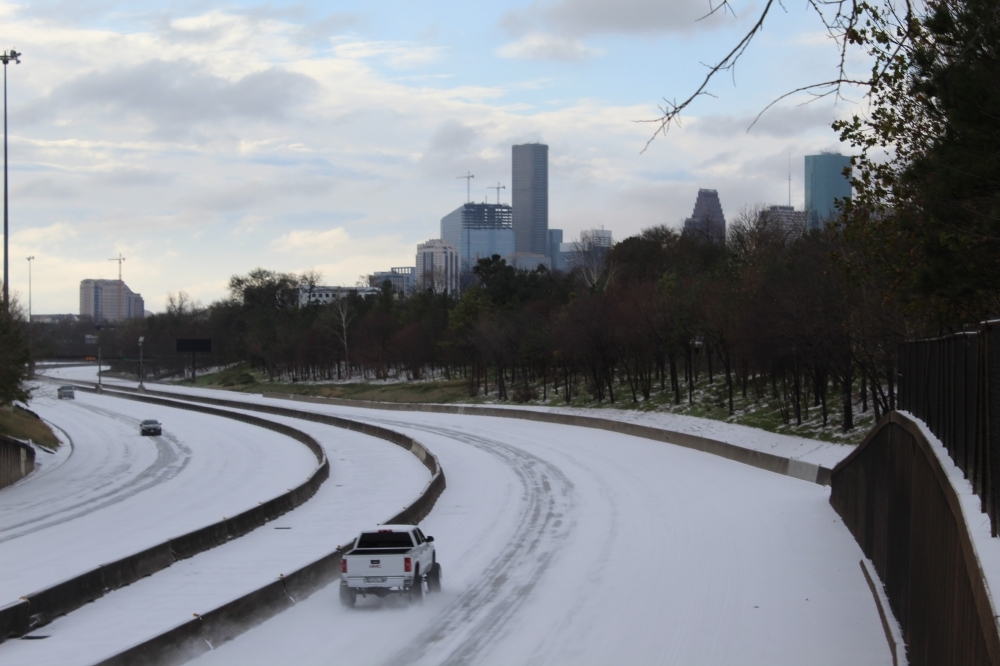
This January, Texans again braced for an arctic blast that brought ice and below-freezing temperatures to large parts of the state. Residents prepared by stocking up on groceries and dripping faucets, while some businesses, schools and government offices closed for days.
Local officials reported less than one dozen storm-related deaths and state leaders warned that some communities could see isolated power outages due to weather conditions; however, the Texas power grid remained stable throughout the storm and the state came away largely unscathed.
“The grid has held once again [and] worked absolutely flawlessly,” Gov. Greg Abbott told Dallas radio host Mark Davis on Jan. 26. “That’s because of everything that we’ve done over the past five years to make sure that the grid is stronger than it’s ever been.”
The Lone Star State has not seen widespread blackouts since February 2021, when Winter Storm Uri brought days of extreme cold to Texas and temperatures fell below zero in some areas. Electric demand soared as large swaths of the state’s energy infrastructure, unprepared for the subfreezing temperatures, froze and dropped offline.
Millions of Texans were left without power and water for days, and nearly 250 people died, Community Impact reported.
In Uri’s wake, state lawmakers and the Electric Reliability Council of Texas, which operates the independent power grid, made changes to restructure ERCOT’s governing board, mandate earlier public alerts during tight grid conditions and require that energy providers “weatherize” their facilities to withstand extremely hot or cold temperatures.
Roughly 40,000 megawatts of power—enough to serve about 10 million residential customers—have been added to the grid since 2021 and the state’s energy supply has become more diverse. ERCOT documents show that much of that new capacity comes from renewable energy sources and batteries, which can be used to store electricity and release it during periods of high demand.
State leaders have expressed confidence that the grid would hold up during “a storm similar to Uri.” Yet some energy analysts caution that rapidly rising electric demand, driven by the construction of new data centers throughout Texas, means challenges may still lie ahead.
Looking back
When Winter Storm Uri hit Texas, many of the state’s power plants were not designed for extreme winter weather, causing them to freeze and stop producing power, according to post-storm reviews from state agencies and other organizations.
“A lot of the focus around Texas and electricity has been historically focused on the summer, because we know it’s going to get hot with absolute certainty, [but] we don’t know if we’re going to have a winter storm every year,” Joshua Rhodes, an energy and power grid research scientist at the University of Texas, told Community Impact. “We lost half of our power plants, and nothing really performed as we would have liked it to.”
On Feb. 13, 2021, some large power generation facilities started to shut down due to the extreme cold, according to a July 2021 report produced by Rhodes and other UT researchers. Electric demand began approaching available supply on Feb. 14, and in the early hours of Feb. 15, about 1,500 megawatts of generation fell off the grid in a roughly 20-minute span, ERCOT leaders said during legislative hearings later that month.
ERCOT quickly declared a grid emergency and ordered electric companies throughout the state to turn off power for homes and businesses, which is known as load-shedding. Officials said the outages were required to reduce electric demand and avoid a system-wide blackout.
The grid emergency lasted more than four days, per the UT report, and at least 4.5 million households lost power. At the height of the crisis, about 20,000 megawatts of electricity were simultaneously pulled from the grid, ERCOT said.
The extreme weather led to 246 deaths, many caused by hypothermia, car crashes and carbon monoxide poisoning, Community Impact reported. Electricity prices skyrocketed and the Federal Reserve Bank of Dallas estimated that the storm caused between $80-$130 billion in economic losses.
The response
Since February 2021, legislators have passed several laws aimed at hardening the grid against future severe weather and shielding residential customers from blackouts during grid emergencies. Under Senate Bill 6, a 2025 law, ERCOT is working on rules that would require data centers and other large electric consumers to supply backup power when joining the Texas grid and switch to those reserves if grid conditions become tight, according to previous Community Impact reporting.
“During Uri, no one died at the office building and no one died at the manufacturing plant,” Sen. Phil King, R-Weatherford, said during a February 2025 hearing on SB 6. “They all froze to death in their homes in 2021 and that will never happen again. It cannot.”
In a Feb. 11 statement to Community Impact, ERCOT spokesperson Trudi Webster pointed to recent grid reforms, including the weatherization program; changes allowing ERCOT to bring backup power online sooner; and a requirement that power facilities conduct maintenance during the milder spring and fall months in preparation for extreme temperatures.
“Additional reforms—such as transmission upgrades, flexible resource integration, and market design improvements—are underway to further strengthen reliability and meet Texas’ growing demand,” Webster said. “As Texas continues to experience significant population and economic growth, ERCOT operates the grid with a conservative, reliability-first approach and remains committed to manage the grid reliably for Texans under all conditions.”
ERCOT CEO Pablo Vegas said in December that the agency has inspected over 4,000 weatherized facilities since that program launched in late 2021, with at least 450 additional inspections planned for this winter. He noted that inspectors saw “significant improvements” in power plant performance due to the program, resulting in greater grid reliability.
The Railroad Commission of Texas, which regulates the state’s oil and gas industry, said its employees conducted over 7,400 weatherization inspections from September 2024-September 2025, although the state auditor found in an August 2025 report that the commission was not holding natural gas facility operators to high enough standards. In response to the state auditor’s findings, RRC leaders agreed to adjust some agency best practices while largely defending their inspection policies.
“As demonstrated in all subsequent winter storms, Texas gas supply remains adequate, and the supply chain is stronger than ever before,” RRC executive director Wei Wang wrote in an Aug. 1 response to the audit.
Looking ahead
Demand on Texas’ power grid reached a record 85,508 megawatts in August 2023, with ERCOT estimating that demand could grow to about 145,000 megawatts by 2031. That growth is due in part to Texas’ influx of large electric consumers, including data centers, cryptocurrency mining facilities and industrial projects.
ERCOT reported in November that large projects consuming about 5,300 megawatts of demand had joined the grid since 2022, with data centers making up nearly 73% of the new demand.
“Over a number of years, we’ve seen this continued trajectory of increasing risk, and not only in Texas, but all over the country. We really have never been here before,” said John Moura, the director of reliability assessment and performance analysis for the North American Electric Reliability Corporation.
NERC, a federal nonprofit that sets and enforces grid reliability standards, released its annual assessment of long-term grid reliability last month. It found that in Texas and large parts of the country, the risk of power shortages is rising amid data center growth and the shuttering of aging power plants.
In the last decade, Texas has retired some older natural gas plants and added tens of thousands of megawatts of battery storage, solar and wind energy. Moura told Community Impact that the diversification of Texas’ energy supply has benefits to the environment and affordability for consumers, but also comes with challenges.
He noted that due to Texas’ investment in solar energy and batteries, the risk of shortages on a hot summer day “has almost gone away.” The issue in the winter is that solar power is not always available when Texans get up in the early morning and return home in the evening, which can create tight grid conditions.
“Battery storage steps in and can help, but in those persistent cold weather events, like we saw in Uri, and most recently, with [Winter Storm Fern in January], storage can’t charge fast enough,” Moura said. “So by day two or three [of a storm], you’re not getting all the energy that you really need when you need it.”
The outlook
Experts have noted that Texas has not seen a recent storm as severe, widespread or long-lasting as Uri, which they said can make it hard to forecast just how prepared the grid is for the next one.
“We’re not going to have a Winter Storm Uri every winter, but it will happen,” Moura said. “It wasn’t the first cold weather event like that, so we can expect it in the future.”
ERCOT’s own models indicate that Texas could be in trouble if a storm similar to Uri hits large parts of the state. Demand could surpass 96,000 megawatts during extreme, Uri-like conditions, shattering previous records, ERCOT projected earlier this winter. However, the grid operator noted that the probability of a storm severe enough to cause more than 96,000 megawatts of demand hitting Texas this year is “well under 1 percent.”
“I definitely think we would do better if we had a Winter Storm Uri-like event, particularly because we’ve got a lot more energy storage on the grid,” Rhodes, the UT researcher, said. “One of the nice things about energy storage is that it is able to respond very quickly—quick response resources would have been very helpful… from 1-1:15 a.m. on Feb. 15, [2021], when power plants were tripping offline left and right. The only thing ERCOT could do at that point was to shed load, because you have to match supply and demand in real time, or the whole thing comes crashing down.”
In a Jan. 29 news release, Moura said NERC’s assessment is “not a prediction of failure but an early warning on the trajectory of risk. The path forward is still manageable but only if planned resources come online and on time.”
To mitigate rising risks and keep pace with growing demand, states should speed up the addition of new resources to their grids, enhance energy efficiency standards and continue building out dispatchable power, according to NERC. Dispatchable power refers to energy sources that can be turned on quickly in response to demand on the grid, including fossil fuels, nuclear energy, hydroelectric power and battery storage.
Texas lawmakers should also “prioritize encouraging the buildout of diverse energy sources,” Rhodes and Hugh Daigle, a sustainable energy professor at UT, wrote in a 2024 column.
“That way, if thermal generation must go offline for maintenance, less of the overall generation capacity will be affected,” they wrote. “Encouraging renewable generation such as wind, solar and geothermal in particular could also help, as these technologies do not need as much extensive maintenance. … These measures will help ensure that Texans are not left in the dark, again.”