
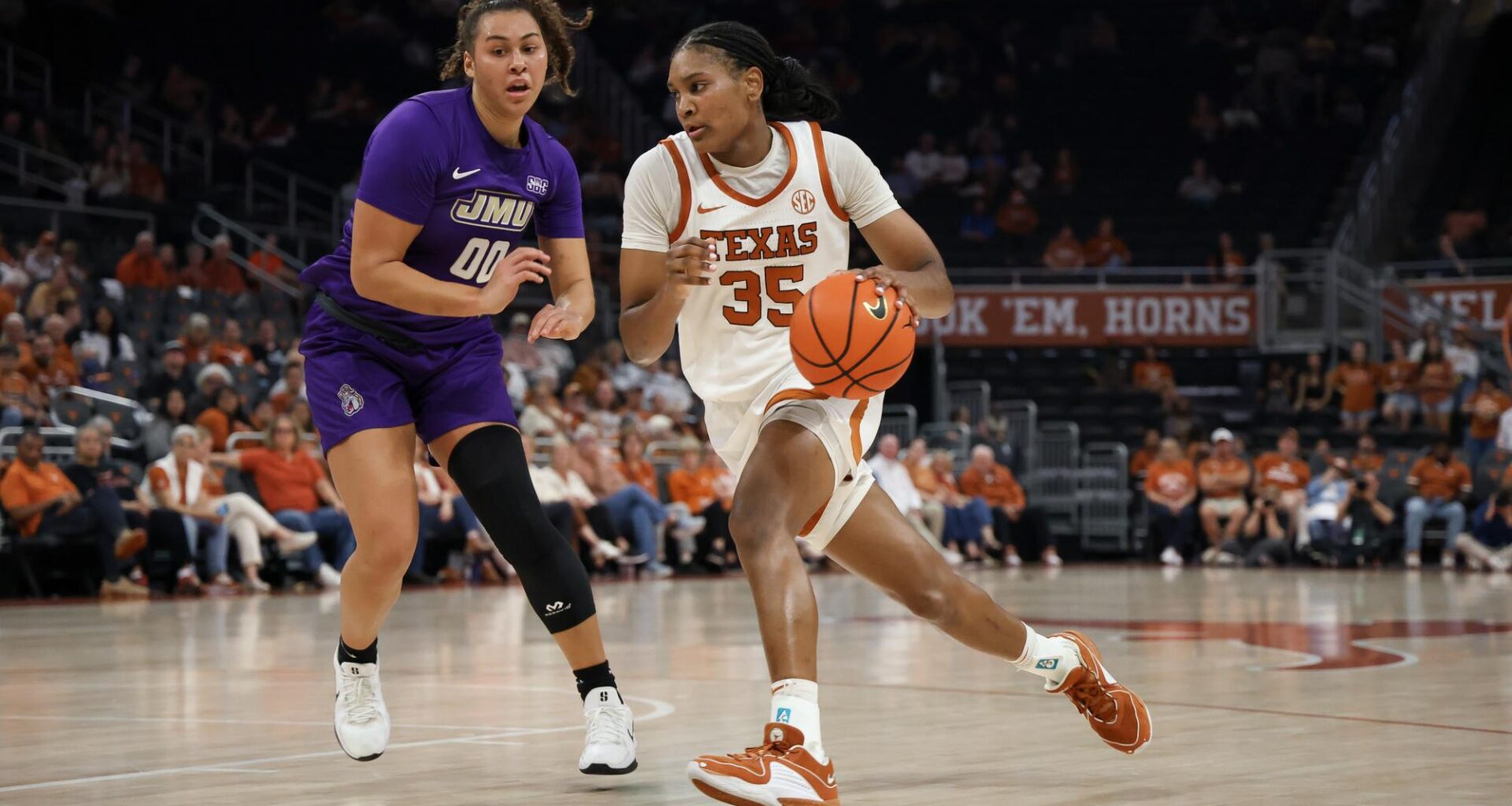
The biggest point of contention surrounding Texas women’s basketball this season has been its three-point shooting.
It’s been an issue for the Longhorns the past couple of years. Even with a talented roster and depth, they’ve lacked consistent perimeter shooting.
Perimeter shooters head coach Vic Schaefer recruited to mitigate this issue — freshman guard Aaliyah Crump and senior transfer guard Ashton Judd — were out for considerable stretches of the season with injuries. Sophomore guard Jordan Lee carried much of the load but eventually hit a slump of her own.
On Sunday against Tennessee, the Longhorns didn’t hit a single 3-pointer. It’s something Schaefer has been asked about constantly, and by the looks of Texas’ win over Arkansas Thursday night, he got tired of being asked about it.
For the first time this season, the Longhorns proved critics who say they cannot shoot the three wrong.
“This group, offensively, was really good tonight,” Schaefer said. “We made some shots. I told them at halftime: ‘Man, it’s a whole lot more fun to coach, and a whole lot easier to coach when you make some shots.’”
Arkansas played zone for most of the game, limiting Texas’ ability to establish paint play and drive in for layups. But the scheme also created space for the midrange and clean perimeter looks.
Texas took advantage. Arkansas essentially dared the Longhorns to shoot, and it came with consequences.
Texas finished 10 for 28 from three-point range, scoring 30 points from beyond the arc. It marked a season high in both makes and attempts.
Judd, Crump and Lee each knocked down at least one three-pointer. For a group that has struggled to find rhythm — especially Crump and Judd, who haven’t had consistent minutes — the game felt essential. It was an opportunity to build confidence heading into the postseason.
Fifth-year point guard Rori Harmon and junior forward Madison Booker even stepped out beyond the arc. Booker, who had been quiet in recent games, led the team with 21 points.
“(My three-point shooting) has always been there,” Booker said. “Early on in the season, I turned some down, and once I started shooting them again, they were on. Coach (Schaefer) put a lot of confidence in me. He just told me to keep shooting the ball, so I listened to him.”
Teams scouting the Longhorns moving forward should take note not let Texas get hot from the perimeter early. If those shots work in the first half, the offensive momentum becomes difficult to contain.
Two months ago, injuries forced Schaefer into a seven-player rotation. Now he’s working with 10. The added depth allows Texas to present different offensive looks and preserve key players’ minutes.
And, as usual, the defense set the tone.
Arkansas didn’t make a field goal until the final 35 seconds of the first quarter. Aside from early free throws that briefly kept the Razorbacks within striking distance, they never seriously challenged Texas. The Longhorns forced 20 turnovers and committed just nine.
Texas doesn’t need to center its offense around three-point shooting when it clearly has never been its identity. But the Longhorns do need reliable production from beyond the arc to contend for a national championship.
Maybe that piece is finally coming alive.
Texas hosts Mississippi State on senior night Sunday at 1 p.m.