
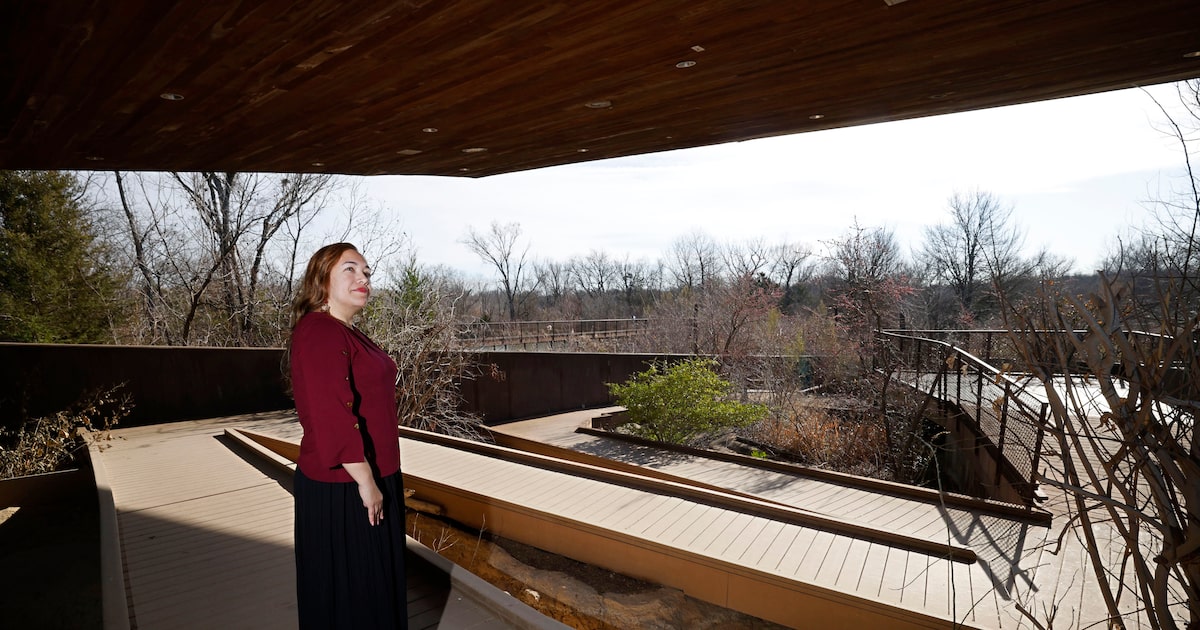
Amaris Alanis Ribeiro, recently named the new director of the Trinity River Audubon Center, describes herself as an environmental change-maker.
In an interview with The Dallas Morning News, she said her upbringing, experience running a nature center in Chicago and the challenge of moving to a new city attracted her to the position.
The center, a green sanctuary 10 miles south of downtown Dallas, is part of the National Audubon Society. It’s a bird watcher’s paradise and the gateway to the Great Trinity Forest. Also known as TRAC, its mission focuses on bird conservation and habitat restoration.
Related

Breaking News
“I saw the posting and it just felt like the right fit,” said Alanis Ribeiro, who started her new job in late November. “I’d run a nature center in Chicago before, so I knew I could do the work, but this was also a new challenge in a new city, and the history of this space in particular was really appealing to me.”
From landfill to green gem
The center used to be a landfill. It began operating in 1982 as a landfill when the city issued a permit for the extraction of sand and gravel from an 82-acre property adjacent to a residential area of Pleasant Grove.
The site quickly became an illegal dumping ground for tires, shingles, rusted cars, asbestos and acid containers.
For years, the city of Dallas failed to take action. In 1997, neighbors of the “Deepwood” dump filed a lawsuit in the Fifth Circuit Court of Appeals that eventually led to the land’s transformation. More than 2 million cubic yards of waste were removed.
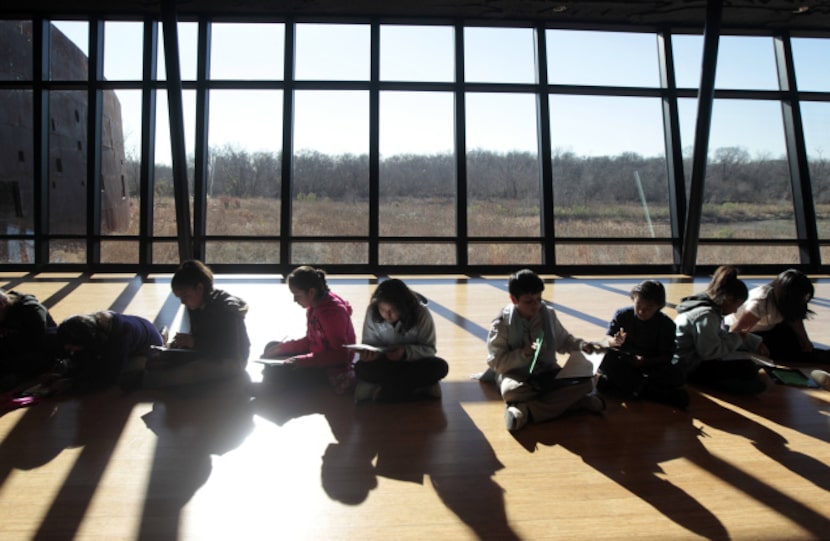
Fifth-graders from Stevens Park Elementary take a pretest at the Trinity River Audubon Center in Dallas.
As part of a 2003 legal settlement, the city agreed to build a nature center on the site. The Trinity River Audubon Center opened in October 2008. Since then, the city owns the center, and has contracted with the National Audubon Society to manage the center and its programming.
Naturalist and educator at heart
Alanis Ribeiro, 45, was born and raised in Chicago. She is fluent in Spanish and Portuguese. Her parents migrated from Michoacan, Mexico, in the ’70s. Regular road trips to Mexico during her childhood exposed her to different landscapes and broadened her horizons.
In school, she was drawn to science, imagining herself as a teacher or doctor before discovering ecology, evolution and animal behavior.
She considers herself a naturalist and educator at heart, raised to see living creatures as relatives and to reject the idea that humans are separate from nature.
Alanis Ribeiro’s favorite bird is the vibrant, painted bunting, with its bright blue, lime-green and red hues. But she said focusing only on iconic species can lead people to overlook more common birds, and said even everyday birds like mockingbirds and grackles are special to her because of their songs.
“These are living creatures; we cannot see ourselves separate from the environment,” Alanis Ribeiro said. “That’s where empathy and care come in when we start paying attention, because the way we treat nature and the environment is how we treat each other.
Before moving to Dallas, she served as director of forestry at the Hispanic Access Foundation, a nationwide organization that connects Latinos to opportunities that help improve their lives. In her role, she collaborated with municipalities and nonprofits across the U.S. and Puerto Rico to strengthen climate resilience.
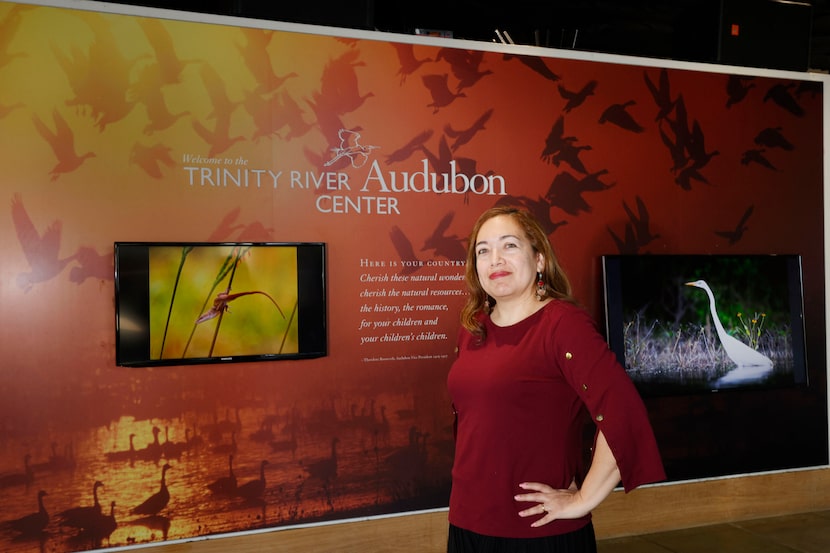
Amaris Alanis Ribeiro, new director of Trinity River Audubon Center, poses for a photo at the center, Wednesday, Feb. 11, 2026, in Dallas.
Chitose Suzuki / Staff Photographer
Alanis Ribeiro previously directed the Chicago Park District’s North Park Village Nature Center. She holds a bachelor’s degree in Ecology, Ethology and Evolution from the University of Illinois at Urbana-Champaign and completed advanced graduate coursework in Science Education at the Illinois Institute of Technology.
More than a center
Alanis Ribeiro wants to keep building on the Trinity River Audubon Center’s legacy as a model of transformation. That means honoring the community, educators, volunteers and advocates who helped turn a damaged site into a thriving conservation and education space.
She emphasized this work must be done collaboratively, pointing to public–private partnerships. The center has worked with the city of Dallas and Dallas Independent School District, as well as neighborhood-based groups already organizing around environmental and community issues.
Jacob Poinsett, who has been the education manager at the center for six years, saw Alanis Ribeiro’s previous experience working with the city of Chicago as a plus to help the center elevate its work and reach its goals. He said working in collaboration with the city of Dallas is key.
“It’s a fine line we have to walk and balance to make sure that all goals are met, not just for Audubon, but for the city of Dallas,” Poinsett said.
He said there’s more intentionality in aligning programs with Audubon’s mission and strategic plan. Poinsett said Alanis Ribeiro’s focus on intentional messaging and telling the story of environmental justice and community roots will help elevate the center and its mission.
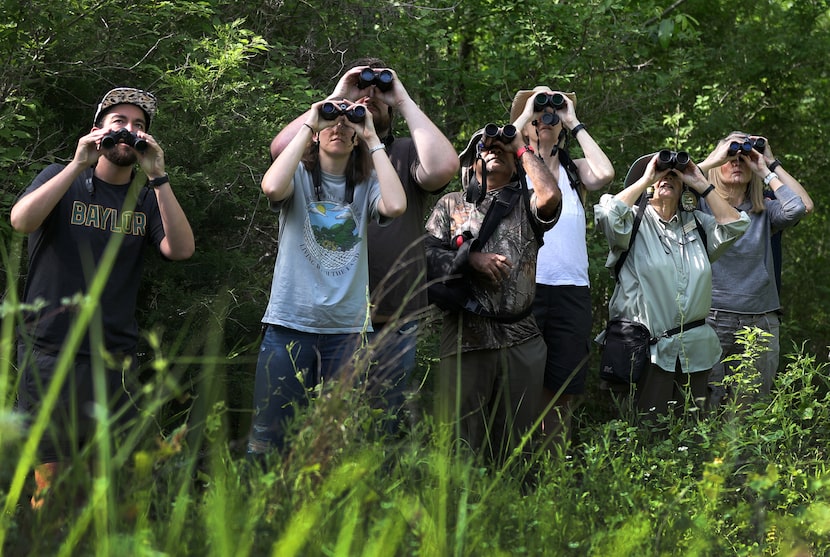
A bird watching group at the Trinity River Audubon Center in Dallas, Texas, Saturday, May 11, 2024.
Anja Schlein / Special Contributor
But taking care of the building and its grounds is also essential for the center’s success, said Joseph Abrego, the facilities, grounds and buildings coordinator since 2015.
Abrego said Alanis Ribeiro has fully involved herself in “the building, the projects, the education programs, fundraising,” and he’s looking forward to working with her on these priorities.
Alanis Ribeiro said there is a need to deepen the center’s role in current environmental debates, like development decisions and climate-related policies. And to help people connect everyday choices, such as avoiding single-use plastic, to broader conservation outcomes.
She wants the center to be a hub where visitors not only learn about birds, but also take action.
“I would love to invite folks to start thinking about policy. Like, ‘I care about birds now, what’s the next way to level up?’” Alanis Ribeiro said. “I would also love to invite some of our local decision makers to a bird walk at the center to talk about both local and federal [issues] and just really have that opportunity.”
Alanis Ribeiro stressed the importance of inclusive, relevant programming, from bird walks to art contests, music events and new programs. She said offering these could help more people see themselves reflected in the center’s work and understand that local efforts in Dallas are connected to bird migration and conservation across the hemisphere.
Related

Sofia Lopez, an educator at the center, said she hopes to see the center’s engagement grow under Alanis Ribeiro’s leadership and is excited about Alanis Ribeiro’s bilingual skills, which will enable more programming for the Spanish-speaking community.
Alanis Ribeiro wants people to know that the Trinity River Audubon Center exists as a powerful model of transformation.
“When people visit and see what the site used to be and then walk the 120 acres and five miles of trails, I hope they grasp that history matters because of what it looks like today and that the transformation is both tangible and inspiring,” Alanis Ribeiro said.