
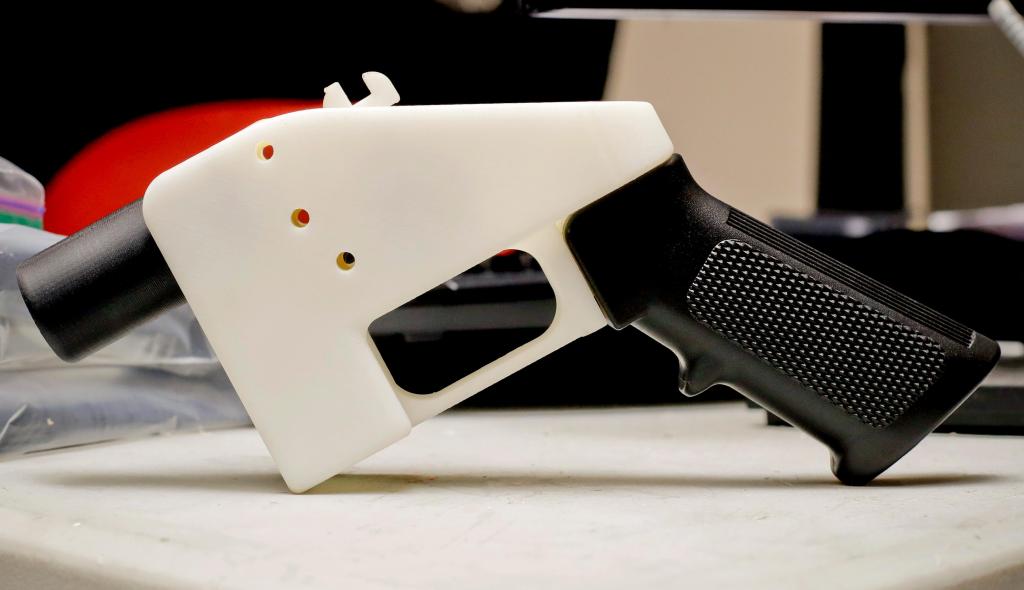
Colorado Democrats this week advanced a measure that would ban 3-D printing of guns, the latest effort to restrict firearm access in a legislative session that has otherwise lacked the high-profile efforts of years past.
House Bill 1144 would bar the manufacture of firearms, key gun components, large-capacity magazines and rapid-fire devices using 3-D printers. It would also prohibit the possession of instructions to manufacture guns or their components with 3-D printers or automated precision milling machines with the intent to fabricate them. It would prohibit the distribution of those instructions, too.
Federally licensed firearm dealers would be exempt.
During a hearing that ended Wednesday night, supporters characterized the measure as aiming to fill gaps left by a 2023 law banning so-called ghost guns, or firearms without serial numbers, and to align the intent of state law with rapidly changing technology. Opponents countered that the bill was duplicative of those prior efforts but might cast an even wider net to criminalize people unnecessarily.
The bill would make a first-time violation a misdemeanor, while subsequent violations would be felonies.
“It is a bipartisan issue of law and order, ensuring that bad actors can’t use technology to evade background checks and serialization laws,” Rep. Andrew Boesenecker, a Fort Collins Democrat, said.
He cited reports that the Club Q shooter used a 3-D printer to build guns prior to the 2022 attack in Colorado Springs, as well as the 2025 indictments of two Colorado Springs men who allegedly used 3-D printers to make rapid-fire conversion devices for rifles.
The Colorado Bureau of Investigation has seized 89 homemade firearms that were involved in some kind of crime — including those that made with 3-D printers — since it started tracking them in August 2024, according to spokesperson Rob Low. That does not include such firearms found during local agencies’ investigations.
The bill passed the House Judiciary Committee on a 7-4 party-line vote. It still needs a vote from the full House of Representatives and to go through the Senate.
“It just doesn’t make sense to me,” Rep. Ava Flanell, a Colorado Springs Republican, said. “Why bring this law, other than we’re going to make more law-abiding citizens at risk for owning a 3-D printer or similar devices?”
The bill drew threats of a lawsuit over concerns it would infringe on First and Second Amendment rights by limiting access to information and the right to bear firearms.
Daniel Fenlason, director of operations for the Colorado State Shooting Association, argued that embedding political messages in instructions would give them First Amendment protections.
“This is going to be a lawsuit that our team here at CSSA will explore, and if you do pass this, it’s going to cost taxpayers millions of dollars to defend — and you guys will lose at the Supreme Court level,” Fenlason said.
Rep. Jennifer Bacon, a Denver Democrat on the committee, countered that there were already restrictions around possessing plans to build bombs, and that, like with this proposal, simple possession isn’t enough. There also needs to be evidence that the plans will be used.
“3-D printing is a technology that is here, and we have a responsibility to figure out how to understand this technology and to get ahead of it as much as we can,” Bacon said.
The bill is one of a handful of firearm restrictions working through the Democrat-controlled legislature. Though proposals so far this year are largely about building on prior efforts, rather than adding sweeping new regulations like a 2025 law that will soon require background checks and training to buy many semiautomatic weapons.
The Senate passed Senate Bill 4 at the start of February, and it would expand the range of people and institutions that can file extreme risk protection order petitions, which ask a judge to order the confiscation of firearms from individuals deemed a risk to themselves or others. The House still needs to take up the measure.
The Senate is also set to consider Senate Bill 43 next week. It would restrict the sale of gun barrels to in-person transactions with federally licensed firearm dealers.
Democrats in the House have introduced a measure that would expand who is covered by state rules governing licensed firearm dealers and storage requirements for large-capacity magazines. House Bill 1126 is scheduled for its first committee hearing on March 2.
Earlier this week, Democrats voted down a Republican proposal, House Bill 1021, that sought to repeal several laws governing firearm possession.
Staff writer Seth Klamann contributed to this story.
Stay up-to-date with Colorado Politics by signing up for our weekly newsletter, The Spot.