
None
amccoy@star-telegram.com
Road construction abounds in and around Fort Worth, a testament to modernization and the area’s unprecedented growth. And while that growth is often celebrated, few appreciate the sight of orange construction cones and striped barriers barring progress on their daily commute. That’s especially true when lanes are blocked, but workers are nowhere to be seen.
A recent midday tour of road project sites around Fort Worth showed that to be the case in places like the intersection of Marine Creek Parkway and Cromwell-Marine Creek Road and the intersection of South Hulen Street and Risinger Road. And on Camp Bowie Boulevard, where a water line was being repaired between Ridglea Avenue and Hilldale Road, Camp Bowie was down to one lane, creating gridlock while a single worker went about his business with a shovel.
Risinger Hulen Matt Adams
Beyond the optics of having one or no workers present at a project site in the middle of a pleasant day (it was approximately 70 degrees and sunny), there’s the question of why road projects seem to take so long in Fort Worth. Is it just perception? Or is there more to it?
Lara Ingram, a spokesperson for Fort Worth’s Transportation and Public Works department, said there’s more to road projects than meets the eye.
When a roadway is widened, for instance, the city has to acquire the right-of-way from property owners. This, Ingram said, can greatly affect how long a project takes.
Another obstacle is utility placement. In many cases, buried utilities have to be relocated before the bulk of work can begin on road projects. In some instances, especially with older roadways, there might be buried infrastructure that dates back decades and was long forgotten. These surprise pipes and lines force contractors to extend project timelines.
In these cases, Ingram said, city departments have to work with utility providers — the gas company, internet and phone providers, etc. — to move the buried infrastructure, and timing is outside the city’s control.
Ingram said the work at Marine Creek Parkway and Cromwell-Marine Creek Road is part of a $45 million project that began in 2024 to widen the road, improve drainage, modify the roundabout and add pedestrian walkways, streetlights and traffic signals and construct a new bridge over Marine Creek.
As of Feb. 11, Ingram said, the contractor was paving the road, and the project page on the city’s website says underground utility work is complete, and the project is 60% finished. Most of the work is scheduled to wrap up in the fall.
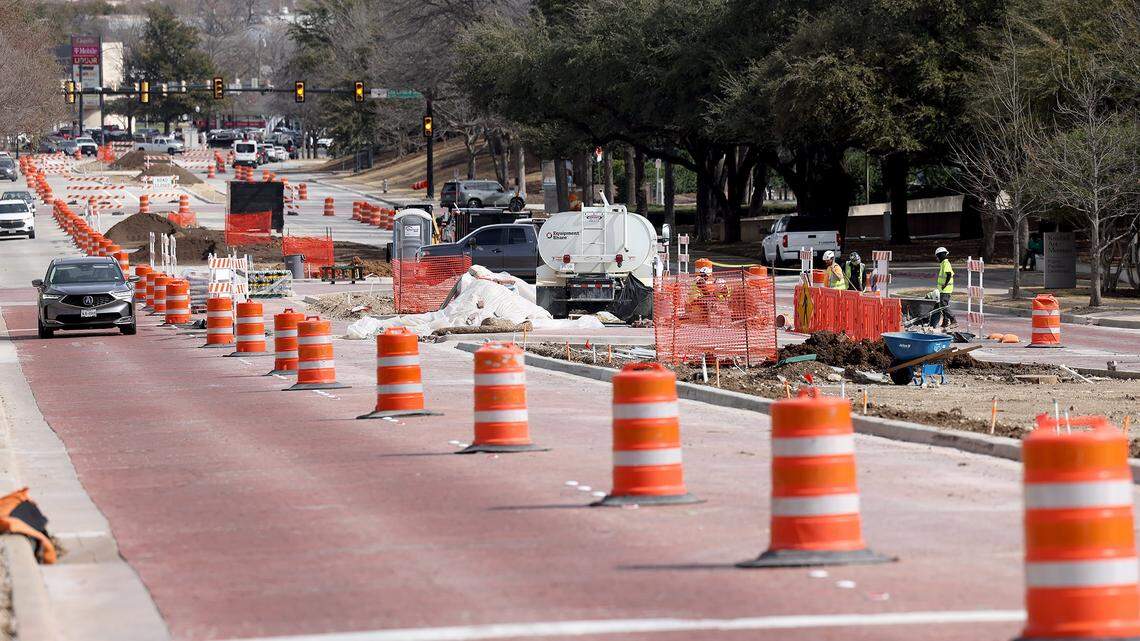
Construction continues on Camp Bowie Boulevard on Wednesday, Feb. 18, 2026. None amccoy@star-telegram.com
Some of the road and lane closures you see around the city are so workers can replace aging cast iron water mains, the type that are prone to burst during a freeze. A lengthy water main replacement project recently wrapped up on Trail Lake Drive, and that work has continued in that area along Alton Road near the Westcliff Shopping Center.
Mary Gugliuzza, spokesperson for Fort Worth Water, said some of the same things Ingram said about the placement of buried infrastructure causing delays. Gugliuzza added that when you see cones and barriers up but no workers present, it’s sometimes because crews are rotating among multiple projects. Fort Worth uses outside contractors, not city employees, for large-scale projects.
The water main replacement project that’s happening now on West Lancaster Avenue near Summit Avenue consists of 12 phases, Gugliuzza said. Phases two, three and six are ongoing and required crews to tunnel underneath Lancaster Avenue. That created delays, Gugliuzza said, because they had to cut through stone to create the tunnel.
Gugliuzza said that project is a difficult one, and work will have to pause this summer for the World Cup so as not to create additional congestion during what’s expected to be a busy time in Fort Worth. Work will be further complicated because crews have to time things so as not to disrupt water flow during the high-demand warm months.
The next phases of that water main replacement work will continue up Summit Avenue to West Fifth Street, Gugliuzza said. Construction will then go east along West Fifth Street to North Henderson Street, up Henderson Street to West Second Street and along Second Street to Burnett Street.
TxDOT projects
Some of the work you see in Fort Worth is overseen by TxDOT. That’s the case at Jacksboro Highway and North University Drive/West Northside Drive where lanes were closed in early February (and no workers were present the day the Star-Telegram drove through).
There’s another TxDOT project at North Main Street and East Northside Drive that, according to satellite images, has been ongoing since at least 2018. Work concluded in 2021, then recommenced last summer.
Val Lopez, a TxDOT spokesman, said the work on Jacksboro Highway is part of a larger effort to improve intersections along that corridor. Lopez said work is progressing “as material availability and scheduling allow.”
Like the city’s spokespeople, Lopez said utility relocation can change a TxDOT project’s timeline, and he mentioned other factors that affect how long it takes to complete work.
“The duration of construction on any project reflects complex coordination and a deliberate balance between safety, maintaining access and mobility for the traveling public, and giving the contractor the time and space needed to complete the work safely and efficiently within those parameters.”
The next phase of the North Main Street and East Northside Drive project is traffic signal installation, Lopez said, which will be completed in the spring.
Who keeps Fort Worth road projects on track?
Ingram said project managers and city inspectors oversee progress and safety at road work sites. And, as in the case of the project on Cromwell-Marine Creek Road, city teams meet with neighborhood associations and City Council members to provide status updates. Contractors are also obligated to keep things moving.
“The project contracts require the contractor to maintain project schedules,” Ingram said. “Project managers are required to track construction progress and to act if progress is slow and causing the project to fall behind schedule. Additionally, contracts include a clause that assesses liquidated damages for every day that completion is delayed.”
Marine Creek Matt Adams
District 3 City Council Member Michael Crain said road and infrastructure projects are planned far in advance, but work crews can encounter unforeseen challenges once ground is broken.
“Those unexpected findings can extend the timeline, particularly when replacing aging water and sewer lines that haven’t been touched in decades,” Crain said. “It’s a priority for me to limit how much these projects affect residents’ daily routines, and I closely monitor them to promote efficiency and accountability in how taxpayer dollars are spent. While delays can be frustrating, the end result is modern infrastructure — water mains, sewer systems and roadways — that will serve our fast-growing city safely and reliably for many years to come.”
The Star-Telegram reached out to all of Fort Worth’s council members, but Crain was the only one to respond.
Indeed, the growth Crain mentioned is driving much of the construction you see around Fort Worth. According to the most recent TxDOT figures, there are 2.4 million registered vehicles in this area, and drivers travel roughly 53 million miles per day on TxDOT-managed roadways in the Fort Worth district.
With the region’s population increasing, those numbers will likely continue to rise, meaning we’ll need to construct more and larger roads to handle the traffic. At the same time, those roads will deteriorate faster resulting in more frequent maintenance work.
According to a city website used to track bond projects, there have been 439 transportation projects funded by bonds since 2014 with a total cost exceeding $840 million. Over that span, more than 64% of bond projects were focused on transportation improvements. There will be another $845 million bond package for voters to consider on the May ballot, with $511 million set to go toward street and mobility infrastructure improvements.
Looking at past bond projects from 2018 and 2022, some are still ongoing. A $15 million project approved in 2022 to rehab streets in the Bluebonnet Hills neighborhood is still in the early phases. According to the city, a pre-construction meeting is scheduled for April 8.
TxDOT is developing a Transportation Master Plan for this area to account for population growth and an increase in traffic. According to the project website, TxDOT officials are conducting a needs analysis now. Beginning in the spring, they’ll start prioritizing corridors for expansion and improvement work, meaning there’s more orange barrels and striped barriers in our future, with no end in sight.
This story was originally published February 19, 2026 at 11:59 AM.

Fort Worth Star-Telegram
Matt Adams is a news reporter covering Fort Worth, Tarrant County and surrounding areas. He previously wrote about aviation and travel and enjoys a good weekend road trip. Matt joined the Star-Telegram in January 2025.